
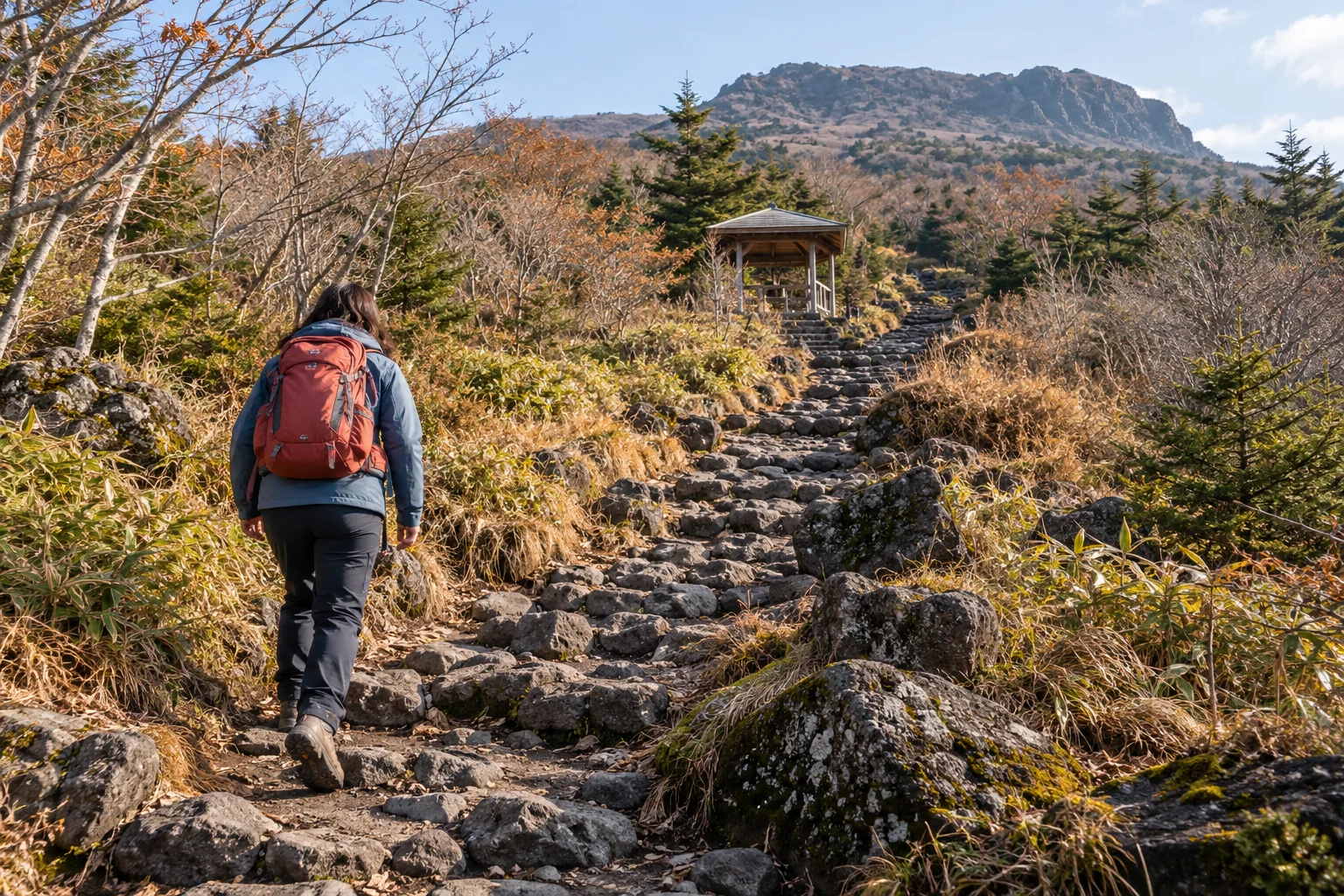
For an October–March summit hike on Hallasan’s Seongpanak trail, plan to pass Jindallaebat (Azalea Field), 7.3 km uphill from the entrance, before the 11:30 cutoff. The summit departure deadline is 13:30. Work backward from the mountain checkpoint before choosing a reservation window or hotel pickup time.
Official information checked October 25, 2026. All times are Korea Standard Time (KST). The winter rules below apply from October through March, including autumn dates with no snow. Check the park’s operating notice again for your hiking day.
The three deadlines your reservation does not replace
The park’s winter access notice, published September 30, 2026, lists these times. The normal opening time is 05:00, subject to access restrictions.
| Where you are | October–March limit | What to plan |
|---|---|---|
| Seongpanak entrance and Jindallaebat checkpoint; Gwaneumsa entrance and Samgakbong checkpoint | Uphill access closes at 11:30 | Reach the mountain checkpoint with time to spare |
| Summit | Begin descending by 13:30 | Include summit stops in the plan |
| Jindallaebat or Samgakbong shelter on the descent | Final descent time 15:30 | Keep track of progress after leaving the summit |
A reservation window controls your entry arrangement. It does not move these mountain deadlines. In particular, an entrance arrival near 11:30 leaves the uphill checkpoint still ahead of you.
The notice allows restrictions for conditions such as severe weather, snow, strong wind and poor visibility. A confirmed reservation cannot guarantee access or a summit attempt.
Seongpanak versus Gwaneumsa: compare the uphill segment
These are the park’s published route distances and walking-time estimates from its Seongpanak guide and Gwaneumsa guide.
| Planning detail | Seongpanak | Gwaneumsa |
|---|---|---|
| Mountain checkpoint | Jindallaebat / Azalea Field | Samgakbong |
| Entrance to checkpoint | 7.3 km; about 3 hours | 6 km; about 3 hours 20 minutes |
| Entrance to summit, one way | 9.6 km; about 4 hours 30 minutes | 8.7 km; about 5 hours |
| Winter uphill checkpoint cutoff | 11:30 | 11:30 |
Gwaneumsa has the shorter distance but the longer official time estimate. Choosing it simply because “8.7 is less than 9.6” can produce an unrealistic start time.
Treat both estimates as planning references. Your pace, conditions and stops can make the journey longer. Passing the checkpoint also leaves more climbing before the summit and a full descent afterward.
Work backward from 11:30, then add your own allowance
Use this planning equation:
Trail start = checkpoint cutoff − your expected uphill time − extra time for stops or delays − margin before the checkpoint closes.
The following is a hypothetical calculation, not a recommended departure schedule or a guarantee that the route is suitable for you.
| Calculation | Seongpanak | Gwaneumsa |
|---|---|---|
| 11:30 minus the official checkpoint estimate, with zero extra time | 08:30 | 08:10 |
| Worked example: also subtract 60 minutes for breaks/slower progress and 30 minutes to reach the checkpoint before closure | 07:00 | 06:40 |
The first row lands exactly on the published cutoff, with no room for a bathroom stop, queue or slower section. It is useful for exposing an over-tight itinerary. The second row shows how quickly a realistic-looking morning can become an earlier start; the chosen 60- and 30-minute allowances are illustrative. Replace them with a plan appropriate to your group and the day’s conditions.
Next, check that the remainder of the climb and your summit stop fit the 13:30 descent deadline. Finally, plan the downhill journey and transport home. Do not use a fast uphill estimate to assume an equally fast descent.
Convert the trail start into a hotel departure
A reservation time, a hotel pickup and the moment you begin walking are different points on the itinerary. Add the pieces in order:
- Choose the exact entrance. Save Seongpanak or Gwaneumsa, matching your reservation, as the transport destination.
- Allow for arrival tasks. Parking or drop-off, finding the entrance, admission checks and getting ready happen before the uphill walk.
- Confirm the ride for that time. Check a dated bus schedule or an agreed pickup; a general journey-time estimate does not establish an early departure service.
- Plan the exit separately. If descending to a different trailhead, decide how you will reach your accommodation or parked vehicle.
- Keep a fallback. If the morning runs late, reassess the route instead of trying to recover the delay by rushing uphill.
For a rental-car plan, check Jeju pickup, licence and insurance arrangements before assigning the vehicle to an early hike. The Jeju driving-route guide can help you choose a different day’s route if mountain access changes.
What if your available entry window is too late?
A booking slot that you can obtain is only useful if the whole hike fits. Rework the itinerary before travelling to the entrance. Check the official reservation system for an appropriate available arrangement, or choose a different day or route.
Our five Hallasan trails without a summit reservation guide compares alternatives and their own access limits. Those routes have different endpoints; choose one for the walk it offers rather than expecting every Hallasan trail to reach Baengnokdam.
Is November already under the winter cutoff?
Yes. The current notice groups October, November, December, January, February and March together. Use the date-based schedule even if the weather looks mild.
Does an 8–11 reservation window mean I can start at 11?
Check the entry terms on your confirmation, then calculate the mountain schedule separately. On Seongpanak, an 11:00 trail start plus the park’s three-hour checkpoint estimate produces 14:00, already beyond the winter checkpoint cutoff. The window alone cannot establish a workable summit plan.
What should I check before leaving the hotel?
Your reservation’s route and entry terms, the latest Hallasan park notice, the forecast and required equipment, transport to the correct entrance, and a turnaround plan if progress or conditions differ from expectations. Make that decision while there is still time to choose another walk.