Quick Info
- 📍 Area: Jeju Island (East: Seongsan/Seopjikoji/Udo)
- 🕒 Best time: Spring (Mar–May) and fall (Sep–Nov); avoid peak summer crowds if possible
- 💰 Budget: KRW 50,000–100,000 per person (typical group tour); private charter varies by vehicle/hours
- 🚇 Getting there: Tour bus/van + Udo ferry (weather-dependent); hotel pickup may be offered in some products
- 👥 Best for: First-time Jeju visitors, travelers without a car, short-stay itineraries, families wanting easy logistics
- ✅ TL;DR: Most East Jeju day tours bundle Seongsan + Seopjikoji + Udo in ~9–10 hours; expect ~5–10만원 and book early in peak season.
Before you dive in
If any part of this guide feels useful, take 10 seconds to bookmark it.
Quick Info
- 📍 Area: Jeju Island (East: Seongsan/Seopjikoji/Udo)
- 🕒 Best time: Spring (Mar–May) and fall (Sep–Nov); avoid peak summer crowds if possible
- 💰 Budget: KRW 50,000–100,000 per person (typical group tour); private charter varies by vehicle/hours
- 🚇 Getting there: Tour bus/van + Udo ferry (weather-dependent); hotel pickup may be offered in some products
- 👥 Best for: First-time Jeju visitors, travelers without a car, short-stay itineraries, families wanting easy logistics
- ✅ TL;DR: Most East Jeju day tours bundle Seongsan + Seopjikoji + Udo in ~9–10 hours; expect ~5–10만원 and book early in peak season.
Before you dive in
If any part of this guide feels useful, take 10 seconds to bookmark it.
Jeju’s east coast is one of those rare places where a single day can feel like a highlight reel: a UNESCO-listed volcanic crater at Seongsan Ilchulbong (Sunrise Peak), bright blue water and low-key beach towns on Udo Island, and the cinematic coastal cliffs of Seopjikoji. The catch is logistics—bus gaps, ferry timing, weather changes, and long taxi rides can quickly turn “easy day trip” into “why did we do this?”
That’s why Jeju East day tours (제주 동쪽 일일투어) remain popular in 2026: they bundle transportation, time-saving routing, and (often) a guide into one bookable plan. Below is a practical, decision-first guide to who these tours fit best, what they typically include, how much they cost (using ranges as of 2026/2027), what’s extra, and how to avoid booking mistakes—especially for the core trio: Seongsan + Udo + Seopjikoji.
Who This Seongsan/Udo/Seopjikoji Day Tour Is Best For
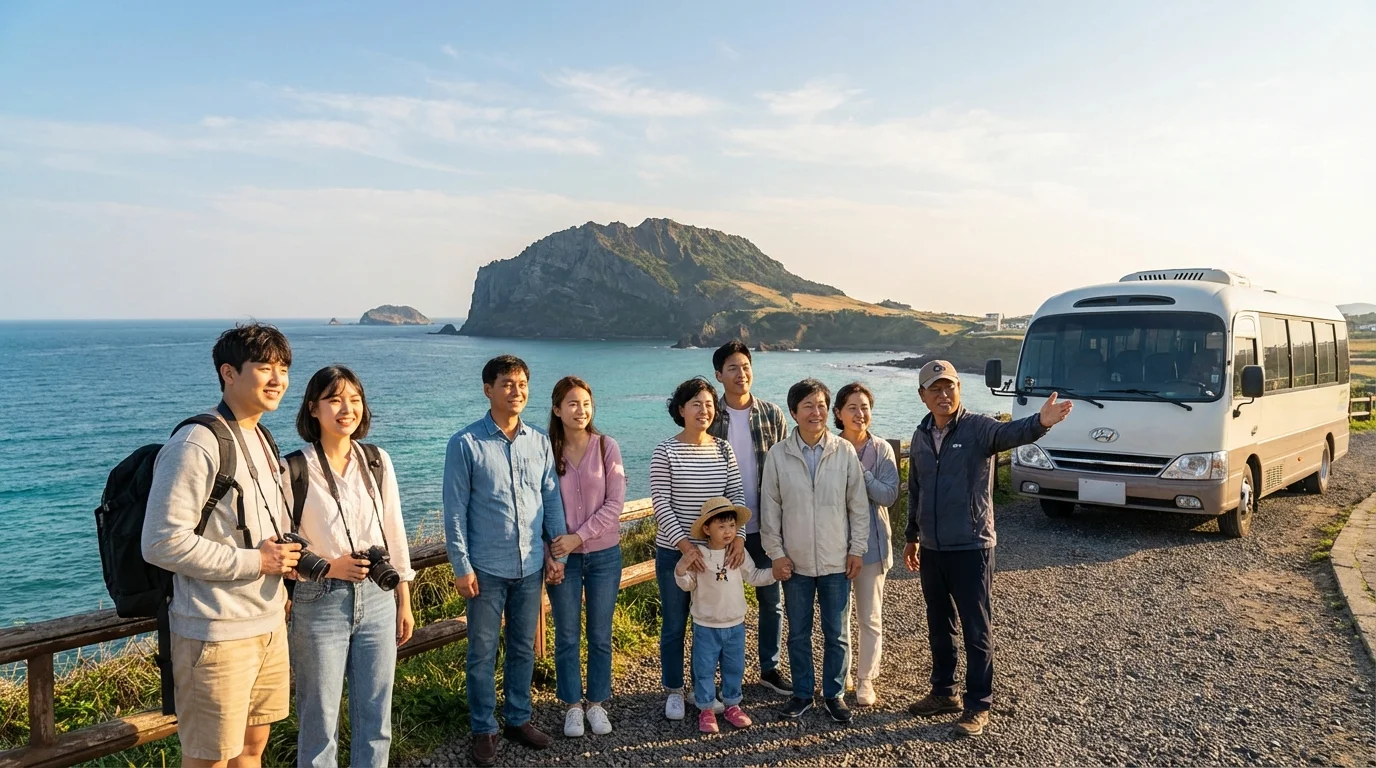
A Jeju East day tour isn’t automatically “better” than going independently—but it’s often simpler. Here’s who usually gets the most value.
1) First-time Jeju visitors with limited days
If you only have 2–4 days on Jeju, a day tour can efficiently cover the east’s headline spots without spending half the day figuring out transfers. Tours are especially helpful if you’re staying in Jeju City and don’t want to play bus roulette all morning.
2) Travelers who don’t want to drive
Jeju driving is doable, but it’s not for everyone—especially if you’re tired, not comfortable with local road rules, or you’d rather look at the sea than the navigation app. A tour eliminates parking stress at busy sites like Seongsan.
3) Families and mixed-age groups
A pre-planned route reduces “decision fatigue.” Many groups appreciate having a predictable schedule, fewer vehicle changes, and a guide who can help coordinate ferry lines or photo stops.
4) Social travelers or solo travelers who want a structured day
Day tours can feel more relaxed when someone else handles the “what’s next?” Some itineraries also create natural social moments—lunch breaks, ferry rides, viewpoint stops—without the commitment of multi-day group travel.
5) Anyone visiting during peak demand periods
During summer vacation and year-end/New Year travel windows, tours can sell out early. If you want Seongsan + Udo + Seopjikoji in one day at a reasonable pace, booking ahead can be worth it.
Who might prefer not to book a tour?
- Photographers chasing golden hours who want to linger at Seopjikoji or wait for the perfect light at Seongsan.
- Slow travelers who prefer one area per day (e.g., Udo only).
- Food-focused travelers who want unlimited time to try multiple cafés and seafood spots on Udo.
If you recognize yourself in the second list, consider a private car charter or a self-planned day instead of a fixed group itinerary.
Typical Itinerary (What You’ll See in One Day)
While routes vary by operator, most Jeju East day tours that emphasize Seongsan/Udo/Seopjikoji follow a similar rhythm: coast → crater → ferry → island loop → coastal cliffs → beach café stop.
A typical one-day tour (often around a full-day duration) may include:
Morning: Seongsan Ilchulbong (Sunrise Peak)
- The star attraction: a volcanic crater rising dramatically from the sea.
- Many tours schedule Seongsan in the morning to avoid the thickest crowds and midday heat.
- If your tour includes a climb, note that it’s not technical, but it does involve stairs and steady uphill walking.
Late morning to early afternoon: Udo Island (via ferry)
- You’ll transfer by ferry (weather permitting).
- On Udo, tour pacing depends on how the operator organizes transportation: some offer a structured loop; others provide “free time” with suggested routes.
- Typical highlights are coastal viewpoints, clear water, beach scenery, and café stops.
Afternoon: Seopjikoji coastal walk
- A scenic headland known for dramatic rock formations and ocean views, also famous as a drama filming location.
- Usually a lighter walk compared to Seongsan, making it a nice late-day stop.
Bonus stops (varies by tour):
Some “classic east coast” routes add extra beaches or photo stops. Based on commonly offered products, you may also see Woljeongri Beach included on broader east-coast itineraries. (Always confirm the exact stop list before you pay—names in the title don’t always mean long time on-site.)
What the schedule feels like in practice
Expect a day tour to be time-efficient, not leisurely. You’ll likely get enough time for a crater walk/photo session, a compact Udo experience, and a Seopjikoji stroll—but not hours of café-hopping or a full Udo beach day. If you want to swim, do a long bike ride, or stay for sunset, you’ll usually be happier going independently or booking a private charter with flexible timing.
Where to Book 제주 동쪽 일일투어 예약(성산/우도/섭지코지) 가격 정리 Tours and Tickets
In 2026, you’ll generally see three booking paths for Jeju East day tours. The “best” one depends on your priorities: language support, cancellation terms, and how much you want to compare options.
1) Major travel activity platforms (best for comparing and flexible policies)
This is often the easiest way to compare:
- different itineraries (Seongsan + Udo + Seopjikoji vs. “east coast classic” with extra stops),
- guide language options (commonly Korean and sometimes Chinese on certain products),
- cancellation rules (some tours offer free cancellation up to a few days in advance; policies vary widely).
If you like to shop smart, this is where you can compare deals, check current prices, and see what’s included line-by-line before booking.
2) Local Jeju tour agencies (best for local coordination and niche options)
Local operators may offer:
- smaller group sizes,
- more specialized schedules,
- pickup points aligned with local hotels,
- seasonal adjustments based on traffic and ferry conditions.
This route can be great, but you need to read the inclusion/exclusion details carefully—especially for ferry/entrance fees.
3) Private car charter tours (best for comfort and customization)
If your group is 3–6 people, a private car charter can be competitive once you compare per-person costs. It’s also the best option if you want to:
- start earlier or later than a group tour,
- spend longer on Udo,
- skip stops you don’t care about,
- accommodate mobility needs more comfortably.
Based on commonly listed options, some charters mention Korean and Chinese guide support and a custom schedule (often stated around an 8-hour block). Just remember: “charter” doesn’t always mean “everything included”—ferry and entrance fees may still be extra.
Booking checklist before you hit pay
- Confirm exact stops (not just the tour title).
- Confirm pickup location (Jeju City vs. Seogwipo vs. designated meeting point).
- Check guide language and whether it’s fully guided or mostly transportation-only.
- Read cancellation policy carefully, especially in ferry-dependent seasons.
- Look for notes about Udo ferry suspension and what happens if boats don’t run.
Typical Prices & Budget Examples
Prices vary based on what’s bundled (transportation, guide, tickets), group size, and whether it’s a standard route or a private charter. The only safe way to talk about pricing is in ranges—and to encourage you to check current prices right before booking.
Typical per-person group tour range (as of 2026/2027)
For many Jeju East day tours, a typical range is about ₩50,000–100,000 per person (as of 2026/2027; check current prices). This aligns with commonly seen east-coast day tours that include multiple stops like Seongsan, Udo, and Seopjikoji, sometimes adding an extra beach.
Why the range is wide:
- Some tours include more admissions or offer more language support.
- Some are “transport + guide” only, with admissions paid on-site.
- Seasonality and demand can raise prices during peak periods.
Private car charter pricing (how to think about it)
Private charters are usually priced per vehicle rather than per person, and costs swing based on vehicle type, duration, and itinerary complexity. Instead of assuming a number, treat it like this:
- If you’re 4+ people, a private charter can be cost-effective compared with buying 4 separate group tour seats—especially if you value flexibility.
- If you’re 1–2 people, a group tour is typically the cheaper baseline.
Because charter inclusions vary a lot, always ask: “Is this only the car/driver, or also guiding and admissions?” and confirm what’s extra (ferry/entrance/meals).
Budget examples (ranges, as of 2026/2027; check current prices)
These examples combine tour cost + likely on-the-day spending. Exact totals depend on what your booking includes and how you spend on Udo.
-
Budget travelers: ~₩60,000–110,000
(Lower-priced group tour seat + minimal extras like a simple meal/snack; assumes some fees may be extra.) -
Mid-range travelers: ~₩90,000–160,000
(Mid-priced tour + a more comfortable lunch + a couple of café/drinks on Udo; possible added admissions.) -
Comfort-oriented travelers / small groups: wide range
(Private charter split among people + flexible stops + more spending on food and experiences; confirm inclusions and compare offers.)
If you want the best value, don’t only compare sticker price—compare what’s included and the realistic out-of-pocket extras.
What’s Included vs Extra Costs (Ferry, Entrance Fees, Meals)
This is where travelers most often get surprised. Two tours with similar titles can have very different inclusions.
Commonly included
- Transportation for the day (bus/van for group tours; car for charters)
- Guide/host (language depends on product; some mention Korean and Chinese)
- A fixed route with coordinated timing across stops
- Sometimes: certain tickets or packaged admissions (varies by operator)
Common extra costs to plan for
1) Udo ferry tickets
Because Udo requires a ferry, many tours treat ferry tickets as an add-on or require you to pay on-site. In addition, ferry operations can be suspended due to weather. Even when a tour handles the logistics, you may still be paying the ticket separately.
2) Attraction entrance fees
Seongsan Ilchulbong often involves an entrance fee if you’re entering the official area/trails. Some tours include it; many do not. Seopjikoji is typically more about walking the coastal area, but rules can change; confirm in your tour details what requires payment.
3) Meals
Lunch is frequently not included, or it’s “free time for lunch” rather than a set meal. Udo is full of tempting cafés and snacks, so it’s easy to overspend without noticing.
4) On-Udo transportation upgrades
Even if your tour gets you to Udo, getting around the island may involve:
- local shuttle/bus,
- bike rental,
- scooter/other rentals (rules and availability vary),
- or walking shorter segments.
Some tours include an on-island loop; others give you free time with suggestions. Confirm this, because it changes how much you’ll see.
Decision tip: When comparing tours, look for an “Includes/Excludes” list and translate it into one sentence:
“What must I pay extra to fully complete the itinerary?”
If the answer includes ferry + Seongsan entrance + lunch, your real total may land much closer to the top of the price range.
Money-Saving Tips
You don’t need to pick the absolute cheapest tour to travel smart. Instead, aim for the best cost per hassle avoided.
1) Compare “classic east coast” tours vs. Seongsan/Udo-only tours
If you only care about the big three—Seongsan, Udo, Seopjikoji—don’t automatically choose the tour with the longest stop list. More stops can mean less time at each place and sometimes a higher price.
2) Book earlier for peak seasons
Summer and year-end periods can sell out. Early booking doesn’t always guarantee a lower price, but it does give you:
- more time slots,
- better pickup choices,
- and better cancellation options if your plans shift.
3) Choose pickup points that reduce backtracking
A cheaper tour that requires a long commute to a meeting point can cost you more in taxis and time. Prefer tours with pickup near where you’re staying (or a simple transit route).
4) Don’t pay for language support you don’t need
If you’re comfortable with a basic host/driver and you mainly want transportation, you may find more affordable options than fully guided multilingual tours. Conversely, if you do want storytelling and context, paying a bit more can be worth it.
5) Budget your “Udo extras” in advance
Udo can quietly become your biggest spending zone: coffee, dessert, drinks, and rentals add up fast. Decide ahead of time whether you’ll splurge on cafés or keep it simple, and you’ll avoid blowing your budget by accident.
6) If you’re 4–6 people, price out a private charter (seriously)
Group tours are usually cheapest for solo/duos. But for a small group, splitting a charter can be competitive—and you gain flexibility. Just remember to compare what’s included (and check current prices).
Seasonal + Weather Notes (Udo Ferry, Crowds, Sunrise Timing)
Jeju’s east is exposed to wind and sea conditions, so season and weather matter more than people expect.
Udo ferry reality check
- Ferry operations can be suspended due to weather, especially wind and rough seas.
- Even if the morning looks fine, conditions can change.
- A good tour operator will have a fallback plan (extra mainland stops, adjusted routing, or partial refunds depending on policy). You should confirm this before booking.
What to ask:
- “What happens if the Udo ferry is canceled?”
- “Do we substitute another attraction, reschedule Udo, or refund part of the cost?”
Crowds by season
- Summer: busiest, hottest, and often the most congested around Seongsan and ferry lines. Expect longer waits and more packed photo spots.
- Spring and autumn: generally more comfortable for walking Seongsan and Seopjikoji, and often ideal for Udo scenery without peak-level crowds (though popular weekends can still be busy).
- Winter: fewer crowds, but stronger winds and a higher chance of weather disruption. Dress for wind, not just temperature.
Sunrise timing vs “Seongsan Ilchulbong” expectations
Seongsan is famous for sunrise, but most standard day tours do not start early enough to catch the actual sunrise. If sunrise is your priority, you’ll need to:
- book a specifically labeled sunrise-focused product (if available),
- go independently very early,
- or arrange a private charter that starts before dawn.
If you’re on a normal daytime schedule, think of Seongsan as a daytime crater hike with ocean views, not necessarily a sunrise event.
What to pack (small details that matter)
- Comfortable walking shoes (Seongsan stairs + Seopjikoji paths)
- Wind layer (especially near the coast and on ferries)
- Sun protection (hat/sunscreen; the coastal sun can be intense even when it’s breezy)
- Motion sickness support if you’re sensitive on ferries
Common Booking Mistakes and How to Avoid Them
A little due diligence prevents most disappointments. Here are the mistakes that show up again and again—and the fixes.
Mistake 1: Assuming Udo is guaranteed
Because Udo depends on ferries, it’s never 100% guaranteed in rough weather.
Avoid it: Choose operators with clear contingency plans and read cancellation/partial refund terms. Keep your schedule flexible.
Mistake 2: Not checking what “included” really means
Some travelers book a “day tour” and then discover they still need to pay ferry + Seongsan entrance + lunch.
Avoid it: Before paying, list likely extras and estimate your real total using ranges (as of 2026/2027; check current prices).
Mistake 3: Booking the wrong starting area (Jeju City vs Seogwipo)
Jeju is bigger than it looks on a map. A tour departing from the opposite side can mean a very early start or extra taxi costs.
Avoid it: Filter by pickup area and confirm your exact pickup point the day before.
Mistake 4: Overstuffed itineraries with “photo stop only” time
Tours sometimes add many stops, but each becomes a rushed 10–20 minute hop.
Avoid it: If your top priority is Udo, pick a tour that clearly allocates meaningful time there—even if it lists fewer total stops.
Mistake 5: Booking too late in peak season
East-coast tours are popular and can fill up.
Avoid it: Reserve early for summer and year-end travel dates, and keep an eye on cancellation windows.
Mistake 6: Expecting a fully guided cultural tour when it’s mostly transport
Some tours are “hosted” rather than deeply guided—still useful, but different.
Avoid it: Read reviews and product descriptions for how much guiding you’ll actually get (history/context vs simple coordination).
Mistake 7: Forgetting that Jeju weather changes fast
Rain and wind can roll in quickly, and coastal spots feel colder than inland.
Avoid it: Pack a light rain layer and windbreaker, and assume conditions may differ between stops.
Jeju’s east coast rewards you with huge scenery for relatively little effort—especially when Seongsan, Udo, and Seopjikoji are stitched together into a well-timed day. If you compare inclusions carefully, budget for the common extras, and choose a booking option that matches your travel style, you’ll spend less time troubleshooting and more time enjoying the views, and you’ll end the day feeling like you truly saw Jeju.
FAQ
Q: How much does a Jeju East day tour (Seongsan/Udo/Seopjikoji) usually cost?
Most group day tours fall around KRW 50,000–100,000 per person depending on route length, inclusions, and language guide.
Q: What’s typically included in the tour price (and what’s extra)?
Usually included: vehicle + guide. Often extra: attraction entry fees, meals, and Udo ferry/transport on the island—always check the inclusions list before paying.
Q: Where can I book these tours and compare prices safely?
You can compare listings on major travel platforms (e.g., KKday/Klook/Trazy) or local Jeju agencies. Prioritize clear inclusions, pickup info, and cancellation terms.
Q: Can I cancel or change my booking without fees?
Many products offer free cancellation up to a certain deadline (commonly a few days before). Policies vary widely, so confirm the cutoff time and whether it’s based on local time.
Q: What happens if Udo ferries stop due to weather?
Udo is weather-dependent; if ferries are suspended, tours may replace Udo with another East Jeju spot or adjust the schedule. Check the operator’s bad-weather contingency policy.
What you can do next
Pick just one action from this guide and do it today—small steps add up.