
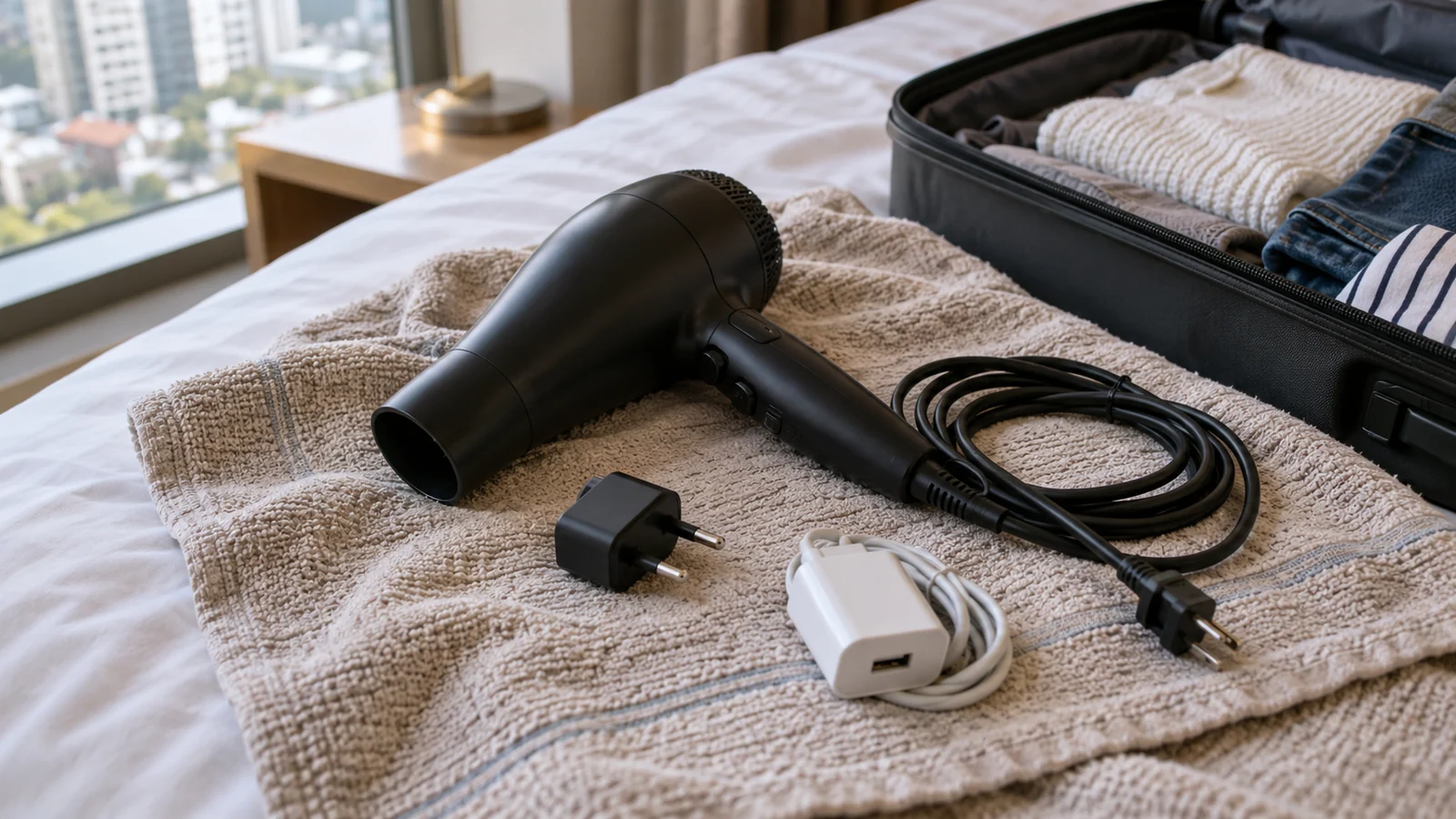
A plug adapter does not make a 120V-only hair dryer compatible with South Korea’s normal 220V supply. Before packing, read the appliance’s input voltage and frequency, then its exact-model instructions. A plug that fits the wall is only one part of the decision.
The Korea Tourism Organization lists the standard supply as 220V at 60Hz. Electrical Safety First explains that a travel adapter changes the plug connection but does not convert voltage or frequency. Do not connect a 120V-only appliance to that supply through a plug adapter. Official sources checked October 23, 2026.
Read INPUT, not just the number on the adapter
Start with the label on the appliance or its power supply. Look for INPUT, voltage in V and frequency in Hz. Photograph it while packing so you can match it to the model’s manual.
These are illustrative labels, not approval for a particular device:
| Example input label | Packing decision for Korea |
|---|---|
| 120V, 60Hz only | The voltage does not match. A plug adapter is insufficient; leave it out unless the manufacturer provides an appropriate solution. |
| 100–240V, 50/60Hz | The stated range includes 220V, 60Hz. Check the model’s travel instructions and required plug connection. |
| 220–240V, 50/60Hz | The stated range includes Korea’s supply. Still check the exact model and adapter requirements. |
| 50Hz only, unclear or unreadable | Do not infer compatibility from voltage alone. Ask the manufacturer before using it. |
Keep three different labels separate: the device’s input, a charger’s output, and the travel adapter’s maximum rating. For example, OUTPUT: 5V on a USB charger describes its output; it does not tell you whether the charger accepts Korea’s mains supply. Likewise, a voltage printed on a plug adapter does not change what your hair dryer accepts.
Why a phone charger and a hair dryer can need different decisions
Apple states that its USB power adapters accept 100–240V AC at 50–60Hz. That range includes Korea’s listed mains supply. An appropriate plug connection may still be needed.
This is an example for Apple’s specified USB adapters, not proof that every charger in your bag has the same input range. Read the label on each third-party charger, laptop power supply and styling tool. Do not copy the phone charger’s answer to the hair dryer merely because both worked in your home country.
Once you have checked charging, use the Korea SIM and eSIM setup guide to check the phone’s carrier lock and service compatibility before buying a plan.
For a practical packing list, give each powered item its own line:
| Item | Write down before packing |
|---|---|
| Phone or laptop power supply | Exact model and complete INPUT line |
| Hair dryer, straightener or styler | Exact model, purchase market and complete INPUT line |
| Travel adapter | Compatible destination connection, electrical rating and allowed uses |
| Final decision | Pack with the specified setup, ask the manufacturer, or use an alternative |
The useful question is “Does this model with this setup meet its instructions?” A product category or brand name alone cannot answer it.
“Can I bring my Dyson?” needs a model name
The official Dyson Korea Supersonic Travel page specifies automatic 100–240V operation. Its FAQ also says an adapter may be needed and recommends one rated for 1,300W across that voltage range. That is a requirement for the named travel model; do not apply it to a different styler or dryer.
By comparison, Dyson’s New Zealand support page for the HD01 Supersonic says it is designed for the voltage of its purchase country and advises against use abroad or using an adapter in another country. This is guidance for that support page and model, not a statement that every Dyson product has identical restrictions.
Find your exact model and purchase-market support page before deciding. If its label and travel guidance leave you uncertain, send the manufacturer both the model number and a clear label photo, and specify South Korea, 220V, 60Hz. A traveler’s report that their dryer worked does not establish compatibility for yours.
Choose the plug connection after checking the appliance
Electrical Safety First’s South Korea guide identifies Type F and explains that converters and transformers have maximum power ratings. A country name on a travel adapter’s packaging is not enough to approve it for every appliance.
Check the adapter’s instructions against the equipment you intend to connect. Watts measure power; volts describe voltage; hertz describes frequency. A large wattage number does not turn a plug adapter into a voltage converter. Do not buy a generic “converter” on the assumption that it solves every hair-tool mismatch; obtain the exact manufacturer’s guidance for the complete setup.
For a manually switchable appliance, follow its own instructions rather than guessing a switch position. If you cannot establish an approved setup before departure, using a compatible alternative is a more workable packing decision than experimenting at the hotel.
Ask the accommodation before carrying a bulky tool
If your appliance cannot be confirmed compatible, ask whether your room already has a hair dryer. If you need a particular attachment or styling function, ask about that explicitly; the word “dryer” does not guarantee the equipment you want.
객실에 헤어드라이어가 있나요? — “Is there a hair dryer in the room?”
Korea Tourism Organization suggests asking the hotel front desk about borrowing or buying an adapter. Confirm availability with your accommodation, including whether the offered item is suitable for your already-compatible appliance. A room amenity or loan adapter is not guaranteed by this guide.
If you are planning a salon appointment instead, use the Seoul hair salon consultation guide to agree on the service and ask how to maintain it afterward. If you are flying Korean Air, check the separate Korean Air power-bank rules; battery carriage and mains compatibility are different packing decisions.
This guide does not describe personal appliance tests or certify an individual electrical setup.