
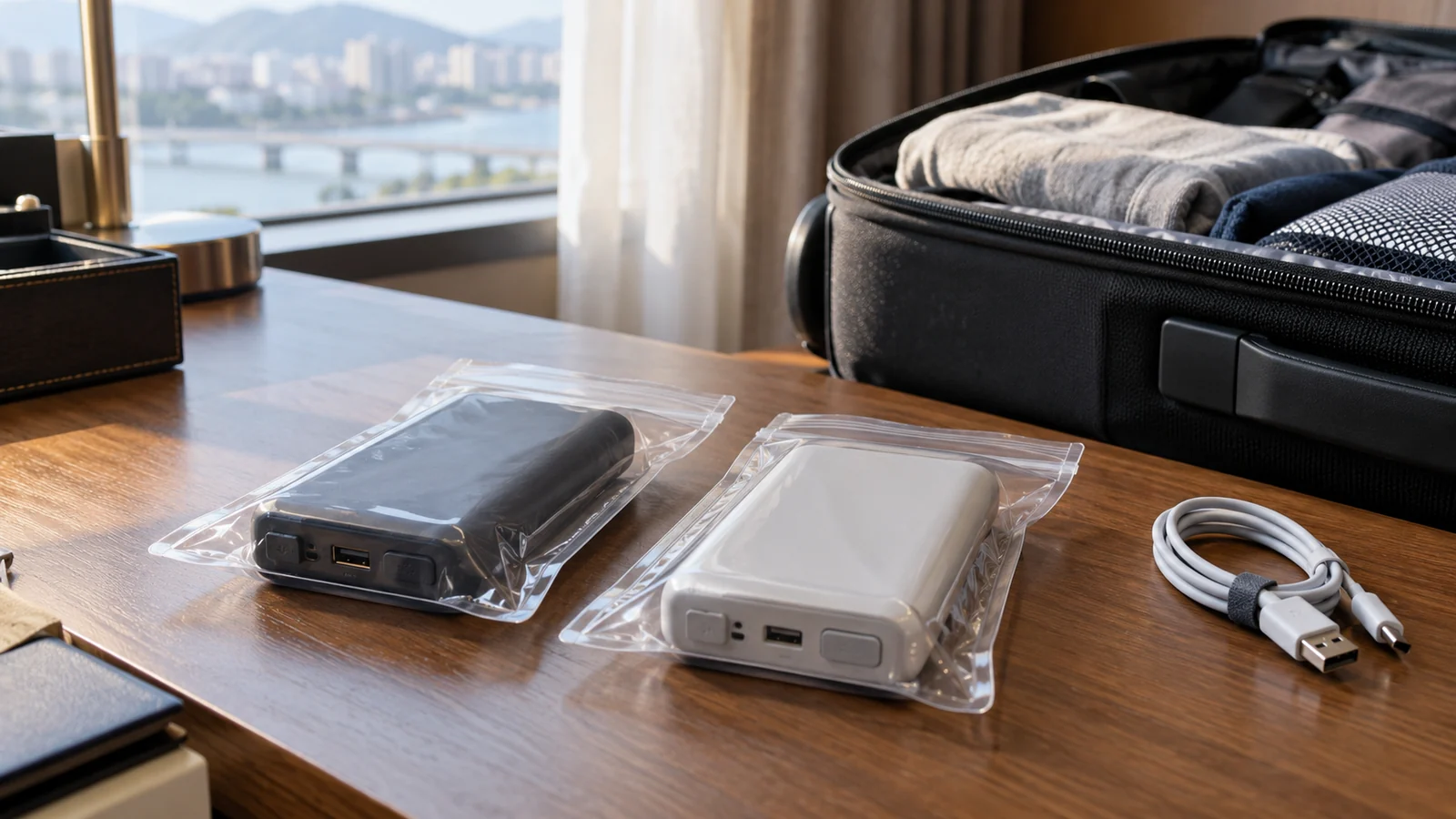
Three small power banks exceed Korean Air’s two-per-person limit—even when every unit is below 100Wh. Count the units before comparing capacity. The airline’s policy effective April 20, 2026 limits power banks to two, requires protection against short circuits, and prohibits using or charging them in flight.
Official guidance checked October 23, 2026. This guide covers ordinary personal-use power banks on Korean Air. For a codeshare or connecting flight, check the airline actually operating that segment and its departure-country rules. Medical equipment needs the airline’s separate guidance.
Check the number and the capacity separately
Korean Air’s current battery table sets these capacity bands: 100Wh or less, over 100Wh through 160Wh with airline approval, and over 160Wh prohibited. The two-power-bank ceiling applies across the permitted bands together.
These are hypothetical packing examples, assuming ordinary, undamaged power banks with readable capacity labels:
| Your packing plan | Count and capacity result | Decision before leaving home |
|---|---|---|
| Three 10Wh units | Each is small; three exceeds the count | Reduce the number |
| Two 74Wh units | Two units, each below 100Wh | Within these two limits; pack each correctly |
| One 111Wh unit | Count is within the limit; capacity needs approval | Arrange airline approval |
| One 170Wh unit | Over the permitted capacity | Leave it out of your flight baggage |
The second row totals 148Wh, but the ordinary 100Wh threshold is tested per unit. Conversely, the first row totals only 30Wh and still fails the number test. Adding all your batteries’ Wh values does not answer both questions.
Does a 20,000mAh power bank qualify?
Start with the Wh value printed on the battery. If it only gives mAh and the rated battery voltage, Asiana’s official battery guidance provides the conversion:
Wh = mAh × battery voltage ÷ 1,000
For illustration, a label specifying 20,000mAh at 3.7V gives 74Wh. A label specifying 30,000mAh at 3.7V gives 111Wh, moving into the approval band. These calculations do not certify a particular product: use its actual label, not an assumed 3.7V or the USB output voltage.
A charger’s wattage is not the battery’s Wh capacity. If the labeling is unclear, send the operating airline the model and label details before travel. Asiana warns that transport may be refused when capacity cannot be established; it also excludes recalled batteries. Do not cover the capacity label while protecting the terminals.
Does the five-battery allowance include power banks?
Read the column heading. Asiana’s April 20 rules distinguish two power banks from five spare batteries at 100Wh or below. Its larger-battery allowance is shared between power banks and spare batteries in the over-100Wh-to-160Wh band. Korean Air’s current table makes the same distinction.
If you also pack removable camera batteries, check both categories and their combined large-battery limit. The spare-battery column does not provide three extra places for phone-charging power banks.
Pack each unit where you can reach it
Use this sequence before handing over luggage:
- Keep power banks out of checked baggage. Korea.net’s April 2026 government announcement confirms the restriction applies regardless of capacity. If a cabin suitcase is checked at the gate, remove the power banks first.
- Protect each unit individually. Korean Air’s April notice lists alternatives: insulating tape on terminals, a separate zip bag for each battery, or an individual protective pouch. One bag containing several unprotected units does not follow its one-per-bag option.
- Keep them with you or in the seat pocket. The same notice prohibits overhead-bin storage. Take them out before lifting a carry-on suitcase into the overhead compartment.
- Disconnect charging cables before the flight. The government announcement prohibits both charging the power bank from aircraft power and using it to charge another device. Carrying an accepted battery does not authorize charging your phone from it onboard.
A useful packing check is: count → label → approval if needed → individual protection → accessible cabin storage. Finish this at home so the check-in counter is for any required approval, rather than discovering an extra unit there.
Plan for a charged phone on arrival
Charge your phone before boarding and save the hotel address, terminal information and transfer instructions offline. If you need aircraft power, check what is available on your flight and bring the appropriate cable. Asiana’s in-flight charging notice points passengers to seat charging ports but warns that availability varies by aircraft; a working socket should not be your only arrival plan.
For the rest of your packing and airport route, see our Jeju domestic versus international liquid rules, Incheon terminal transfer guide and late-arrival transport guide.