
Quick Info
- 📍 Area: Everyday conversations across South Korea, online and in person
- 🕒 Best time: Learn the polite default before meeting Korean speakers
- 💰 Budget: Free to practice; focus on a few reusable endings instead of buying a phrasebook
- 🚇 Getting there: Listen for sentence endings first, then notice titles and honorific verbs
- 👥 Best for: Travelers, new Korean learners, exchange students, and K-content fans
- ✅ TL;DR: Start with polite 해요체, use names or titles instead of 당신, and switch to 반말 only when the relationship and both speakers make it comfortable.
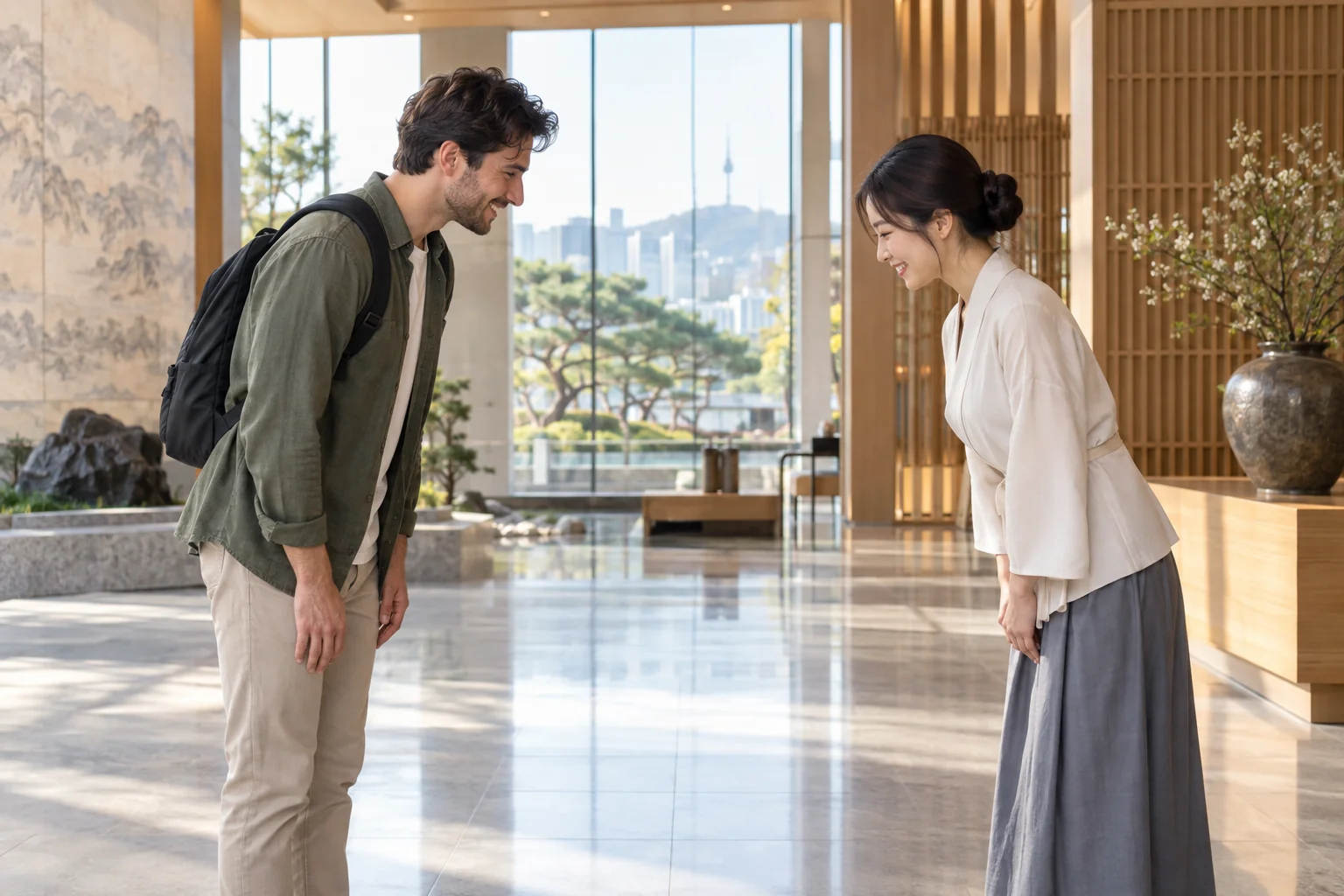
The difference between 존댓말 (jondaetmal, respectful speech) and 반말 (banmal, non-polite or casual speech) is not a password that divides “formal Korea” from “real Korea.” It is a way speakers show how they understand a relationship at a particular moment. Age matters, but so do familiarity, workplace roles, public versus private settings, and the preference of the people speaking.
That is why a visitor can know every verb in a sentence and still feel unsure about its tone. 먹었어요? and 먹었어? both ask whether someone ate, but the first keeps a polite boundary while the second assumes a casual relationship. Neither ending is automatically warmer, colder, better, or worse. The social fit is the important part.
This guide was reviewed on September 11, 2026 using current resources from South Korea’s National Institute of Korean Language (NIKL). Its official Basic Korean Dictionary defines 존댓말 as language that conveys respect and specifically recommends respectful speech in official settings even between familiar people. NIKL also cautions in its language-etiquette guidance that usage cannot always be reduced to one rigid rule: the speakers’ relationship, habits, and context all matter. Use the patterns below as safe practical guidance, then follow how the people around you speak.
Start With 해요체: The Safe Polite Default

For a beginner, the most useful default is 해요체 (haeyoche), the everyday polite style whose statements and questions often end in -요. The official NIKL entry for 해요체 describes it as a non-formal style that ordinarily respects the listener and notes that 안녕하세요 sounds more natural in daily life than the more formal 안녕하십니까.
Use this polite style when you are speaking with:
- someone you have just met;
- a shop, café, restaurant, hotel, or transport worker;
- an older adult you do not know well;
- a teacher, supervisor, client, or professional contact;
- a stranger online whose preferred tone is unknown;
- anyone who continues to use polite speech with you.
You do not need advanced honorific grammar to sound considerate. A few high-frequency patterns solve most visitor situations:
| Purpose | Korean | Romanization | Natural meaning |
|---|---|---|---|
| Greet someone | 안녕하세요. | Annyeonghaseyo. | Hello. |
| Say yes / no | 네. / 아니요. | Ne. / Aniyo. | Yes. / No. |
| Ask if something is okay | 괜찮아요? | Gwaenchanayo? | Is it okay? |
| Ask where something is | 어디에 있어요? | Eodie isseoyo? | Where is it? |
| Request an item | 이거 주세요. | Igeo juseyo. | This one, please. |
| Ask permission | 여기 앉아도 돼요? | Yeogi anjado dwaeyo? | May I sit here? |
| Thank someone | 감사합니다. | Gamsahamnida. | Thank you. |
| Apologize | 죄송합니다. | Joesonghamnida. | I am sorry. |
Notice that the table mixes friendly -요 forms with the very common formal set expressions 감사합니다 and 죄송합니다. Natural speech is not a worksheet in which every sentence must use an identical ending. It is normal to use a polite conversational question and then a conventional -습니다 thank-you in the same interaction.
When ordering, combine a noun with 주세요 rather than memorizing a long sentence: 물 주세요 (“Water, please”), 메뉴 주세요 (“A menu, please”), or 이거 하나 주세요 (“One of this, please”). Our Korean restaurant phrase guide and Korean shopping phrase guide show how this polite base works in complete real-world exchanges.
해요체, 합니다체, and 반말 Compared

Learners often hear that Korean has many speech levels and assume they must master all of them before talking. You do not. Three practical lanes cover most beginner situations: everyday polite 해요체, formal polite 합니다체 (also called 하십시오체 in a fuller grammatical classification), and casual 반말, which commonly uses 해체 endings.
| Practical lane | Example with “to go” | Typical feeling | Useful settings |
|---|---|---|---|
| Everyday polite 해요체 | 가요. / 가요? | Respectful, conversational, flexible | Shops, new acquaintances, most daily visitor interactions |
| Formal polite 합니다체 | 갑니다. / 갑니까? | Formal, careful, public, professional | Announcements, presentations, service formulas, official exchanges |
| Casual 반말 / 해체 | 가. / 가? | Close, direct, informal | Friends who use 반말, close family, younger children in suitable contexts |
The endings change more than the dictionary meaning. Compare these useful pairs:
| Everyday polite | Casual | Meaning |
|---|---|---|
| 안녕하세요. | 안녕. | Hello. |
| 뭐 해요? | 뭐 해? | What are you doing? |
| 밥 먹었어요? | 밥 먹었어? | Did you eat? |
| 괜찮아요? | 괜찮아? | Are you okay? |
| 좋아요. | 좋아. | It is good / I like it. |
| 알겠어요. | 알겠어. | I understand. |
| 잠깐만 기다려 주세요. | 잠깐만 기다려 줘. | Please wait a moment. |
| 같이 갈까요? | 같이 갈래? | Shall we go together? / Want to go together? |
| 죄송해요. | 미안해. | I am sorry. |
| 감사합니다. | 고마워. | Thank you. |
Do not make “remove 요” your only conversion rule. It works for some pairs—괜찮아요 → 괜찮아—but other casual forms change more: 주세요 → 줘, 계세요 → 있어, and 감사합니다 → 고마워. Learn whole pairs from conversations rather than mechanically cutting off the last syllable.
Also separate politeness toward the listener from honoring the person discussed. In 선생님이 오셨어요 (“The teacher came”), -셨어요 contains the subject-honorific -시-, while -요 keeps the sentence polite to the listener. A sentence can therefore honor its subject and use a listener-facing speech level at the same time.
When Can You Switch to 반말?

반말 is not rude by definition. Between close friends it can express ease, intimacy, and belonging. The risk comes from using it before the relationship supports it or assuming that similar age automatically grants permission.
NIKL’s Basic Korean Dictionary explains 말을 놓다 as beginning to speak to someone in the low or casual form and gives first meetings as a context in which doing so carelessly can violate etiquette. Its related expression 말을 트다 describes two people coming to speak casually with each other. Both expressions point to the same practical lesson: switching speech level is relational, not merely grammatical.
A common, clear question is:
우리 말 놓을까요?
Uri mal noeulkkayo?
Shall we speak casually with each other?
Another phrase you may hear is:
말 편하게 하세요.
Mal pyeonhage haseyo.
Please speak comfortably / You can speak more casually.
The second phrase can be context-dependent. Sometimes it clearly invites 반말; sometimes it simply means “do not be nervous.” If the other person is still using -요, you can keep using polite speech or confirm with 반말해도 돼요? (“Is it okay if I use casual speech?”).
Use this decision check:
- Are you strangers, customers and staff, or professional contacts? Stay polite.
- Are you similar-age adults becoming friends? Stay polite until someone raises the switch or the group clearly uses 반말 with you.
- Did only one person receive permission? Do not assume the switch is automatically mutual; listen to the wording.
- Has the setting become official? Friends may return to polite or formal language during a presentation, interview, ceremony, or public-facing work.
- Are you uncertain? Keep -요. Polite speech can still be warm through word choice, voice, and expression.
If someone speaks 반말 to you, that does not always mean you should mirror it. An older relative may use casual speech while you continue politely. A service interaction may sound brisk without establishing friendship. Match the relationship, not just the final syllable you heard.
Address People Without Using 당신

English speakers often search for a direct equivalent of “you” and find 당신 (dangsin). It is rarely the safest conversational substitute. The NIKL Basic Korean Dictionary lists several distinct uses of 당신: between spouses, in writing, and as a confrontational “you” in arguments, among others. That range is why dropping it into a routine café or hotel question can sound distant, dramatic, or hostile.
Korean commonly omits the subject when context makes it obvious. Instead of “Do you have this?” say:
이거 있어요?
Igeo isseoyo?
Do you have this? / Is this available?
When you need to get attention or identify someone, use an appropriate title or neutral call:
- 저기요 — Excuse me; useful for getting staff attention without naming them.
- 선생님 — Teacher; also a respectful professional address in some contexts, but not a universal label for every stranger.
- 기사님 — Driver, used respectfully for taxi, bus, or delivery drivers.
- 사장님 — Owner or proprietor; common in small businesses, even when a learner cannot verify ownership, but follow local usage.
- 직원분 — Staff member, with respectful 분; often useful when referring to an employee rather than calling across a room.
- Name + 씨 — A common respectful form among adult peers or toward someone junior in many settings; do not automatically use it upward to a professor, senior manager, or elder when a title is expected.
- Role + 님 — Titles such as 팀장님 (team leader) or 선생님 preserve the role and add respect.
The dictionary entry for the suffix -님 confirms that it adds honor or respect to certain titles and status nouns. More -님 is not always more natural, though. Use established forms you have heard, and do not invent stacked titles.
For a taxi destination, 여기로 가 주세요 (“Please go here”) while showing the map is easier and safer than building a sentence around “you.” Save the Korean subway and bus phrases guide for more polite transport questions.
Listener, Subject, and Object Honorifics
“Polite ending” and “honorific” are often treated as synonyms in beginner lessons, but Korean can show respect in several places. You do not need every category at once; recognizing the layers prevents common mixed sentences.
1. Respecting the listener
The ending shows how you address the person hearing the sentence:
- 지금 가요. — I am going now. / Someone is going now. (everyday polite)
- 지금 갑니다. — I am going now. (formal polite)
- 지금 가. — I am going now. (casual)
2. Honoring the subject
The marker -시- and special vocabulary can honor the person performing an action:
- 선생님이 오세요. — The teacher is coming.
- 어머니가 집에 계세요. — Mother is at home.
- 할아버지가 주무세요. — Grandfather is sleeping.
- 식사하셨어요? — Have you eaten? (honorific subject)
Common vocabulary pairs include 있다 → 계시다 (to be/stay), 먹다 → 드시다/잡수시다 (to eat), 자다 → 주무시다 (to sleep), and 말하다 → 말씀하시다 (to speak). Do not attach honorific forms to yourself: say 제가 말씀드릴게요 (“I will tell you”) rather than raising your own action with -시-.
3. Respecting the object or recipient
Some verbs lower the speaker’s action in relation to the recipient:
- 드리다 — to give (humbly, to someone respected)
- 여쭙다 — to ask (humbly)
- 뵙다 — to meet/see (humbly)
For example, 선생님께 여쭤볼게요 means “I will ask the teacher.” NIKL’s terminology page for 존댓말 distinguishes direct, indirect, and object-honorific vocabulary such as 성함, 댁, 뵙다, 여쭙다, and 드리다. Beginners should learn these as useful chunks, not as a demand to decorate every sentence.
Six Real-Life Scenarios
Here is what a safe choice looks like when grammar meets an actual relationship.
1. At a café or restaurant
Use polite speech with staff: 아이스 아메리카노 한 잔 주세요 (“One iced Americano, please”) or 계산할게요 (“I will pay”). Being the customer does not make 반말 appropriate. The Korean café etiquette guide covers ordering, seating, and tray-return cues beyond the sentence endings.
2. Meeting a friend’s Korean friend
Begin with 안녕하세요 and -요, even if you appear the same age. If the group proposes 반말, confirm and switch. A friendly voice and questions like 한국에는 자주 와요? (“Do you come to Korea often?”) do not sound cold merely because they are polite.
3. Messaging a new language partner
Open politely. Online profiles and usernames do not reveal age, role, or preference. Once you have chatted and both agree, casual forms can feel natural. Keep abbreviations such as ㅇㅋ, ㄱㄱ, and ㅈㅅ for genuinely casual relationships; our Korean texting slang guide explains their tone.
4. Speaking with a professor or workplace senior
Use a title such as 교수님 or the workplace role plus 님, and keep polite or formal endings. Copy the organization’s normal practice rather than guessing from dramas. In a public or official setting, a more formal style may appear even among people who use casual language privately.
5. Talking with a younger child
Adults often use casual speech with young children, but a visitor does not need to force it. Gentle -요 speech is safe, and some adults intentionally use it to model mutual respect. Never use a child’s age as permission to sound commanding.
6. Meeting an older stranger who speaks English casually
Continue using polite Korean unless they clearly invite a change. The fact that English has one “you” does not erase the relationship signaled in Korean. Switching languages can switch the visible grammar without automatically changing the social understanding.
Common Mistakes and Better Fixes
Mistake: Assuming all -요 sentences are equally respectful
An ending cannot rescue a blunt address or command. 너는요? can feel mismatched with a stranger because 너 is casual even though -요 appears later. In the same NIKL language-etiquette answer, the institute notes that mixing a low-form pronoun with a polite ending can sound unnatural because the levels do not align. Omit the pronoun and ask 어떻게 생각하세요? (“What do you think?”) when appropriate.
Mistake: Using 반말 because someone is younger
Age is one factor, not a license. Adult strangers generally begin politely, and workplace position or a public setting can outweigh a simple age comparison. Use the other person’s chosen style as information, not as automatic permission.
Mistake: Treating polite speech as emotionally distant
Friends, couples, colleagues, and creators may use polite speech playfully or affectionately. Warmth also comes from intonation, attentive replies, softeners such as 좀, and caring questions. The NIKL dictionary even shows 좀 being used to soften a request, as in 창문 좀 열어도 될까요? (“May I open the window?”).
Mistake: Copying drama dialogue without its relationship
A line may be appropriate because the characters are siblings, lifelong friends, rivals, or a superior and subordinate. Learn the scene’s relationship before copying the ending. Historical dramas and stylized characters may also use speech levels that are not a beginner’s everyday target.
Mistake: Switching every sentence at once
When invited to use 반말, learners sometimes produce abrupt commands because their casual vocabulary is smaller. Start with a few gentle pairs—네 → 응, 괜찮아요? → 괜찮아?, 고마워요 → 고마워—and keep requests considerate. 반말 removes a politeness level; it does not remove kindness.
A Seven-Day Practice Plan
You can build reliable instincts without memorizing a grammar chart in one sitting.
- Day 1: Highlight -요, -습니다, and casual endings in one short clip.
- Day 2: Record the ten polite/casual pairs in this guide and compare rhythm.
- Day 3: Practice three service requests with 주세요 and one permission question with -아/어도 돼요?
- Day 4: Replace unnecessary 당신 with an omitted subject or a role title.
- Day 5: Listen for -시- in 하세요, 가세요, 계세요, and 드세요.
- Day 6: Write two mini-dialogues: first meeting in 해요체, then close friends in 반말.
- Day 7: Review a restaurant, shopping, transit, or K-pop phrase list and label each line polite, formal, or casual.
The goal is not to calculate another person’s rank. It is to notice the relationship being offered and respond with enough respect for the setting.
FAQ
Q: Is 반말 always rude?
No. It is normal and often affectionate among close friends, family members, and others whose relationship supports casual speech. It can feel rude when used uninvited with a stranger, customer-service worker, older adult, or professional contact.
Q: Should same-age adults use 반말 immediately?
Not automatically. Many adults begin with polite speech and switch after a brief conversation or explicit agreement. Similar age can make the switch easier, but familiarity and preference still matter.
Q: What is the difference between 존댓말 and 높임말?
In everyday conversation the terms often overlap. A fuller grammar explanation separates respect toward the listener from honor shown to the sentence’s subject or object. For beginners, start by controlling listener endings and learn common honorific verbs as chunks.
Q: Is 해요체 formal Korean?
It is polite but grammatically classed as non-formal. It is the flexible everyday respectful style used in many ordinary conversations. 합니다체 is more formal and common in public, official, or carefully professional speech.
Q: Can I call a stranger 당신?
Usually avoid it. Omit “you,” use the person’s title or role, or frame the question without a pronoun. 당신 has special written, marital, and confrontational uses that make it an unreliable default.
Q: What should I do if I use the wrong speech level?
Correct the sentence and continue. If the mistake was noticeably too casual, say 죄송해요. 아직 한국어를 배우고 있어요 (“Sorry. I am still learning Korean”). Most people care more about your respectful intent and adjustment than perfect grammar.
Keep One Default, Then Listen
Your simplest working rule is strong: start with 해요체, address people by an appropriate name or title, and wait for a clear social cue before using 반말. Add formal -습니다 expressions for official moments and common honorific verbs as your listening improves.
Save the comparison tables, practice one service dialogue and one friend dialogue aloud, then choose your next real-world set from our Learn Korean guides. The fastest progress comes when you connect each ending to a person and setting—not when you memorize it in isolation.