
Quick Info
- 📍 Area: Convenience stores, supermarkets, neighborhood marts, and Korean grocery shops
- 🕒 Best time: Year-round; compare shelf prices before buying and avoid carrying bulky cups home
- 💰 Budget: Compare the actual total per serving; cups, bags, delivery charges and promotions are different offers.
- 🚇 Getting there: Convenience stores cluster near subway exits and hotels; larger supermarkets offer better multipack choice
- 👥 Best for: First-time Korea visitors, spicy-food beginners, K-food shoppers, and travelers planning an easy meal
- ✅ TL;DR: Buy a single cup for convenience, a bag multipack for value, and choose by broth style—not package color. Read the cooking, allergen, and dietary labels every time.
Korean ramyeon is instant noodle comfort food: quick, inexpensive, endlessly varied, and easy to find from a Seoul subway exit to a small-town mart. English searches often use “Korean ramen,” but ramyeon is the Korean pronunciation and helps distinguish the packaged Korean dish from Japanese restaurant ramen. Korea Tourism Organization’s food guide makes the same practical distinction: Korean ramyeon is generally instant noodles, while Japanese ramen usually refers to fresh noodles served with a prepared broth.
The hard part is not finding ramyeon. It is choosing one from a wall of red, black, yellow, and neon packages when the front may not tell you—in English—whether the bowl is soupy, dry, seafood-based, extremely hot, or merely peppery. Price tags also reward different choices: a supermarket multipack can be cheaper per serving, while a convenience-store cup costs more for the ability to eat immediately.
This guide is for buying and eating ramyeon in Korea as of August 26, 2026. It explains where to shop, how to compare the price per usable meal, which flavor family fits your taste, how to use a self-service cooker, and what to check if you have allergies or dietary restrictions. Product formulas, promotions, and shelf prices change, so treat the worked numbers below as examples and verify the current label before paying.
Where to Buy Korean Ramyeon in Korea

The best store depends on whether you want one hot meal now or several packets at the lowest unit cost.
Convenience stores: best for one serving and the full experience
CU, GS25, 7-Eleven, and Emart24 locations usually stock cups, large bowls, and popular bag noodles. Many have hot-water dispensers, microwaves, chopsticks, and a small eating counter. Some stores also have dedicated cookers for bag ramyeon. This is the easiest option after a late arrival, before a train, or when your hotel room has no kitchen.
The tradeoff is value. A single cup or bowl normally costs more per gram than a supermarket multipack. Promotions such as 1+1 or 2+1 can change the calculation, but they rotate. Read the shelf tag rather than assuming yesterday’s social-media deal is still active.
KTO’s CU Ramyun Library guide describes a specialty Hongdae branch with multilingual flavor and spice information and a large selection. That article’s detailed product prices were last updated in 2024, so use it for the cooker method and experience—not as a 2026 price list.
Supermarkets: best for multipacks and price comparison
Large supermarkets and neighborhood marts are better when you want four- or five-packs, dried-noodle lines, family packs, or several flavors side by side. Unit prices are easier to compare, and a standard multipack is generally the sensible souvenir if luggage space allows.
Look at both the total price and the pack count. Korean producers do not use one universal count: a similar-looking bundle may contain four, five, or more servings. Sales, loyalty pricing, and online coupons can also make the bright headline price different from the amount available to a visitor without membership.
Traditional markets and independent grocers
These shops can be convenient near guesthouses or residential neighborhoods. Selection and prices vary, but they may sell individual bag noodles without requiring a multipack. Check the package condition and best-before information, especially in a small shop with slower turnover.
Korean grocery stores outside Korea
If you are shopping at home, a Korean or Asian supermarket usually offers better ingredient-label access and fewer marketplace markups than a random third-party seller. Match the package weight and country-market version before comparing prices: export formulas, serving sizes, and labels can differ from the Korean domestic package.
For a broader immediate-meal basket, pair this guide with our Korean convenience store food combos. If you plan a larger grocery run, the Korea shopping guide explains store types, payment, and practical carrying tips.
Best Korean Ramyeon Types for Your Taste
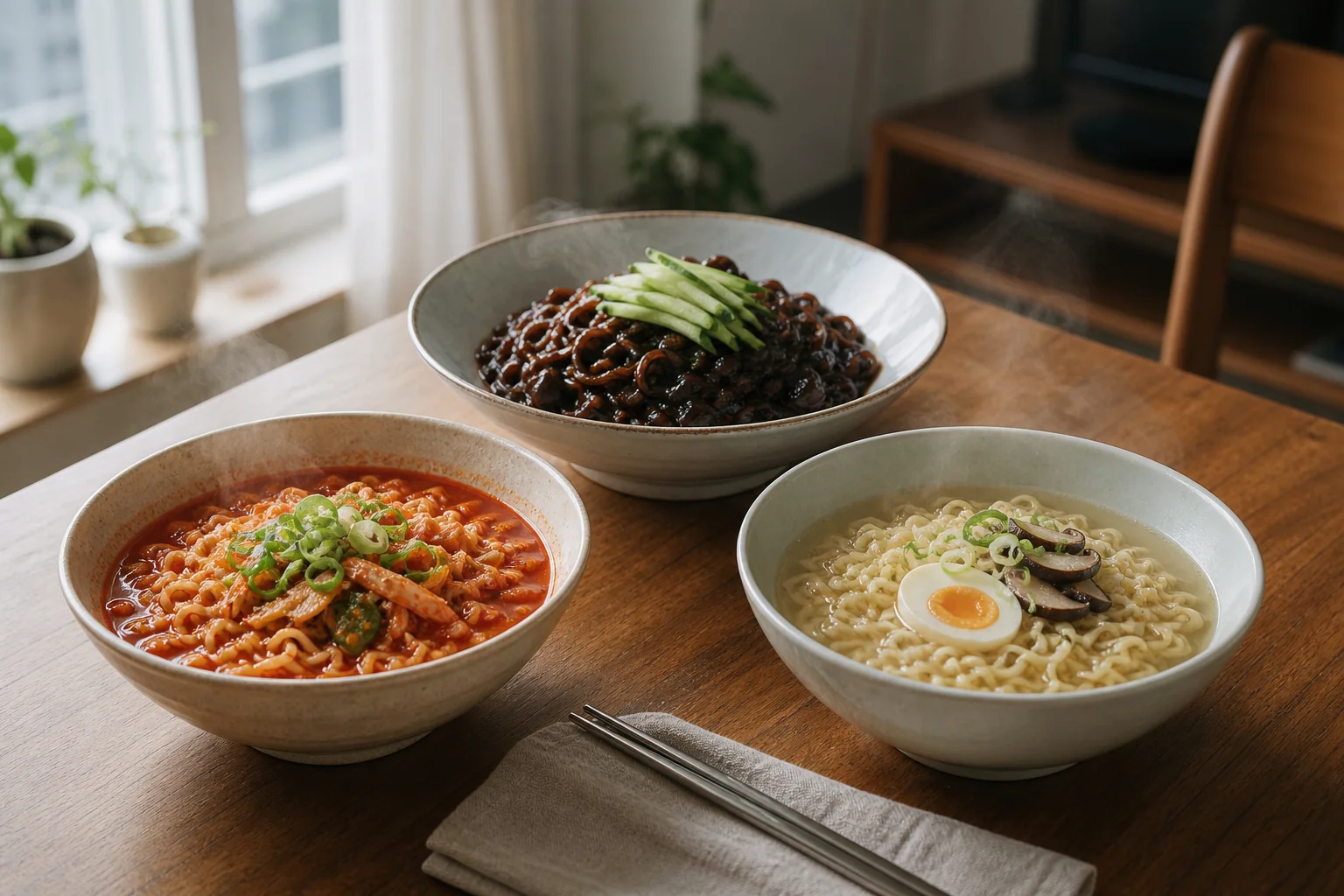
There is no single “best Korean ramyeon” for every eater. The useful question is: what kind of bowl do you want? Start with the cooking style and broth family, then choose your heat level.
| Ramyeon style | What it tastes like | Good first choice for | Main caution |
|---|---|---|---|
| Red spicy soup | Chili heat, savory broth, garlic, and vegetables | The classic Korean ramyeon experience | “Mild” can still be spicy |
| Mild savory soup | Beef, chicken, vegetable, sesame, or egg-forward broth | Beginners and travelers who dislike intense chili | May still contain pepper or chili oil |
| Seafood soup | Kelp, anchovy, shrimp, squid, clam, or spicy seafood notes | Fans of briny, deeper broth | Check shellfish and fish allergens |
| Black-bean dry noodles | Sweet-savory roasted black-bean sauce, little or no broth | Anyone wanting a less fiery option | Not necessarily vegetarian |
| Spicy stir-fry noodles | Concentrated sauce, sweetness, and strong heat | Experienced spicy-food fans | Usually hotter per bite than soup noodles |
| Dried or air-dried noodles | Cleaner, less oily noodle texture; flavor varies | Shoppers comparing fried and non-fried noodles | Often costs more per serving |
| Cold or bibim noodles | Sweet, tangy, spicy sauce served after rinsing | Hot-weather meals | Requires draining and usually cold water |
For a classic first bowl
Choose a medium-spicy red soup noodle with a separate powder packet and vegetable flakes. It gives you the familiar Korean combination of chewy noodles, savory broth, scallion, mushroom, and chili. Add an egg only after tasting the plain broth once; toppings can hide what you actually like about the base product.
For lower heat
Do not rely on package color alone. Look for 순한맛 (sunhan mat, mild flavor), a mild marker, or an English spice scale. KTO notes that even products described as mild may include pepper, so “mild” does not always mean zero heat. Black-bean noodles, sesame-forward soup, udon-style products, and some chicken or beef broths can be easier starting points, but the ingredient label remains the final authority.
For serious spice
Dry stir-fry noodles can feel more intense than soup ramyeon because the sauce clings to every bite rather than dispersing through a pot of broth. Start with part of the liquid sauce packet, mix, taste, and add more only if wanted. This is better than cooking the full packet and trying to rescue the bowl with cheese afterward.
Fried noodles versus dried noodles
Ramyun noodles are not all made the same way. Nongshim’s official RamyunPedia explains that the familiar instant style is steamed, fried, and dried, while non-fried dried noodles are dehydrated with hot air. Dried noodles often have a firmer, cleaner texture and can take slightly longer to cook. “Non-fried” is a manufacturing description, not permission to ignore the full nutrition panel.
Bag vs Cup Ramyeon: Price, Cooking & Use
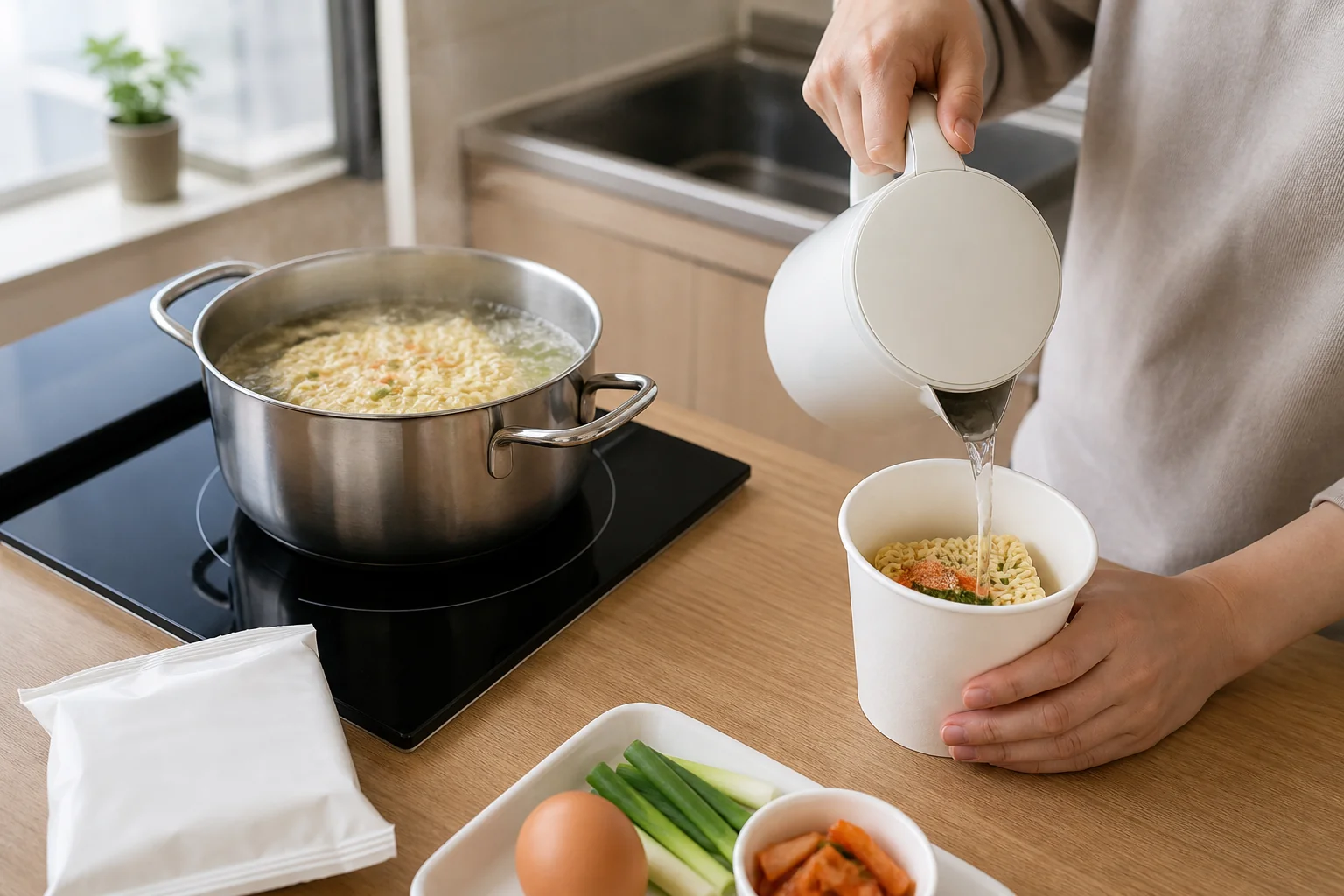
Bag and cup versions with the same brand name are not always identical. Noodle thickness, portion size, seasoning strength, flakes, and cooking instructions can differ.
| Format | Best for | Typical method | Value | Packing note |
|---|---|---|---|---|
| Bag ramyeon | Hotel kitchens, apartments, home cooking, self-service cookers | Boil noodles and seasoning in measured water | Usually lowest cost per serving in multipacks | Flat and easier to pack than cups |
| Small cup | Snack, short transfer, light appetite | Add boiling water to the fill line and cover | Convenience premium | Bulky for the amount of food |
| Large cup/bowl | Full quick meal without a pot | Add boiling water; some products have drain holes | More food but usually higher unit cost | Easy to crush in checked luggage |
| Premium or dried bag | Texture-focused meal at home | Follow the product’s exact boil time | Higher price tier | Good gift only if the recipient cooks |
For bag noodles, use the water amount and time printed on that package. The official Shin Ramyun product page, for example, currently specifies 550 mL and 4 minutes 30 seconds for the bag version, while the cup version uses its internal fill line and about 3 minutes. Those numbers are product-specific, not a universal ramyeon formula.
Cup noodles are simple, but “fill to the line” matters. Too little water makes the seasoning harsh and salty; too much produces weak broth and under-seasoned noodles. Open the lid only as far as instructed, remove every packet, add the packets in the printed order, and use genuinely boiling water unless the label says otherwise.
Do not microwave a cup merely because a store has a microwave. Some containers are designed only for boiling water; others provide explicit microwave directions. Follow the package, remove any metal lid, and ask staff if the instructions are unclear.
How to Use a Convenience-Store Ramyeon Cooker
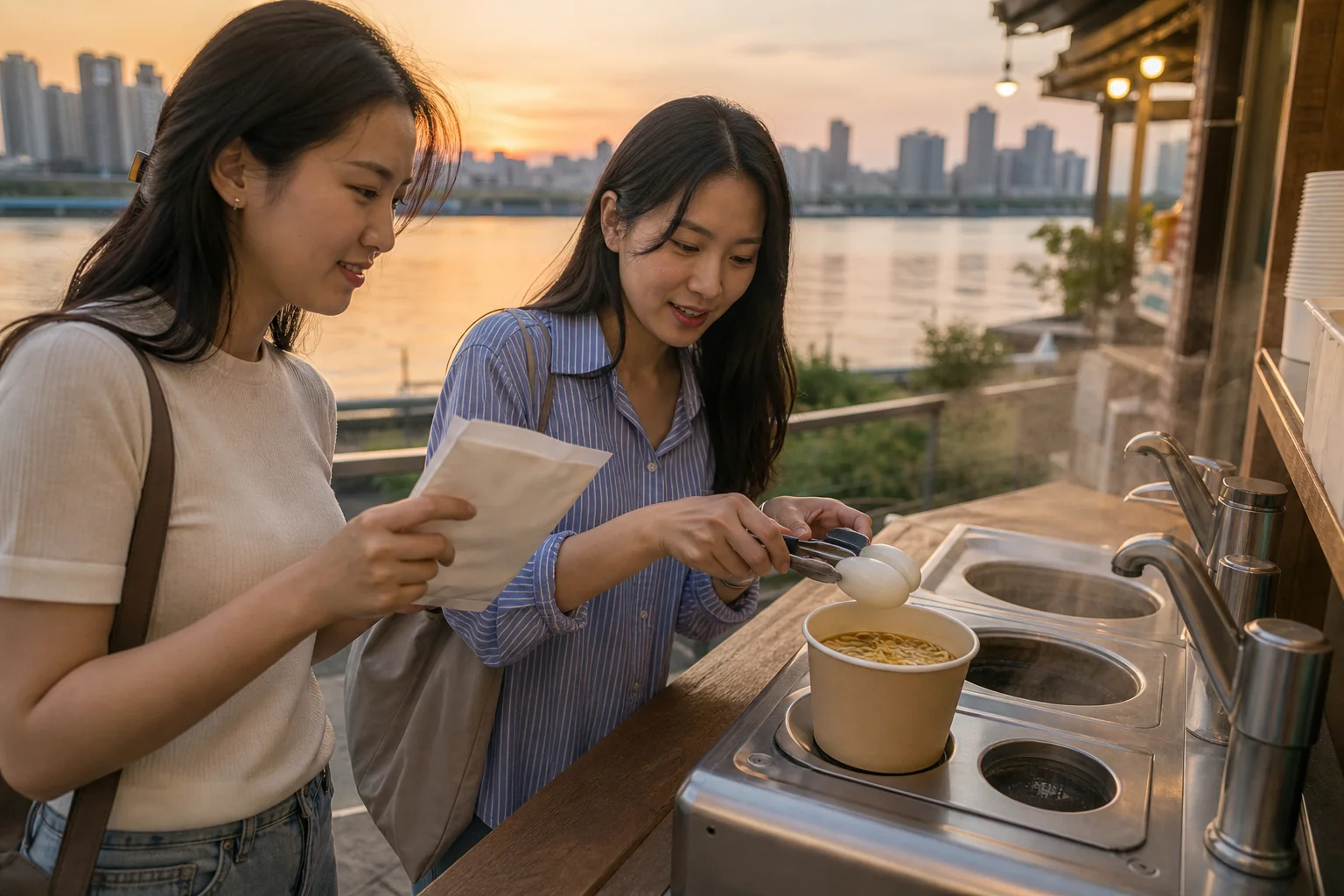
Self-service ramyeon cookers turn a bag of noodles into a hot meal without a stove. KTO’s cooker guide gives a basic flow: buy the noodles and compatible paper bowl, empty the noodles and seasoning into the bowl, scan the package when the machine supports barcode settings, place the bowl on the heating surface, and start the cycle.
Use this practical sequence:
- Pay first. Buy the bag noodles, the cooker-safe paper bowl, and any toppings. Do not substitute an ordinary paper container.
- Check the station. Find the matching cooker and confirm whether its controls have English or pictograms.
- Empty the package. Put noodles, powder, and flakes into the bowl. Hold back liquid chili sauce if you want to control heat.
- Scan or select. Some machines read the product barcode and set water and time automatically; others require a button selection.
- Keep the bowl centered. The base must sit flat on the heating plate.
- Wait beside it. Do not walk away while water heats and bubbles.
- Add delicate toppings late. Cheese, a cooked egg, or chopped scallion does not need the full cycle.
- Carry with both hands. The bowl and steam are hot. Use the provided tray if available.
- Sort waste. Empty leftover broth where instructed and separate the bowl, lid, and general trash according to the bins.
The same experience appears along the river. KTO’s May 2026 Hangang picnic guide confirms that visitors can buy instant noodles near Hangang parks and cook them on self-service machines at many nearby stores. Availability is location-specific, so look for the cooker before buying a bag that you cannot otherwise prepare.
Compare the price per meal
Read the shelf price for the exact serving count and package size. An online coupon, a membership price and an in-store price may be different. The Emart Shin five-pack listing and dried-noodle listing are starting points for checking current offers, not fixed price promises.
Hypothetical comparison: a five-pack costing ₩4,500 is ₩900 per serving. A ₩1,500 cup costs ₩600 more for one meal, but you can prepare it with hot water. The five-pack is poor value for a traveler who cannot cook it or will use only one packet. Add any cooker bowl, topping or delivery charge before deciding.
Compare similar serving weights and formats. Buy only the amount you can use or carry; a lower unit price does not make a larger unwanted purchase a saving.
How to Read the Package and Dietary Labels
The back of the package matters more than the front. Korea’s Ministry of Food and Drug Safety explains that processed-food labels provide product name, ingredients, dates, net contents, business information, nutrition information, storage instructions, and safety warnings. MFDS also requires allergen warnings when cross-contact is possible on a shared manufacturing process.
Check these fields before buying:
- 조리방법: cooking method
- 원재료명: ingredients
- 알레르기 or 함유: allergen information or “contains”
- 영양정보: nutrition information
- 소비기한: use-by date
- 내용량: net weight
- 보관방법: storage method
- 유탕면: fried noodles
- 건면: dried, non-fried noodles
- 봉지면: bag noodles
- 용기면: cup or bowl noodles
Wheat, soy, egg, milk, fish, shellfish, sesame, beef, pork, or chicken can appear in noodles, soup powder, oil packets, and flakes. A seafood picture is an obvious warning, but a plain vegetable image is not proof that the product is vegetarian. “No meat pieces” does not mean the seasoning lacks meat or seafood extract. Halal, vegan, gluten-free, and allergen-safe choices require an explicit current claim or certification on the exact package.
If you have a severe allergy, do not depend on an unofficial translation app alone. Compare the Korean allergen panel with the official imported label, contact the manufacturer when necessary, and skip any product that remains ambiguous. The MFDS food labeling overview is a useful official starting point.
Easy Toppings and Pairings That Actually Help
Toppings should solve a problem: add protein, soften heat, introduce freshness, or make a small cup more filling.
- Egg: crack a raw egg into boiling bag ramyeon, or add a packaged cooked egg to a cup after it softens.
- Scallion: adds freshness without changing the broth’s identity.
- Mandu: turns soup noodles into a fuller meal; allow enough time for frozen dumplings to cook safely.
- Rice or samgak gimbap: useful with spicy soup, especially when the noodle portion is small.
- Kimchi: adds acidity and crunch, but it also increases salt and heat.
- Cheese: softens perceived heat and enriches dry spicy noodles; one slice is usually enough.
- Bean sprouts or mushrooms: add texture to stovetop noodles, provided they are cooked through.
- Tofu: mild protein for a soup-style ramyeon pot.
Avoid pouring gochujang into every red broth by instinct. It adds salt, sugar, starch, and fermentation as well as chili. If you want to understand how Korean pastes behave before experimenting, see our gochujang, doenjang, and ssamjang comparison.
For a balanced convenience-store meal, pair ramyeon with a mild rice item, egg, and water or unsweetened tea. A cup noodle, tteokbokki, sausage, chips, and a sweet drink may look like a fun haul, but the combined salt, spice, and richness can overwhelm the experience.
How to Buy Ramyeon as a Korea Souvenir
Start with the recipient, not the shelf trend. A useful mixed selection might include one classic spicy soup, one mild soup, one black-bean dry noodle, and one premium or dried style. That gives variety without turning the gift into a heat challenge.
Choose bags rather than cups, keep ingredient panels visible, and avoid removing individual packets from labeled outer packaging if allergies matter. Place the noodle blocks inside a rigid box or between soft clothes. Check your destination’s customs rules for products containing meat or animal-derived ingredients; entry rules vary by country and can change.
If space is limited, buy two or three distinctive servings rather than a giant multipack available at home. Photograph the Korean cooking directions before packing, or save the manufacturer’s official product page. The best souvenir is one the recipient can prepare correctly.
What to Do Next
Save this simple shopping rule: format first, flavor second, heat third, price per serving last. Pick one bowl you can cook with the equipment you actually have, read the allergen panel, and taste the base product before adding toppings. Then bookmark this guide and browse more K-food guides when you are ready to build the rest of your Korea food list.