
Quick Info
- 📍 Area: Casual restaurants, barbecue restaurants, set-menu shops, and food halls across South Korea
- 🕒 Best time: Read before your first meal; recheck the restaurant’s ordering and refill rules when you arrive
- 💰 Budget: Etiquette does not add a fee; menu prices, minimum orders, and paid extras vary by restaurant
- 🚇 Getting there: Use a map or reservation app, then follow the queue, kiosk, counter, or host system at the entrance
- 👥 Best for: First-time visitors, solo diners, families, and groups sharing a Korean meal
- ✅ TL;DR: Watch the restaurant’s system, keep individual bowls separate from shared dishes, use serving tools when provided, ask before changing the grill, and normally pay the displayed total without a tip.
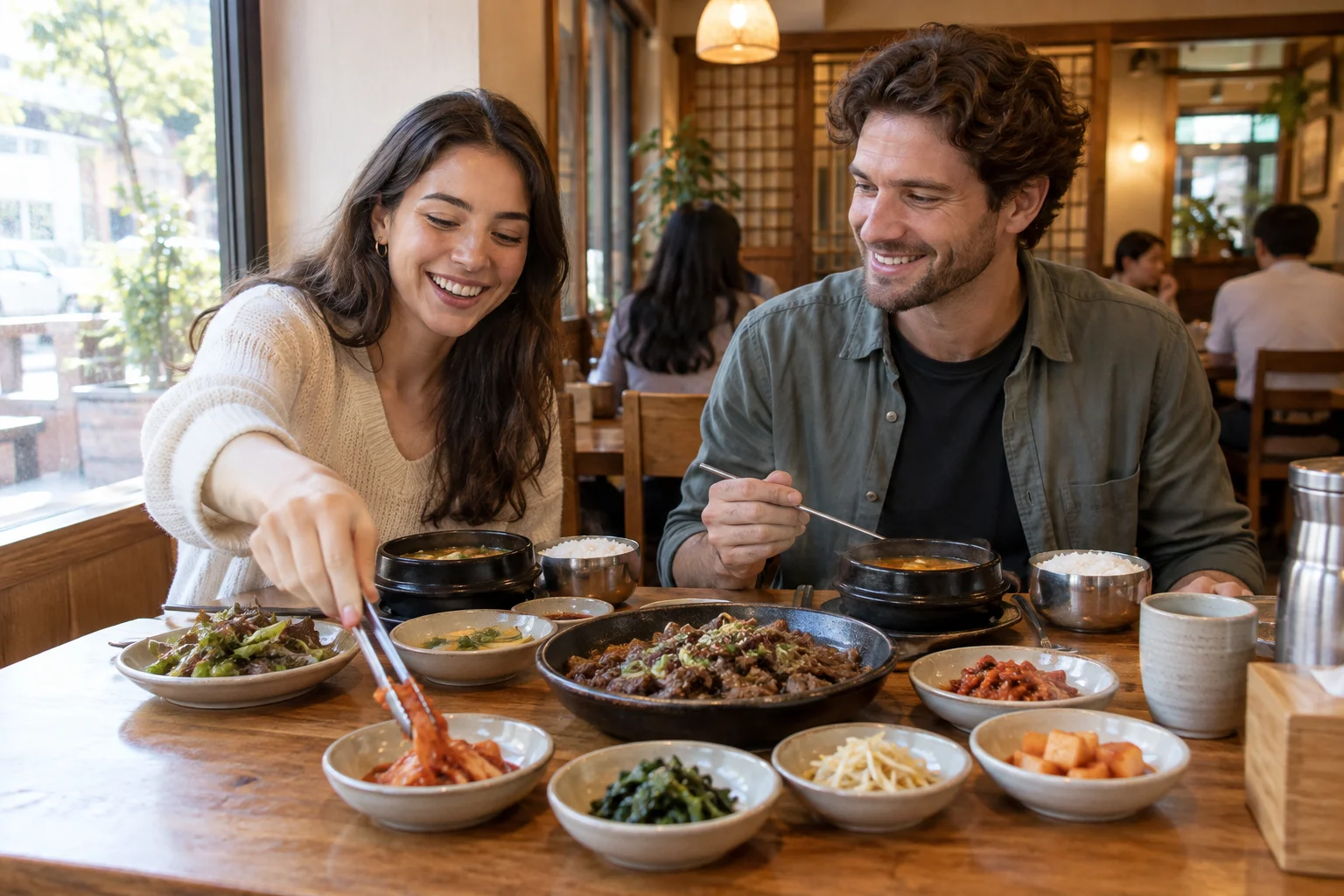
Korean restaurant etiquette is easier than lists of rigid rules make it sound. Most casual meals are not a manners exam. The practical goal is to notice how that restaurant works, avoid creating extra work for staff or other diners, and handle shared food cleanly.
The details vary. A soup shop may serve one bowl per person and collect payment at the front. A barbecue restaurant may require a minimum number of portions and have staff manage the grill. A busy Seoul restaurant may use a digital waitlist, while a neighborhood diner may simply ask how many people are in your party. Treat the posted system and staff instructions as more important than any general cultural tip.
This guide was reviewed on September 12, 2026 against current Korea Tourism Organization and Korean government material. Korea Tourism Organization’s overview of Korean food and restaurant features confirms several patterns visitors notice: the important role of the spoon, complimentary water and ordinary side-dish refills, self-service stations, table call bells, and utensil drawers. Its page also reminds readers that practices change, so the specific restaurant always gets the final say.
Complete Guide to Korean Restaurant Etiquette: Before You Sit
Use this table as a quick decision guide rather than a list of universal laws.
| Situation | Good default | Check before assuming |
|---|---|---|
| Entering | Pause at the entrance and look for a host, queue kiosk, or waiting list | Whether you may seat yourself |
| Ordering | Confirm portions, quantities, and spice changes before staff leave | Minimum orders and whether one serving means one person’s portion |
| Water and utensils | Check the table drawer and nearby self-service station first | Whether staff bring everything to the table |
| Banchan | Take a modest amount and use serving tools when available | Which refills are free and which dishes are paid extras |
| Shared food | Move a bite to your own plate or bowl before eating it | Whether the dish is meant to be divided by staff |
| Korean barbecue | Let staff lead if they start cooking or changing the grill plate | Whether guests should cook, cut, or move the meat |
| Getting service | Press the call bell once or say 저기요 politely | Whether ordering is handled only by kiosk, tablet, or counter |
| Paying | Follow the restaurant’s counter, table, or kiosk process | Whether separate checks are possible |
| Tipping | Pay the displayed total; routine tipping is not expected | Any explicit service policy at a special venue |
Three habits solve most uncertainty. First, pause and observe before acting. Second, ask one short question instead of guessing. Third, copy the process, not every gesture, of nearby diners. You do not need to imitate how quickly someone uses metal chopsticks or how they combine food. You only need to understand where to wait, how to order, what is shared, and where to pay.
If language is the main worry, save our Korean restaurant phrases guide with phrases for ordering, allergies, refills, takeout, and payment. Etiquette and language work together: a short polite question is usually better than silently improvising.
Read the Room: Queues, Ordering, and Table Setup
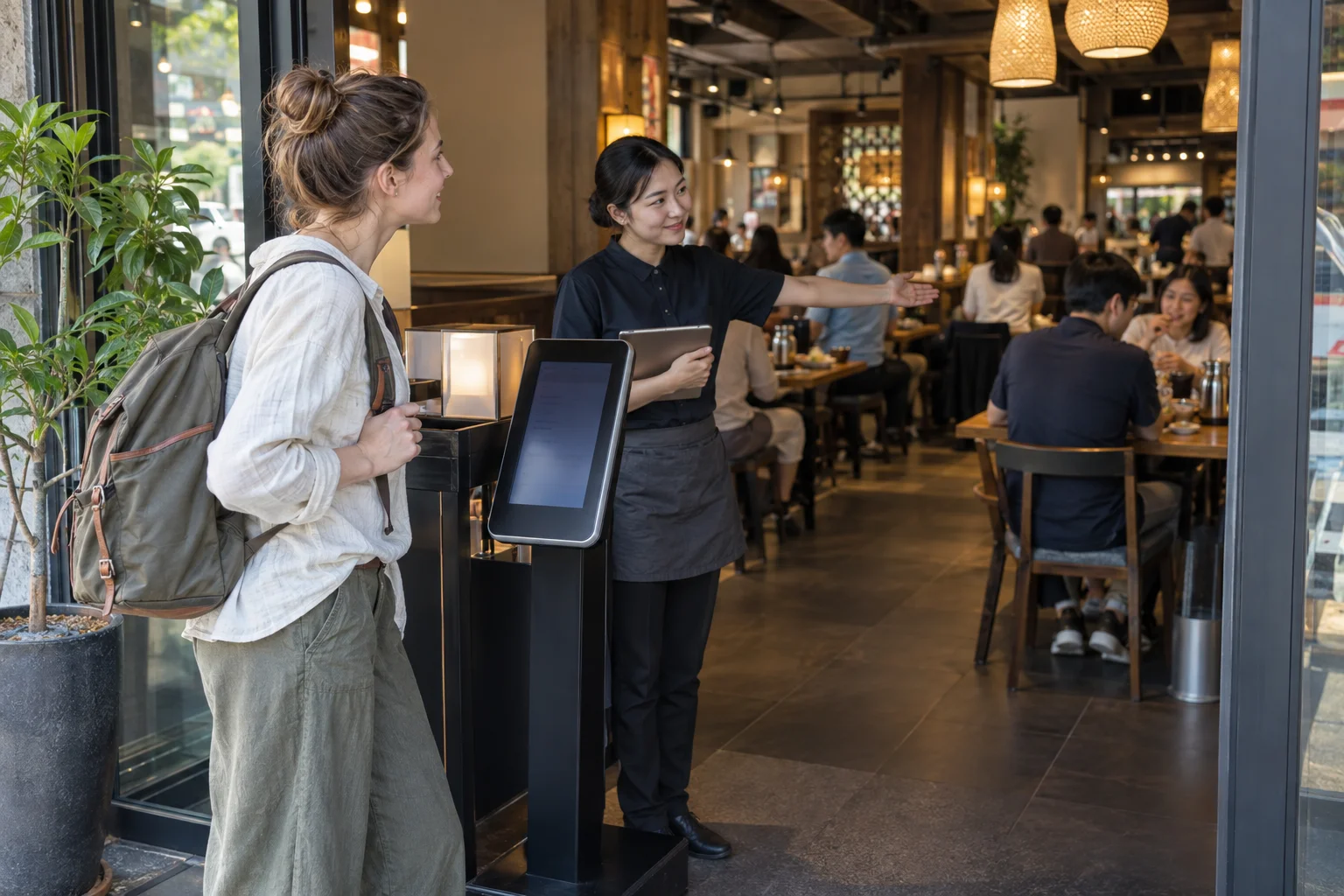
At the entrance, stop long enough to identify the system. Look for a host, a tablet or kiosk, a paper list, numbered tickets, or a line. If other guests are waiting outside while empty tables are visible, do not assume those tables are available. They may be reserved, waiting to be cleaned, or assigned through a queue.
Popular restaurants increasingly use reservation and remote-waitlist tools. Korea Tourism Organization’s June 2026 guide to CATCHTABLE GLOBAL describes both remote and on-site waitlisting and advises visitors to check current details. A reservation does not always mean immediate seating: arrive on time, keep the booking name or confirmation ready, and follow the venue’s grace-period policy.
Once seated, take a quick inventory before calling anyone. Many tables have a shallow drawer holding metal chopsticks, spoons, and napkins. Water may arrive automatically, sit in a bottle on the table, or come from a self-service station. A call bell may be on the wall or tabletop. None of these features is guaranteed, but looking first avoids asking staff for something already within reach.
Confirm how much you are ordering
Portion language can be confusing even when the menu has photos. Some dishes are individual bowls. Stews, platters, and grilled meat may be sold by serving, by weight, or in small/medium/large sizes intended for more than one person. A menu may also state a two-serving minimum. Point to the exact line and confirm the number before the server leaves.
For an ordinary group meal, decide who will speak before staff arrive. One clear order is easier to confirm than several people calling out items at once. Repeat the final quantity and note any non-negotiable allergy or dietary need separately. A preference such as “less spicy” and a medical allergy are not the same conversation.
Do not treat every table as identical
One restaurant may want guests to order at the counter before sitting. Another may take the order at the table and collect payment afterward. A third may use a tablet for everything. Following a remembered rule from yesterday’s restaurant can create more confusion than simply asking 여기서 주문해요? (Yeogiseo jumunhaeyo?, “Do I order here?”).
The same flexibility applies to seating. Couples and small groups may be asked to use compact tables during a rush. Bags should stay out of aisles; some barbecue restaurants provide storage inside a chair or a plastic bag for coats. Keep phones, sleeves, and paper away from hot grill edges.
How to Handle Banchan and Shared Dishes
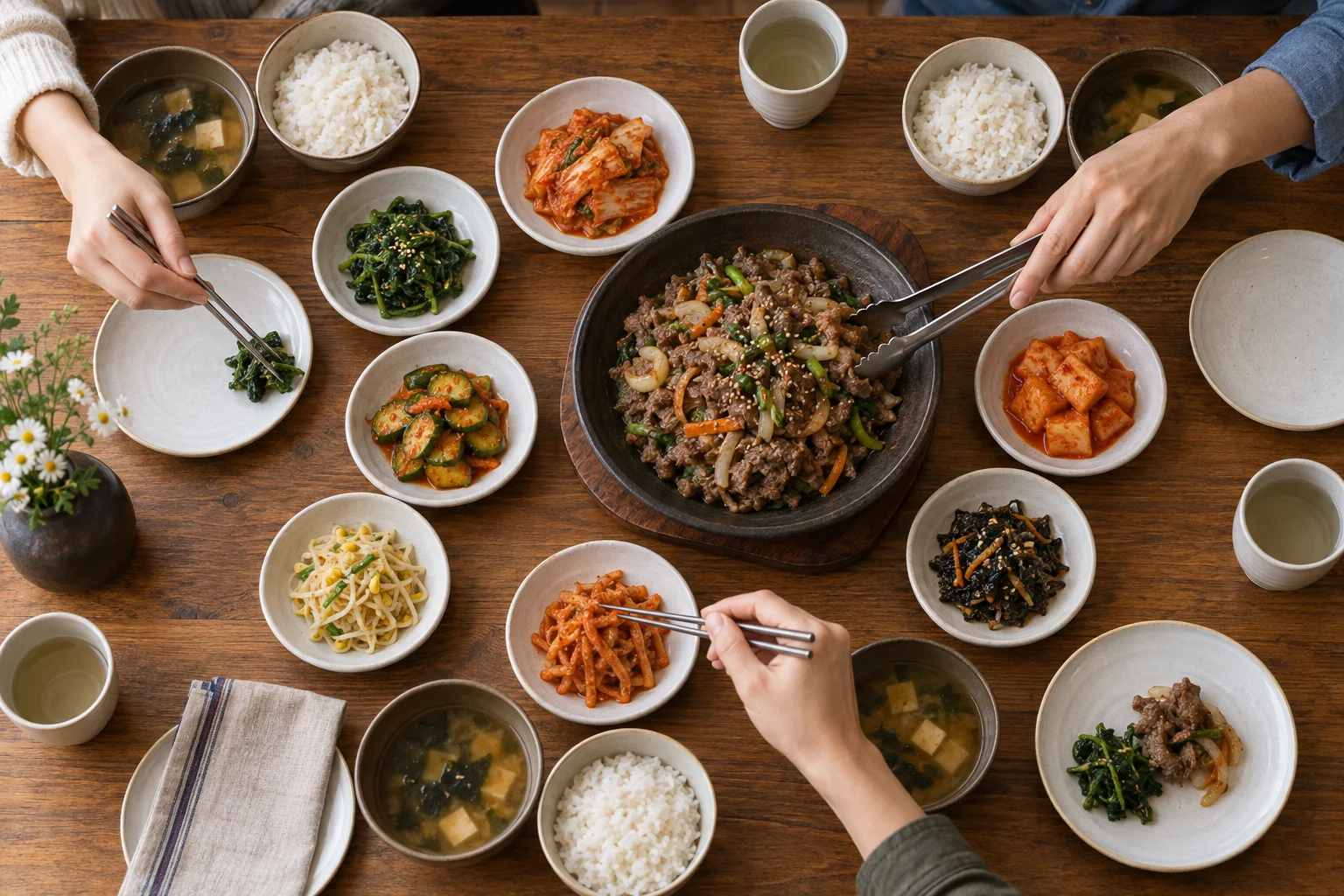
Banchan are the small side dishes placed around the table. They are part of the meal rather than a sequence of appetizers you must finish before the main dish. A typical rice-centered setting may include individual rice and soup plus kimchi, seasoned vegetables, and other shared sides. Korea Tourism Organization’s baekban guide describes rice, soup, and several side dishes as the backbone of this set-menu style.
You may alternate freely: a bite of rice, a little banchan, soup, and the main dish. There is no required tasting order. If you are unsure what a side dish is, try a small portion first. Our guide to ten Korean kimchi types helps distinguish cabbage, radish, cucumber, and watery styles without assuming every red dish has the same heat.
Share cleanly and take small amounts
When serving tongs, spoons, or ladles are provided, use them. Move a bite to your own small plate or rice bowl, then eat it with your personal utensil. If there is no serving tool, follow the table’s setup and avoid touching or sorting through food you will not take. Do not hover chopsticks over several dishes while deciding.
Take a modest first portion. Shared plates make it easy to return for more, and a smaller serving reduces waste. This matters especially with strong condiments, unfamiliar fermented foods, raw garlic, and spicy banchan. Finishing every side dish is not a condition of politeness, but ordering or repeatedly refilling far more than the table will eat is inconsiderate.
Ask before assuming a refill is free
Korea Tourism Organization says extra water and ordinary side dishes generally do not incur an extra charge at Korean restaurants. That is a useful default, not permission to treat every small plate as unlimited. A premium side, egg dish, extra meat, rice bowl, noodle portion, or menu-listed add-on may cost extra. Some businesses limit refills, and some ask customers to use a self-service bar.
Check the menu or signs, then ask 이 반찬 리필돼요? (I banchan ripil dwaeyo?, “Can this side dish be refilled?”). At a self-service bar, take only what you expect to eat and use the supplied utensils. Do not bring a used personal plate into contact with communal containers.
Understand what “shared” means
A stew pot or platter in the center may be shared, but each diner’s rice and soup bowl is normally personal. Use the common ladle when one is provided. At meals with family or close friends, people may be relaxed about personal chopsticks touching common dishes; travelers do not need to copy that intimacy. Choosing the cleaner serving method is never rude.
Shared dishes also do not mean that dietary restrictions disappear. Sauces, marinades, broths, and banchan may contain ingredients that are not visible. If an allergy is serious, ask staff directly and do not rely on another diner tasting the food first. A common spoon or grill can create cross-contact.
Spoon, Chopsticks, and Korean BBQ Manners
Korean meals commonly provide a long-handled metal spoon and metal chopsticks. Use the spoon for rice, soup, stew, mixing, and foods that are difficult to control with chopsticks. Using a spoon is not a beginner’s shortcut; Korea Tourism Organization specifically emphasizes its central place at the table.
Keep your utensils on the table or on a rest when one is provided. Do not plant chopsticks upright in a bowl of rice. Do not use chopsticks as pointers, drums, or tools for moving hot grill equipment. If metal chopsticks feel slippery, slow down, move the dish closer to your side of the table, and use the spoon when it makes sense.
Let the grill routine reveal who is cooking
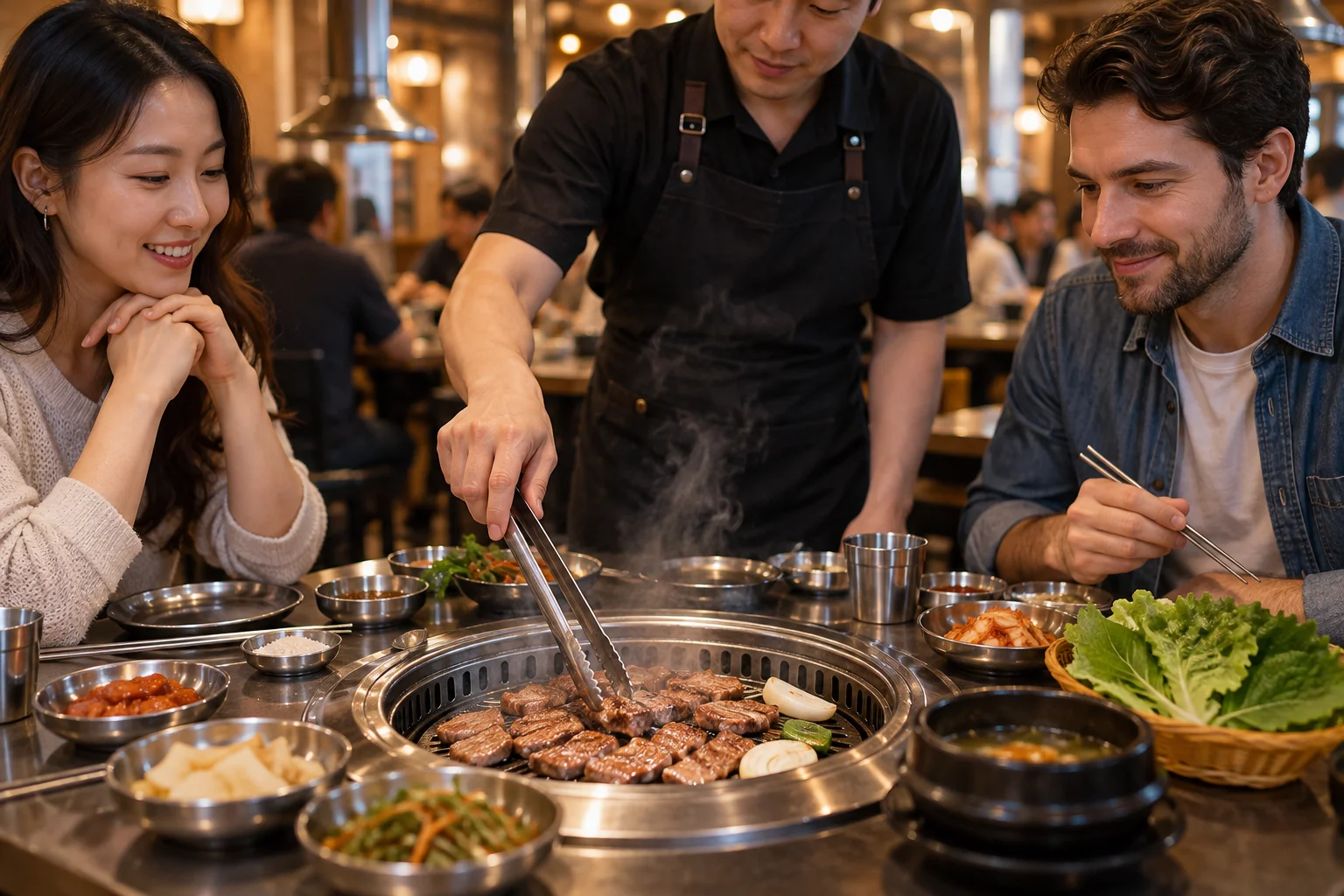
At Korean barbecue, do not seize the tongs the moment meat arrives. Watch what the server does. If staff place, turn, cut, and distribute the meat, let them manage timing and grill changes. If they place raw meat and leave the tools with your group, guests are probably expected to cook. When uncertain, ask 구워 주실 수 있어요? (“Could you grill it for us?”) if you are requesting help, or 저희가 구워요? (Jeohuiga guwoyo?, “Do we grill it ourselves?”).
Keep raw-meat tongs and scissors separate from personal chopsticks. Do not taste with a tool that touched raw meat. Use a clean utensil for cooked pieces if the restaurant provides one. Do not pour water, sauce, or soup onto a grill, and do not move hot charcoal, burners, or ventilation equipment yourself. Ask staff when heat is too high or the grill plate needs changing.
Our gochujang, doenjang, and ssamjang comparison explains the sauces that may appear around the grill. Ssamjang is usually a concentrated condiment, so start with a small dab rather than coating the whole bite.
Build a manageable ssam
Ssam is a leaf wrap, often built with lettuce or perilla leaf, a bite of meat, a little rice, and condiments. The Ministry of Culture, Sports and Tourism’s overview of Korea’s ssam tradition describes its mix of greens, food, and sauce and even notes a historical warning against overstuffing the leaf.
That warning is excellent practical advice. Make one bite that you can eat comfortably. Use tongs or chopsticks to move food to the leaf, fold it, and eat it without sauce spilling across the table. You do not have to make a wrap for every piece of meat, and you do not need to copy someone who combines many ingredients at once.
Age and hierarchy are context, not a tourist test
Traditional descriptions of Korean table manners often say to wait for the oldest person to begin. In a formal family meal or when hosts clearly pause, waiting a moment is considerate. In a casual restaurant, date, food hall, or solo meal, do not freeze while hot food cools because you are searching for a hierarchy. Follow your host if you have one; otherwise, begin when everyone is served or the group indicates it is time.
Similarly, pouring drinks with two hands can be a respectful gesture in formal company, but ordinary meals vary by relationship and setting. The dependable rule is attention: do not pressure anyone to drink, do not refill alcohol without checking, and do not assume a visitor must participate in every custom.
Calling Staff, Paying, and Tipping
In a table-service restaurant, press the call bell once or say 저기요 (jeogiyo, “excuse me”) in a normal voice. The bell may be louder than expected. Repeated pressing, snapping fingers, or waving across the room creates pressure without clarifying what you need. Prepare the request before staff reach the table.
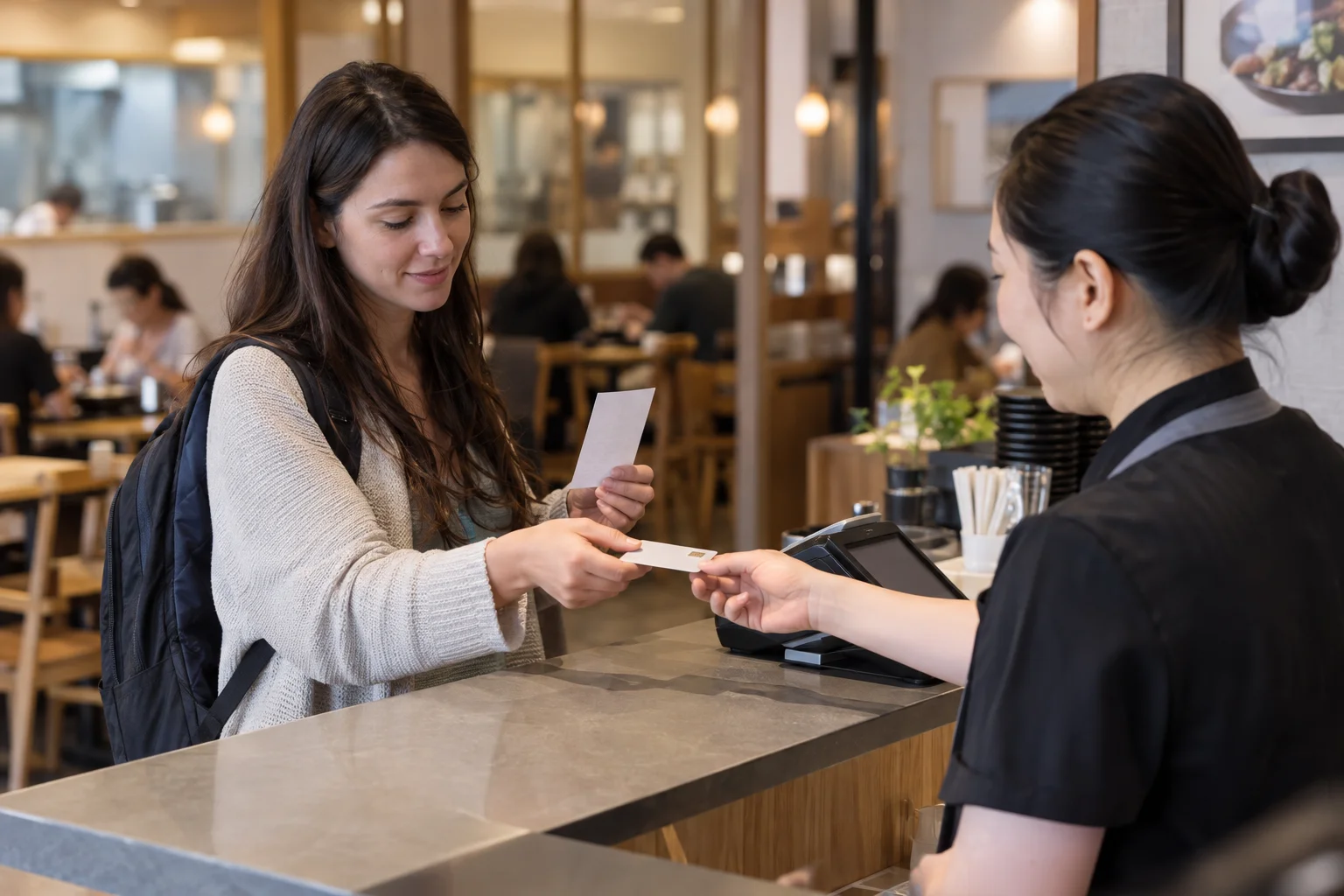
At the end of the meal, look for the payment pattern. Many casual restaurants take payment at a front counter, but some bring a terminal to the table or use a kiosk. Carry the table number, order slip, or receipt if one was provided. Ask 어디에서 계산해요? (Eodieseo gyesanhaeyo?, “Where do I pay?”) rather than waiting indefinitely for a check.
One bill is often simpler
Separate checks are not guaranteed. Ask 따로 계산할 수 있어요? (Ttaro gyesanhal su isseoyo?, “Can we pay separately?”) before presenting multiple cards. A busy restaurant or table-based order system may require a single transaction. If so, one person can pay and the group can settle privately.
Check the total against the order before tapping or inserting a card. If you need a receipt, ask 영수증 주세요 (Yeongsujeung juseyo). Keep the receipt until you are sure the payment went through and you have all belongings.
Routine tipping is not expected
Korea Tourism Organization states that tipping is not required or expected at Korean restaurants. The normal action is to pay the displayed total. Do not leave loose cash on the table; staff may think it was forgotten. A special venue with an explicit service policy is an exception, so read the bill rather than applying a universal rule from another country.
Do not confuse a no-tipping norm with permission to occupy a busy table indefinitely. When the meal is finished, the bill is paid, and people are waiting, gather your belongings and make room. For coffee shops, where seat-saving and tray-return patterns are different, use our Korean cafe etiquette guide.
Practical Tips for Solo Diners, Families, and Groups
The most useful etiquette changes with the party.
Solo diners: Choose restaurants and menu items that accept one-person orders. A table with an empty seat does not override a two-serving minimum printed on the menu. Counter seats, noodle shops, soup restaurants, gimbap shops, department-store food halls, and explicitly solo-friendly barbecue formats can be easier than large shared platters.
Families with children: Keep strollers and bags out of aisles, supervise children around burners and hot stone bowls, and move metal utensils away from table edges. Ask for a child seat rather than taking one from another table. Noise standards vary, but running between tables is unsafe in a room where staff carry boiling soup and grill plates.
Groups: Decide on portions, restrictions, and payment before ordering. Place one coordinated order, keep raw and cooked barbecue tools distinct, and do not let one diner control every shared dish. If some people do not drink alcohol, order and toast without making them explain repeatedly.
Hosted meals: Let the host guide seating, ordering, and whether the bill is shared. You can offer once to contribute without turning payment into a struggle at the register. A sincere thank-you is more useful than forcing a second transaction the restaurant cannot process.
Dietary restrictions: State concrete ingredients and cross-contact concerns. “Vegetarian,” “halal,” or “gluten-free” may not answer questions about broth, fish sauce, shared grills, or cooking oil. Use written Korean, ask staff to confirm, and choose another dish when the answer is uncertain.
Save This Guide for Your First Korean Meal
Before you enter, remember four steps: pause at the door, confirm the order, share neatly, and follow the restaurant’s payment system. Save this guide together with the phrase list, then focus on the people and food in front of you. Calm observation and one polite question will carry you through far more meals than memorizing dozens of rigid rules.