
Quick Info
- 📍 Area: Restaurants across South Korea, from counter-service shops to barbecue restaurants
- 🕒 Best time: Practice before your trip and save the phrase table offline
- 💰 Budget: Free to learn; menu prices vary by restaurant and city
- 🚇 Getting there: Use your map app, then show the Korean restaurant name or address if needed
- 👥 Best for: First-time visitors, beginner Korean learners, and diners with dietary questions
- ✅ TL;DR: Use 저기요 to get attention, point to the exact item, state the quantity, and finish requests with 주세요. For allergies, show a written Korean card and ask staff to check ingredients and shared equipment.
Ordering food is one of the fastest ways to make beginner Korean useful. You do not need a perfect sentence: a polite opener, the dish name, a quantity, and 주세요 (juseyo, “please give me”) can carry most ordinary restaurant interactions.
This guide gives you 30 practical Korean restaurant phrases for choosing a dish, changing an order, explaining an allergy, paying, and requesting takeout. The Korean and natural English meanings were checked against resources from Korea’s National Institute of Korean Language, including its official restaurant-ordering phrase sheet, on August 29, 2026. Romanization is a pronunciation bridge, not an exact sound system, so listen to native audio whenever possible.
30 Korean Restaurant Phrases at a Glance

Start with the rows that solve your most likely problem. If you can say 저기요, 이거 하나 주세요, 안 매워요?, and 계산할게요, you can already manage attention, ordering, spice, and payment. Save the Korean column as a screenshot so you can show it when pronunciation is not enough.
| # | Korean | Romanization | Natural English | Best moment |
|---|---|---|---|---|
| 1 | 저기요. | Jeogiyo. | Excuse me. | Get a server’s attention |
| 2 | 메뉴 주세요. | Menyu juseyo. | May I have a menu? | Ask for a menu |
| 3 | 주문할게요. | Jumunhalgeyo. | We’re ready to order. | Begin your order |
| 4 | 이거 하나 주세요. | Igeo hana juseyo. | One of this, please. | Point to one item |
| 5 | 이거 두 개 주세요. | Igeo du gae juseyo. | Two of this, please. | Order two portions or items |
| 6 | 뭐가 제일 인기 있어요? | Mwoga jeil ingi isseoyo? | What is most popular? | Ask for a popular choice |
| 7 | 추천해 주세요. | Chucheonhae juseyo. | Please recommend something. | Ask for a recommendation |
| 8 | 이거 매워요? | Igeo maewoyo? | Is this spicy? | Check heat level |
| 9 | 안 맵게 해 주세요. | An maepge hae juseyo. | Please make it not spicy. | Request no heat if possible |
| 10 | 덜 맵게 해 주세요. | Deol maepge hae juseyo. | Please make it less spicy. | Request less heat |
| 11 | 고추장 빼 주세요. | Gochujang ppae juseyo. | Please leave out the gochujang. | Remove a separate sauce |
| 12 | 소스는 따로 주세요. | Soseuneun ttaro juseyo. | Sauce on the side, please. | Keep sauce separate |
| 13 | 밥 하나 추가해 주세요. | Bap hana chugahae juseyo. | Please add one bowl of rice. | Add rice |
| 14 | 물 좀 주세요. | Mul jom juseyo. | Some water, please. | Ask for water |
| 15 | 앞접시 주세요. | Apjeopsi juseyo. | A small plate, please. | Ask for a sharing plate |
| 16 | 반찬 더 주세요. | Banchan deo juseyo. | More side dishes, please. | Request a refill where offered |
| 17 | 알레르기가 있어요. | Alleoreugiga isseoyo. | I have an allergy. | Start an allergy conversation |
| 18 | 땅콩 알레르기가 있어요. | Ttangkong alleoreugiga isseoyo. | I have a peanut allergy. | Name a peanut allergy |
| 19 | 이거에 우유가 들어가요? | Igeoe uyuga deureogayo? | Does this contain milk? | Ask about an ingredient |
| 20 | 땅콩을 완전히 피해야 해요. | Ttangkong-eul wanjeonhi pihaeya haeyo. | I must completely avoid peanuts. | State strict avoidance |
| 21 | 같은 조리 기구를 사용해요? | Gateun jori gigureul sayonghaeyo? | Do you use the same cooking utensils? | Ask about shared equipment |
| 22 | 채식 메뉴 있어요? | Chaesik menyu isseoyo? | Do you have a vegetarian menu? | Ask for vegetarian choices |
| 23 | 고기 안 들어간 메뉴 있어요? | Gogi an deureogan menyu isseoyo? | Is there a dish without meat? | Ask about meat-free dishes |
| 24 | 돼지고기 안 먹어요. | Dwaejigogi an meogeoyo. | I do not eat pork. | State a pork restriction |
| 25 | 계산할게요. | Gyesanhalgeyo. | I’d like to pay. | Ask for the bill or go to pay |
| 26 | 카드 돼요? | Kadeu dwaeyo? | Can I pay by card? | Confirm card payment |
| 27 | 영수증 주세요. | Yeongsujeung juseyo. | A receipt, please. | Request a receipt |
| 28 | 따로 계산할 수 있어요? | Ttaro gyesanhal su isseoyo? | Can we pay separately? | Ask to split payment |
| 29 | 포장해 주세요. | Pojanghae juseyo. | Please make it to go. | Order takeout |
| 30 | 남은 음식 포장해 주세요. | Nameun eumsik pojanghae juseyo. | Please pack the leftovers. | Ask about taking leftovers |
Two polite building blocks appear repeatedly. 좀 (jom) softens a request, while 주세요 turns a noun or action into a practical “please.” In a noisy room, point first and speak second. The visual context prevents a correct phrase from being attached to the wrong dish.
How to Order and Change a Dish
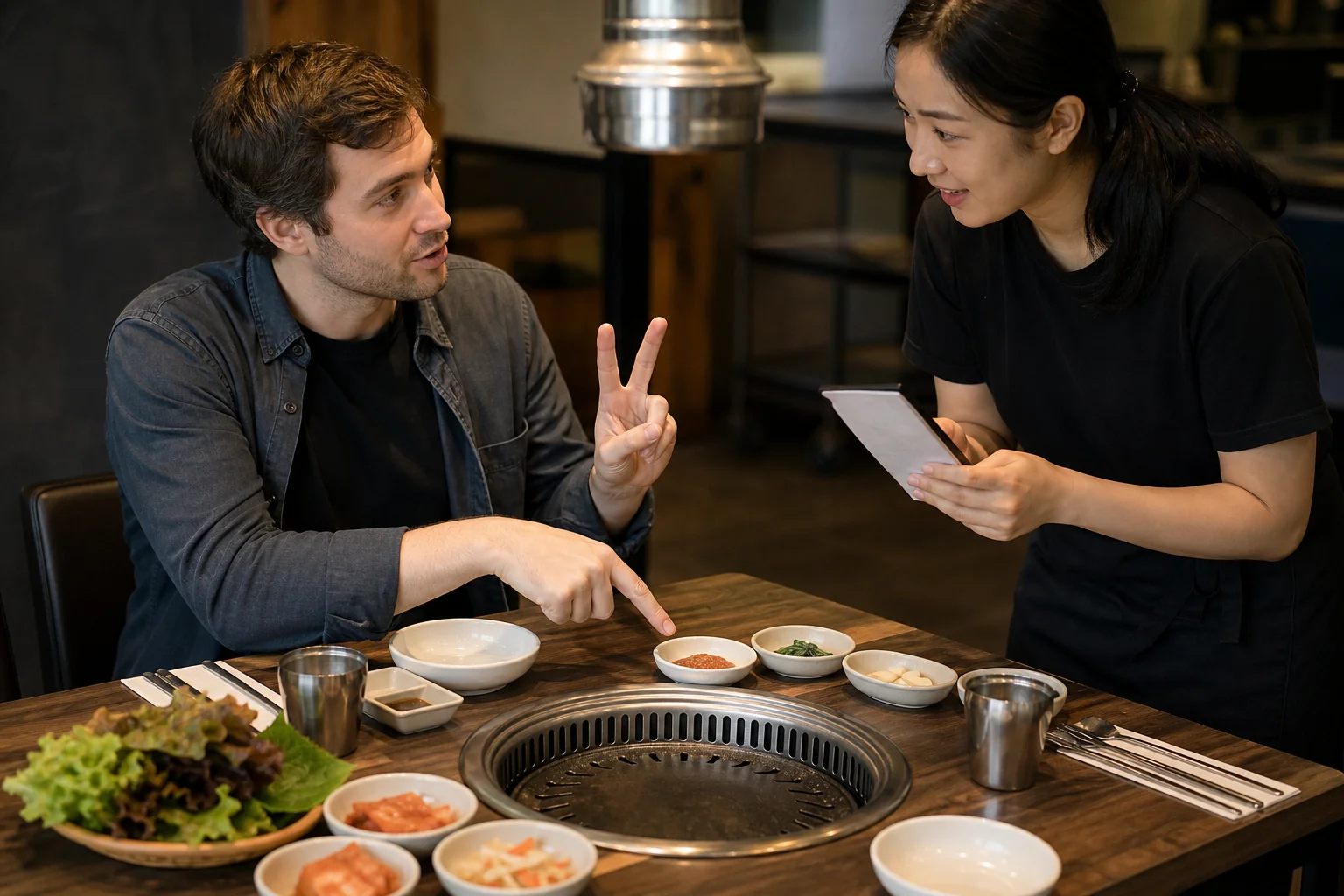
At the table, get attention with 저기요 rather than calling a person by an English title. Some restaurants have a call button, and some expect customers to order at a kiosk or counter. Korea Tourism Organization’s current Korean restaurant overview notes the mix of call bells, self-service water and banchan stations, table drawers, and unmanned ordering machines. Look for the system the restaurant is already using before waving.
When staff arrive, 주문할게요 means you are ready. Point to the exact menu item and say 이거 하나 주세요. Change 하나 (hana, one) to 두 개 (du gae, two items) when appropriate. Portion rules differ: a barbecue menu may require a minimum number of servings, while a bowl of soup is usually ordered per person. Confirm the menu’s unit instead of assuming that “two” means two plates.
A reusable order pattern
Use this sequence:
- 저기요. 주문할게요. — Excuse me. We’re ready to order.
- Point to the exact line or photo.
- 이거 두 개 주세요. — Two of this, please.
- Add one change: 소스는 따로 주세요. — Sauce on the side, please.
- Listen for a confirmation and check the quantity shown on the order screen or repeated by the server.
Do not stack five changes into one fast sentence. Ask for the main item and quantity first, then make one short request. If you are choosing among fermented sauces, our gochujang, doenjang, and ssamjang guide explains how their flavors and common uses differ.
Asking about spice without making promises impossible
이거 매워요? asks whether a dish is spicy. The answer is subjective, so follow with a concrete request. 덜 맵게 해 주세요 asks for less heat; 안 맵게 해 주세요 asks for no heat. Neither guarantees that the kitchen can change a premixed broth, marinated meat, kimchi dish, or prepared sauce.
If the server says 안 돼요 (an dwaeyo, “it isn’t possible”), choose another item rather than repeating the request. For bibimbap, 고추장 빼 주세요 may be easy because the paste can be served separately. For a stew whose seasoning is already in the base, “no spice” may change the dish fundamentally or be unavailable.
Asking for water, plates, and banchan
At many restaurants, water, utensils, or extra side dishes are self-service. Check the table drawer and nearby self-service station before calling staff. 반찬 더 주세요 is polite where refills are offered, but not every special side dish is unlimited or free. Korea Tourism Organization describes ordinary water and banchan refills as a common practice, yet posted restaurant rules and staff instructions always take priority.
For more counter-ordering language and the difference between dine-in and takeout routines, see our Korean cafe etiquette guide.
How to Explain Allergies and Dietary Needs
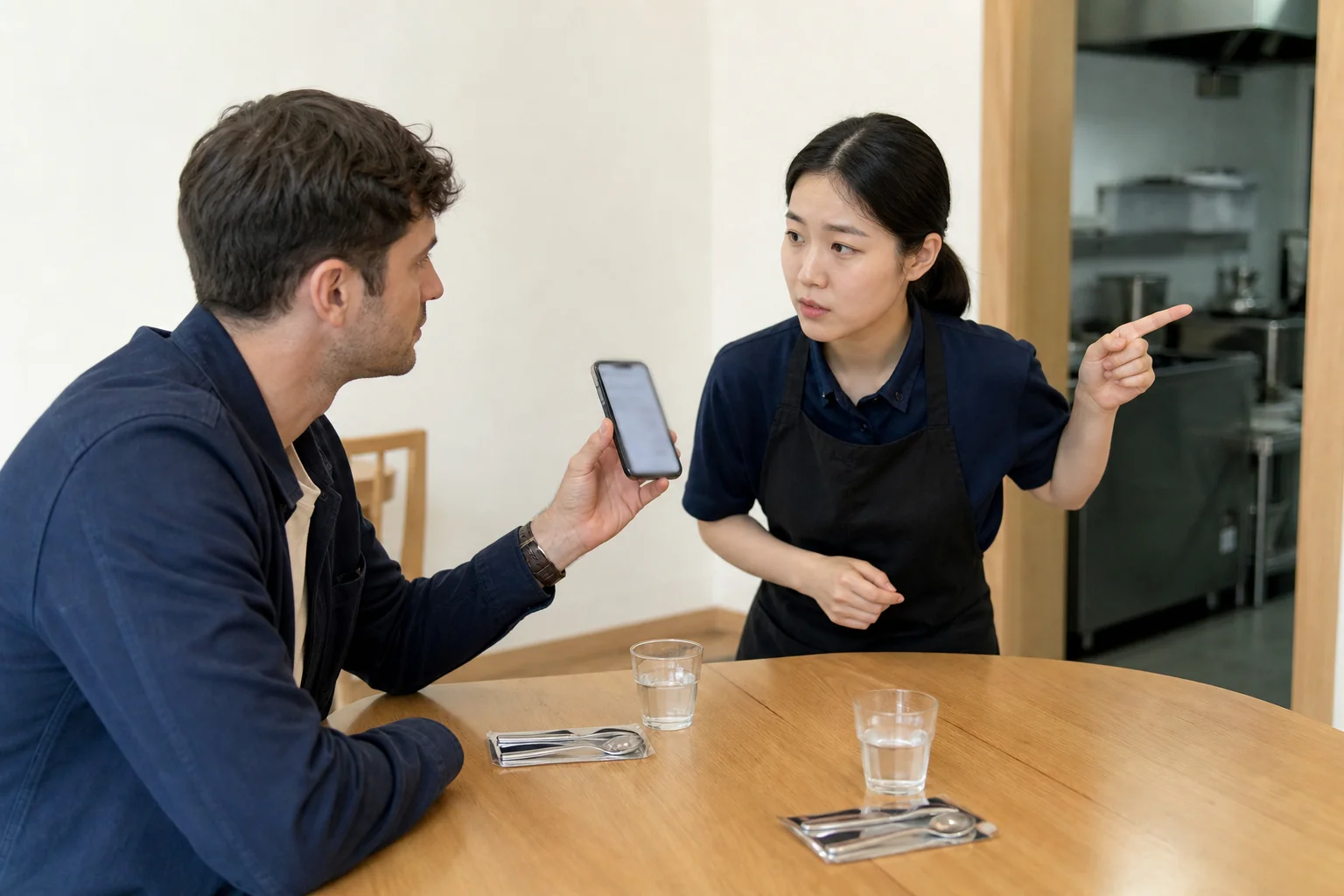
For a medical food allergy, speaking one memorized sentence is not enough. Say 알레르기가 있어요, show a professionally translated Korean allergy card, name every ingredient you must avoid, and ask about broth, sauces, marinades, garnishes, and shared equipment. If staff cannot confirm, do not eat the uncertain dish.
The Ministry of Food and Drug Safety’s current food-labeling overview lists allergens that require declaration in covered packaged foods and explains mixture warnings for shared manufacturing processes. The agency also published a restaurant-focused food-allergy prevention resource. These sources are helpful context, but a package label does not tell you everything about a restaurant recipe or cross-contact. Rules can also apply differently by business type, so never assume every independent restaurant displays a complete allergen matrix.
Swap the ingredient in the pattern
Use [ingredient] 알레르기가 있어요 for “I have a [ingredient] allergy.” Useful ingredient words include:
| English | Korean | Romanization |
|---|---|---|
| Peanuts | 땅콩 | ttangkong |
| Tree nuts / nuts | 견과류 | gyeongwaryu |
| Milk | 우유 | uyu |
| Eggs | 계란 / 달걀 | gyeran / dalgyal |
| Wheat | 밀 | mil |
| Soybeans | 대두 / 콩 | daedu / kong |
| Sesame | 참깨 | chamkkae |
| Shrimp | 새우 | saeu |
| Crab | 게 | ge |
| Shellfish | 조개류 | jogaeryu |
Then ask 이거에 [ingredient]가 들어가요? (“Does this contain [ingredient]?”). Korean particles change after some nouns, but staff will understand the ingredient plus 들어가요? when you also show the written word. Clarity matters more than improvising perfect grammar.
Allergy is different from preference
안 먹어요 means “I don’t eat it”; it does not automatically communicate medical risk. For severe allergy, include 알레르기 and a clear statement such as 완전히 피해야 해요 (“I must completely avoid it”). Ask 같은 조리 기구를 사용해요? about shared utensils or equipment. A shared grill, fryer, pot, knife, cutting board, or sauce container can matter even when the ingredient is not visible in the final dish.
Vegetarian, vegan, halal, and gluten-free needs also require detail. 고기 안 들어간 메뉴 asks for a dish without meat, but broth, fish sauce, anchovy stock, egg, dairy, or shared cooking surfaces may still be involved. State the ingredients you avoid rather than relying only on a broad label. If a restriction is medically serious and communication remains uncertain, choose a restaurant that documents ingredients or contact it before visiting.
Paying, Receipts, Takeout, and Leftovers
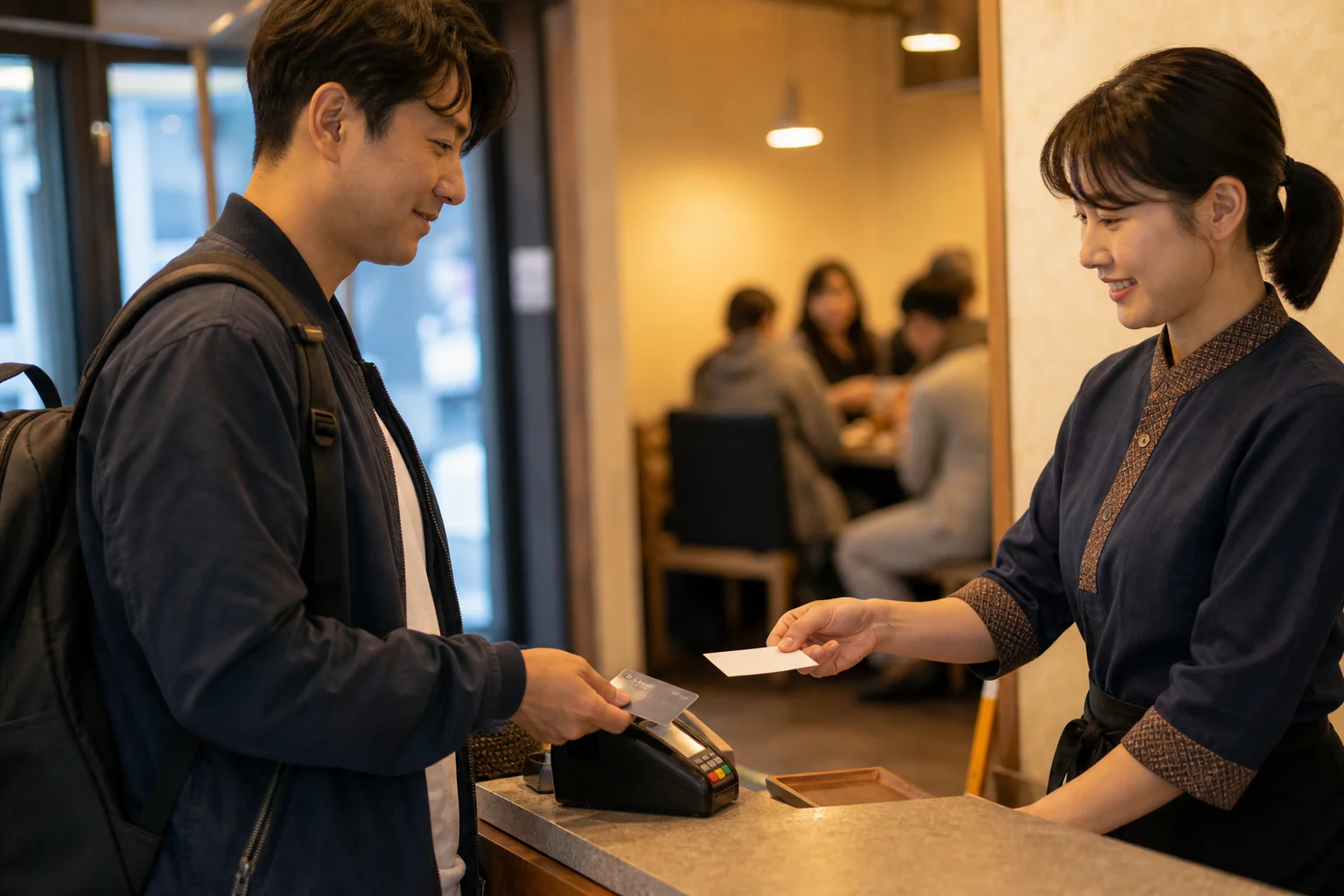
In many Korean restaurants, you pay at the front counter after eating rather than waiting for a bill at the table. Bring the table number or order slip if one was provided. Say 계산할게요 as you approach the register. If you are unsure about payment, 카드 돼요? is a short way to ask whether cards are accepted.
Routine tipping is not generally expected at Korean restaurant counters, according to Korea Tourism Organization. Pay the displayed total unless the business clearly operates another system. Do not add a tip by leaving loose cash on the table where it could be mistaken for forgotten money.
Separate payment may not be available
따로 계산할 수 있어요? asks whether the group can pay separately. Ask before several people present cards. A busy restaurant or single-table order system may require one payment. If so, one person can pay and the group can settle privately afterward.
Ask 영수증 주세요 if you need a receipt. For takeout, 포장해 주세요 works when ordering. After dining, 남은 음식 포장해 주세요 asks whether leftovers can be packed, but the answer depends on the food and restaurant. Raw barbecue meat, buffet items, delicate dishes, and foods with storage risks may not be eligible. Once food leaves the restaurant, refrigerate it promptly and follow safe handling rather than carrying it for hours.
Restaurant Manners That Make the Phrases Work
Polite Korean works best when your behavior supplies the rest of the message. Our Korean restaurant etiquette guide explains banchan, shared dishes, barbecue tools, payment, and tipping in more detail. Keep these habits simple:
- Wait to be seated when the entrance has a queue system. Some shops use a kiosk, a written list, or a host. Do not take an empty table until you understand the process.
- Use the call bell once. It may sound loud. Pressing repeatedly does not make service faster.
- Check for self-service signs and stations. Water, napkins, utensils, or banchan may be nearby. If you cannot read the sign, watch what other diners do or ask 셀프예요? (Selpeuyeyo?, “Is it self-service?”).
- Share banchan neatly. Use serving utensils when provided and avoid hovering personal chopsticks over a shared dish.
- Follow grill instructions. Staff may cook the meat, replace the grill plate, or tell you when it is ready. Ask 지금 먹어도 돼요? (Jigeum meogeodo dwaeyo?, “Can we eat it now?”) if uncertain.
- Keep requests short during a rush. Point, say one sentence, and confirm. A long translation-app paragraph can be harder to process than two precise questions.
- Pay where the restaurant expects. Watch whether other guests go to the counter or scan a table code. When unsure, ask 어디에서 계산해요? (Eodieseo gyesanhaeyo?, “Where do I pay?”).
Korean meals often arrive as a main dish surrounded by several small plates. The tourism board’s guide to the Korean meal table explains the role of rice, soup, kimchi, and banchan. Understanding that layout helps you avoid treating every small dish as a separately ordered appetizer.
Three Mini-Dialogues You Can Reuse
These fictional practice exchanges combine the phrase table into realistic sequences. Replace the dish or ingredient while keeping the structure.
Ordering one dish with less spice
Traveler: 저기요. 주문할게요.
Jeogiyo. Jumunhalgeyo.
Excuse me. We’re ready to order.
Traveler: 이거 하나 주세요. 덜 맵게 해 주세요.
Igeo hana juseyo. Deol maepge hae juseyo.
One of this, please. Please make it less spicy.
Server: 네, 확인해 볼게요.
Ne, hwaginhae bolgeyo.
Okay, I’ll check.
The server has not promised the change; they have promised to check. Wait for the final confirmation.
Checking a milk allergy
Traveler: 우유 알레르기가 있어요.
Uyu alleoreugiga isseoyo.
I have a milk allergy.
Traveler: 이거에 우유가 들어가요?
Igeoe uyuga deureogayo?
Does this contain milk?
Traveler: 같은 조리 기구를 사용해요?
Gateun jori gigureul sayonghaeyo?
Do you use the same cooking utensils?
Show the same questions in written Korean. If the answer is uncertain, select something else; politeness never requires accepting risk.
Paying and requesting a receipt
Traveler: 계산할게요. 카드 돼요?
Gyesanhalgeyo. Kadeu dwaeyo?
I’d like to pay. Can I pay by card?
Cashier: 네.
Ne.
Yes.
Traveler: 영수증 주세요. 감사합니다.
Yeongsujeung juseyo. Gamsahamnida.
A receipt, please. Thank you.
Pronunciation and Communication Tips
Do not chase perfect romanization in a noisy restaurant. Use it to remember the rhythm, then rely on the Hangul text for precision.
The polite ending -요 is often the most audible part of a question. Keep it light rather than stretching it. In 주세요, the first syllable sounds closer to ju than English “jew,” and the final 요 is a short yo. In 매워요 (maewoyo, spicy), the vowels flow together; native audio is more useful than spelling the word with extra English syllables.
Numbers can create the costliest misunderstanding. Pair the spoken quantity with your fingers, but remember that gestures are supporting evidence, not a replacement for checking the order screen or repeated quantity. If the total seems wrong, say 이거 두 개 맞아요? (Igeo du gae majayo?, “Is this correctly two?”) while pointing to the item.
For the same point-and-confirm method on buses and subways, save our Korean transit phrase guide before your trip.
Practice Before Your Next Meal
Choose five phrases from the table: one for attention, one for quantity, one for spice or ingredients, one for payment, and one backup question. Save the Hangul, say each phrase aloud three times, and keep the page offline. That small routine is enough to turn your first restaurant order from a guessing game into a clear, polite exchange.