
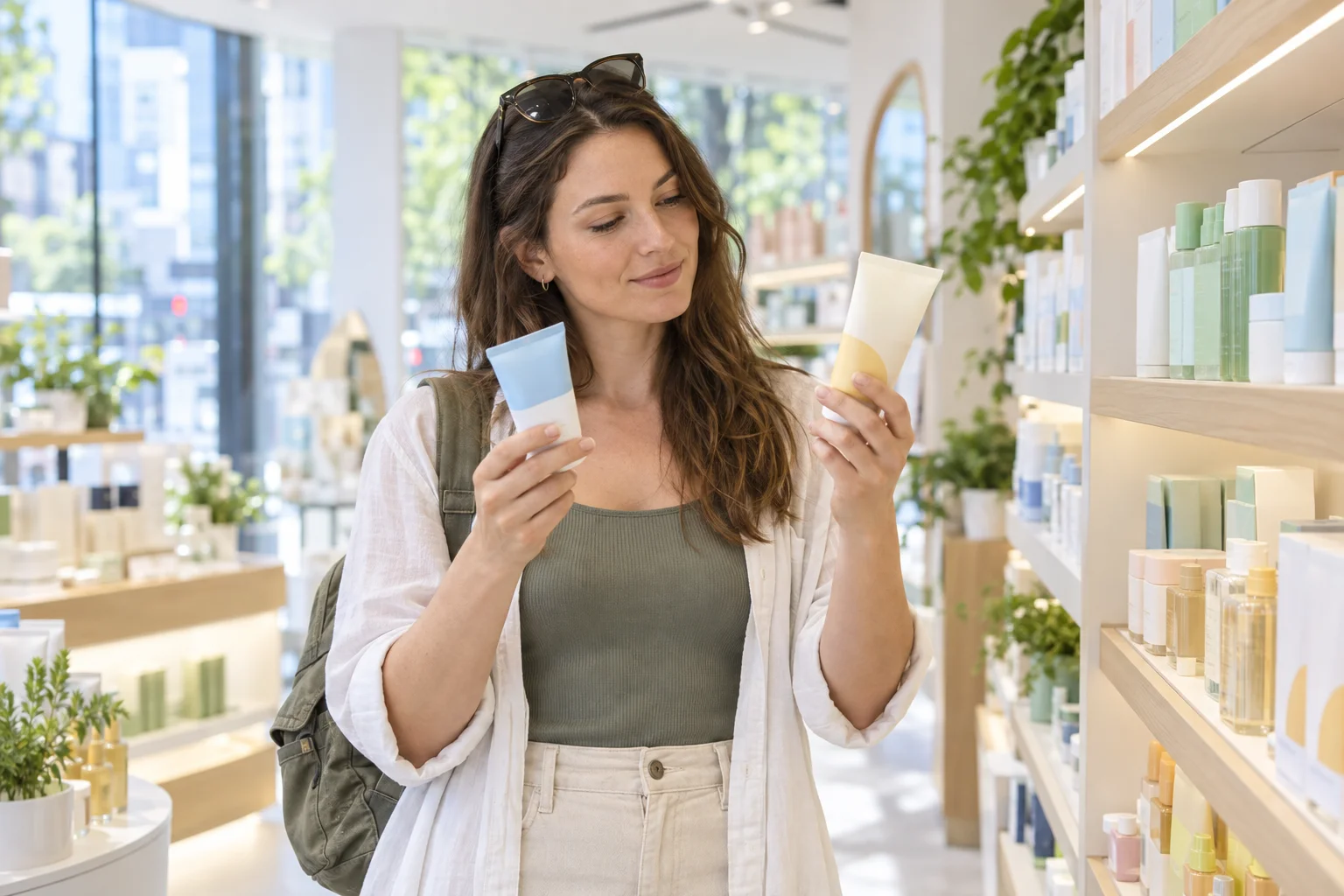
Quick Info
- 📍 Area: Korean health-and-beauty stores, brand shops, duty-free stores, and authorized online retailers
- 🕒 Best time: Buy early enough to test the finish before a long outdoor day; recheck promotions on the day you shop
- 💰 Budget: Official global listings checked September 9, 2026 showed selected 50 ml creams around US$15 on sale and sticks around US$17–29
- 🚇 Getting there: Large Seoul branches make texture and format comparisons easier; check official store finders for current locations and hours
- 👥 Best for: Travelers, first-time K-beauty shoppers, makeup wearers, and anyone confused by SPF, PA, cream, serum, or stick labels
- ✅ TL;DR: Choose tested SPF/PA protection and a texture you will apply generously; treat sticks as convenient reapplication tools, not automatic full-coverage shortcuts.
Korean sunscreen shopping looks simple until one shelf presents watery sun serums, soft-finish creams, mineral formulas, tone-up tints, sticks, cushions, and multipacks at the same time. The most viral option is not automatically the best option for your skin, your destination, or the way you actually reapply.
This guide was researched on September 9, 2026 using current Ministry of Food and Drug Safety (MFDS), U.S. Food and Drug Administration (FDA), American Academy of Dermatology (AAD), and official Olive Young Global pages. Prices, discounts, gifts, availability, formulas, and shipping regions can change without notice. Product examples are dated comparison points, not personal endorsements or promises of future prices. If you have a diagnosed skin condition, known sunscreen allergy, or a reaction that persists, ask a qualified healthcare professional rather than relying on a shopping guide.
Decode Korean Sunscreen Labels: SPF, PA, and Functional Cosmetics
Start with the protection label, not the product nickname. SPF mainly expresses tested protection against UVB, the ultraviolet radiation most closely associated with sunburn. It is not a timer. SPF 50 does not mean you can remain in the sun fifty times longer without reapplying, because exposure changes with time of day, location, weather, reflection, sweat, and how much product you applied.
Korean sunscreen labels also commonly show PA, a grading system for UVA protection. MFDS explains that PA+, PA++, PA+++, and PA++++ represent increasing UVA protection. Under Korea’s four-grade scale, PA++++ corresponds to a UVA protection factor of 16 or higher. SPF and PA therefore answer related but different questions: look at both rather than treating a large SPF number as the entire story.
In Korea, products that help protect skin from ultraviolet rays are regulated as functional cosmetics. The MFDS English functional cosmetics overview says responsible sellers must undergo evaluation or submit a report and lists SPF, waterproof SPF, and UVA protection factor data among the supporting materials. On a Korean-market package, look for the Korean functional-cosmetic wording, 기능성화장품, plus the SPF and PA claims for the exact product.
There is also a timely regulatory detail. In August 2026, MFDS published a proposed amendment on sunscreen claim substantiation that would add internationally recognized non-human test data as acceptable support for SPF and PA advertising claims. As of this article’s September 9 review date, that page is an administrative proposal, not a reason to assume every package or test process has already changed. The practical shopper rule remains the same: rely on the protection claims printed for the exact market product, not a reposted image or a similar-looking tube.
| Label or phrase | What it tells you | What it does not tell you |
|---|---|---|
| SPF 30, SPF 50, or SPF 50+ | Tested sunburn protection, primarily associated with UVB | How many hours you can stay outside without reapplying |
| PA+ through PA++++ | Increasing tested UVA protection under the PA system | Texture, eye comfort, white cast, or water resistance |
| 기능성화장품 | The Korean-market product is presented within the functional-cosmetics framework | That the product will suit every skin type |
| Water resistant | The product has a defined tested resistance claim under the rules of its sales market | Waterproof, all-day protection |
| Tone-up | A visible brightening, correcting, or tinted cosmetic finish | Better UV protection than a non-tinted product with the same tested claims |
For daily selection, the AAD recommends a broad-spectrum, water-resistant sunscreen with SPF 30 or higher. Korean PA and U.S. “broad spectrum” are not identical label formats, so do not mechanically translate one into the other. When buying for use outside Korea, read the label on the version legally sold in your destination.
Choose by Filter Type and Finish, Not by “Best” Lists
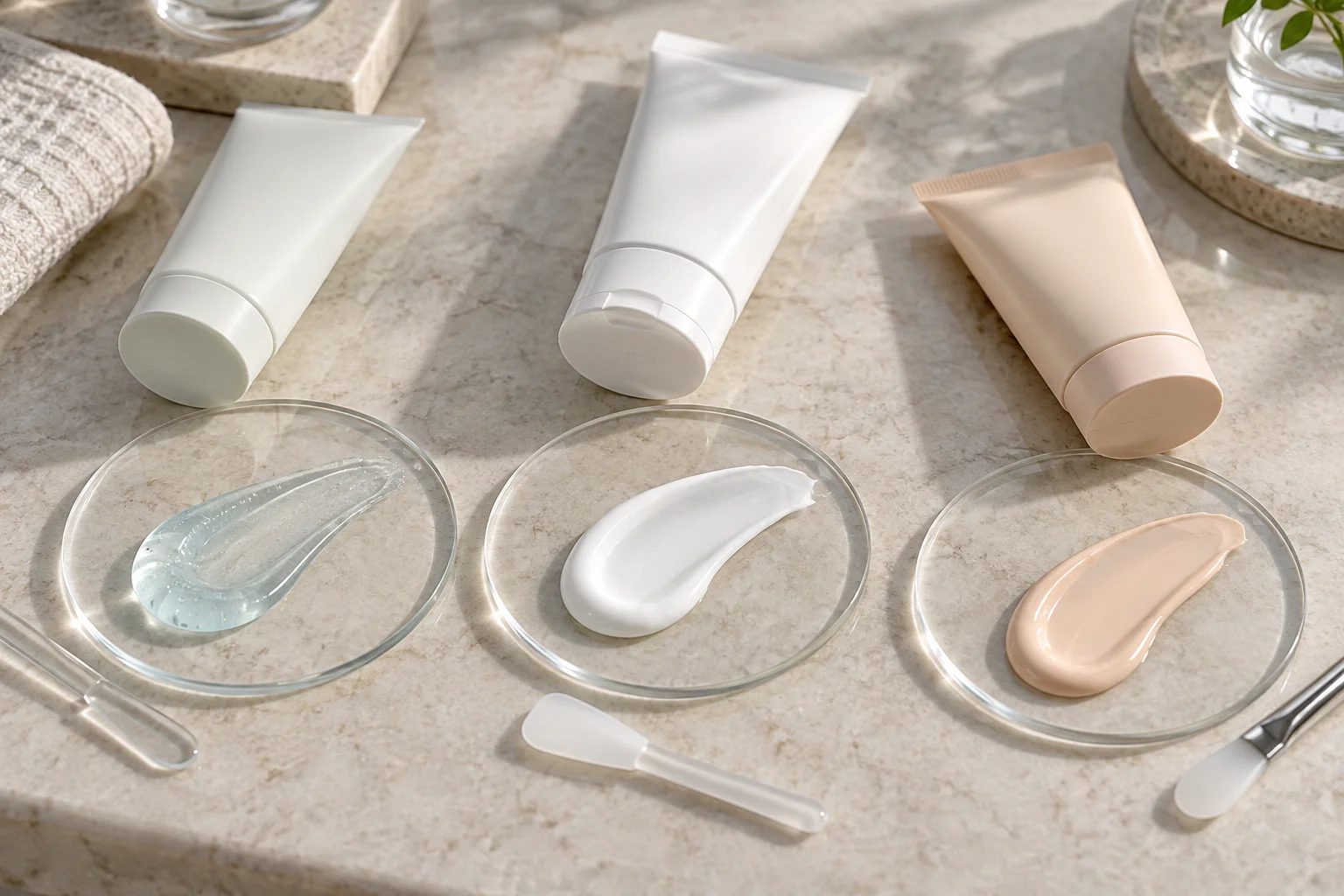
Shoppers often divide sunscreen into mineral, organic or chemical, and hybrid formulas. A mineral sunscreen uses zinc oxide, titanium dioxide, or both as its sunscreen actives. A chemical sunscreen uses other UV filters, while a hybrid combines types. The AAD’s sunscreen label guide notes that all can work when the product supplies appropriate broad protection and is used correctly; mineral formulas are often suggested for people with sensitive skin.
That classification is useful, but the complete formula matters. Fragrance, alcohol, emollients, film formers, tint, powder, and inactive ingredients can affect comfort as much as the filter family. A mineral formula can still sting or feel dry. A lightweight chemical formula can still leave shine. “Hybrid” does not guarantee a perfect compromise.
Use finish as a second decision filter:
- Watery serum or essence finish: Often comfortable for normal, combination, or dehydrated skin and easy under makeup. The trade-off can be shine, eye migration, or uncertainty about whether you used enough because the product spreads so thinly.
- Moisturizing cream finish: Useful when skin feels dry or tight. Under a rich moisturizer or humid weather, it may feel heavier than expected.
- Matte or sebum-control finish: Convenient for oily skin and hot days. Powdery formulas can emphasize flakes or pill over layered skincare.
- Tone-up or tinted finish: Can visibly correct dullness or reduce the appearance of a white cast when the shade works. A single pink, peach, or beige tone will not match every complexion.
- Mineral “mild” finish: May appeal to sensitive-skin shoppers, but test the cast and dryness in daylight. “Mild” is not a universal guarantee against irritation.
If you wear makeup, test compatibility before your most photographed day. Apply your normal morning skincare, allow each layer to settle, apply a measured and even sunscreen layer, then add base makeup. Pilling may come from the combination or application technique, not necessarily a defective sunscreen. Our cushion vs foundation guide explains how Korean base formats differ once the sunscreen layer is in place.
For acne-prone skin, start with texture and tolerance rather than chasing “non-comedogenic” marketing alone. Change one item at a time so you can identify the cause of stinging, clogged-feeling skin, or a rash. The K-beauty acne routine guide has a simpler routine framework that avoids stacking multiple unfamiliar actives around a new sunscreen.
Cream, Sun Stick, Cushion, or Spray: Pick the Right Job
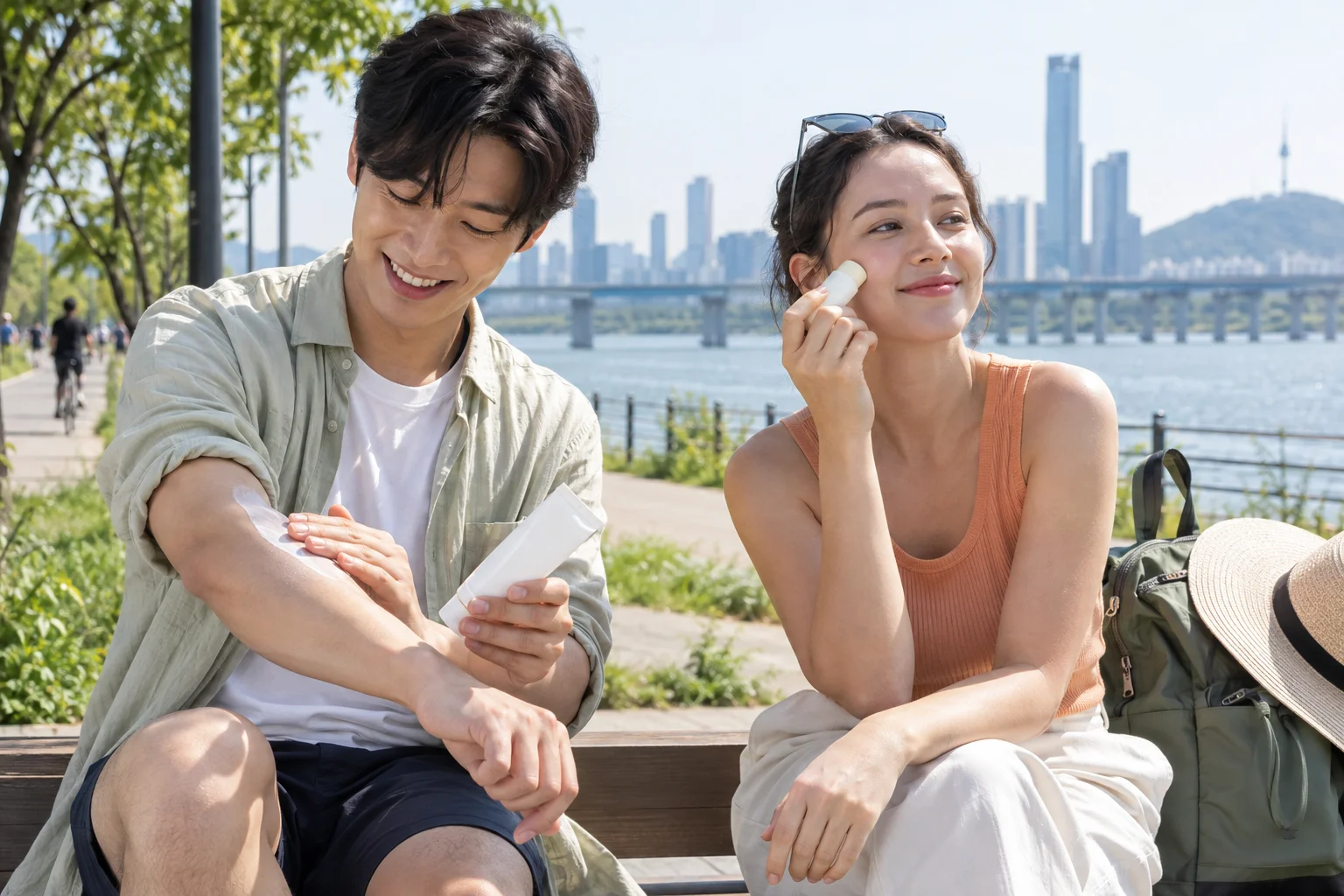
A sunscreen format is an application tool. It does not override the tested protection claim or the directions on the package.
Creams, lotions, fluids, and sun serums are the easiest formats for seeing and spreading a continuous first layer. They work well for the face, neck, ears, and exposed body areas when you use enough. A runny texture requires attention around the eyes and hairline; a thick cream requires patient blending.
Sun sticks are tidy and portable. They are useful around the cheekbones, forehead, ears, or other accessible areas during the day, especially when hands are not perfectly clean. Their weakness is coverage uncertainty. A quick single swipe can skip skin or leave a much thinner film than the product’s test application. Follow the exact stick directions and use overlapping passes rather than assuming one invisible glide equals a full liquid application.
Sun cushions make face touch-ups convenient and can reduce the mess of pressing liquid sunscreen over makeup. The puff, mesh, and compact must stay clean, and even coverage can be difficult to judge. A sun cushion is not the same thing as a foundation cushion that happens to display an SPF claim; makeup applied sparingly may not deliver the protection implied by its laboratory label.
Sprays and mists can help with large or hard-to-reach body areas, but wind, inhalation risk, and uneven application complicate use. Follow the package directions, avoid spraying toward the face, and rub in when instructed. A refreshing face mist with a sun-care theme is not automatically a complete sunscreen application.
| Situation | Strong starting format | Useful backup | Main watch-out |
|---|---|---|---|
| Ordinary city day | Cream, lotion, fluid, or serum | Stick or cushion for a careful touch-up | Applying a beautiful texture too thinly |
| Beach, hiking, outdoor sports | Water-resistant face and body product | Portable tube or stick used as directed | Mistaking “water resistant” for waterproof |
| Dry winter skin | Moisturizing cream | Balm-like stick on small exposed areas | Heavy layering and pilling |
| Humid Seoul summer | Lightweight fluid or gel-cream | Matte stick for selected touch-ups | Sweat, wiping, and missed reapplication |
| Makeup day | Compatible fluid or cream beneath makeup | Cushion or carefully pressed touch-up method | Relying on foundation SPF alone |
The best everyday choice is usually the format you can apply evenly, tolerate around your eyes, and carry for the conditions you face. Many shoppers sensibly buy one primary tube and one portable reapplication format instead of a five-product “sun care wardrobe.”
Korean Sunscreen Prices and Where to Buy in September 2026
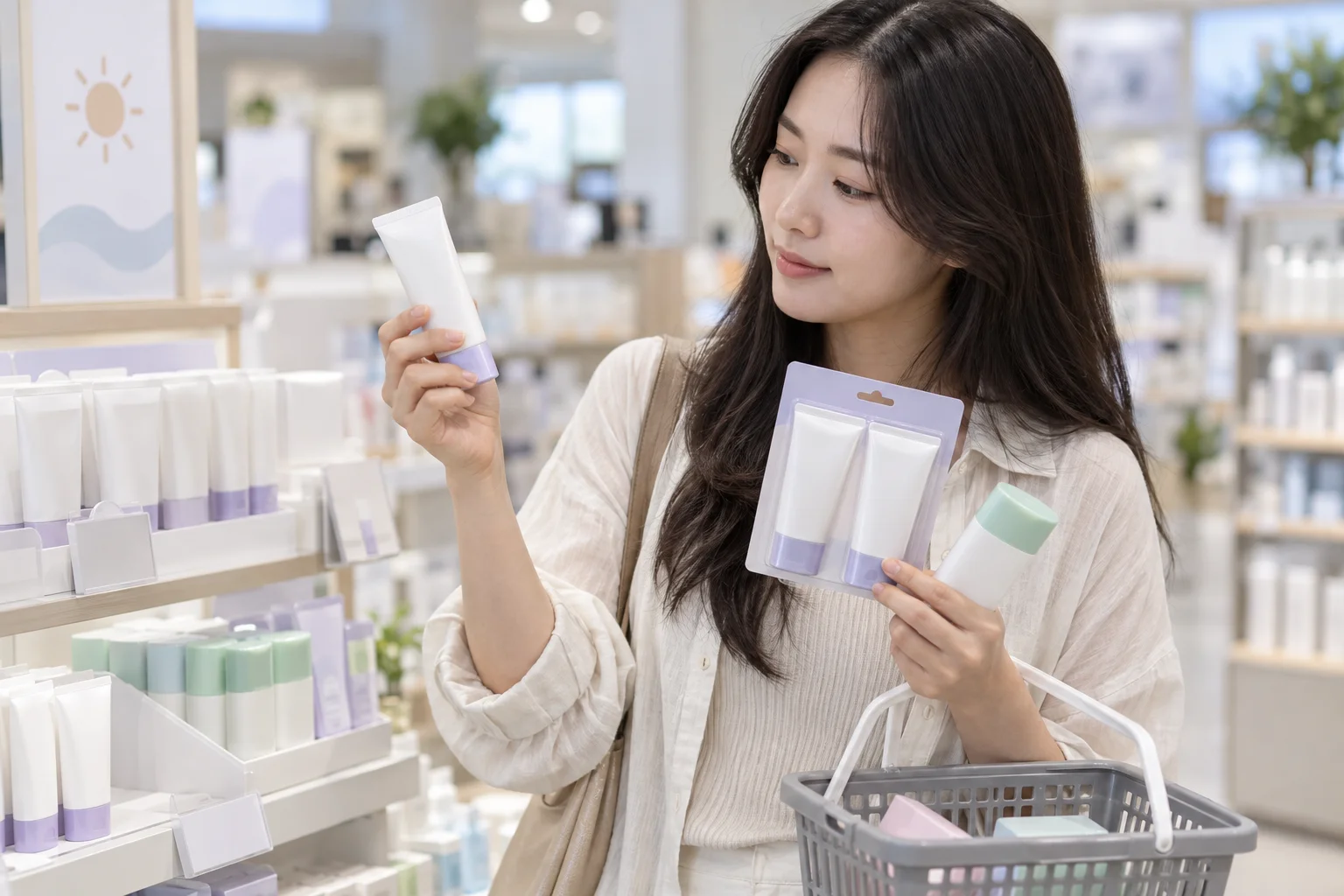
Compare sunscreen by usable amount and delivered price, not by the largest discount badge. A twin pack can be good value when you already know the formula; it can be wasteful when you have never tested the finish. Sticks are often smaller by weight than creams are by volume, and the two formats perform different jobs, so a raw package price is not a complete comparison.
The following examples were visible on official Olive Young Global pages on September 9, 2026. They use the site’s displayed U.S.-dollar setting and exclude shipping, import tax, card conversion, coupons not already reflected, and gifts. Olive Young Global currently states that it does not ship to the 50 U.S. states or Washington, D.C.; treat these as international retailer snapshots rather than universal purchase links.
| Official listing snapshot | Size shown | Regular price shown | Sale price shown | Approx. sale unit price | Practical lesson |
|---|---|---|---|---|---|
| Beauty of Joseon Relief Sun Rice + Probiotics | 50 ml single | US$18.00 | US$14.99 | US$14.99 per tube | A single lowers commitment when testing the finish |
| Beauty of Joseon Relief Sun Rice + Probiotics | 50 ml × 2 | US$30.00 | US$25.47 | US$12.74 per tube | The twin saved about US$2.25 per tube at this snapshot |
| OBgE Pore Zero Oil Control Sun Stick | 18 g | US$23.00 | US$17.38 | US$17.38 per stick | A portable stick may cost more than a sale cream |
| Cell Fusion C Stick Sunscreen 100 | 19 g | US$29.00 | No lower price shown | US$29.00 per stick | Similar formats can sit in very different price tiers |
| Cell Fusion C Advanced Clear Sunscreen 100 twin pack | 35 ml × 2 | US$33.00 | No lower price shown | US$16.50 per tube | Pack size and milliliters matter when comparing “two packs” |
The Beauty of Joseon figures appear on the official retailer’s brand page; the OBgE and Cell Fusion C examples appear on their official Olive Young Global brand pages. Reopen the listing before buying. A temporary set, character edition, gift, or coupon can change the best-value calculation within days.
In Korea, large health-and-beauty stores are the easiest place to compare textures and formats across brands. A large branch may carry more testers and sets than a neighborhood branch, but stock and tester availability are not guaranteed. Brand shops and official brand sites are useful when you want complete ingredient and use information. Duty-free stores can be convenient for a departure-day set, but duty-free does not automatically mean the lowest unit price.
For a Seoul shopping day, our Myeongdong vs Hongdae vs Gangnam K-beauty guide compares the districts by convenience and shopping style. For broader basket planning, use the Olive Young skincare guide and verify every current promotion rather than relying on its older price examples.
How Much Sunscreen to Apply and When to Reapply
Protection depends on application. The FDA’s current consumer sunscreen guidance says to apply sunscreen 15 minutes before sun exposure, use enough to cover exposed skin, and reapply at least every two hours or more often after swimming or sweating. It gives about one ounce—roughly a shot-glass amount—as a general estimate for an average adult’s exposed face and body. The exact product directions remain authoritative for the item in your hand.
A practical face-and-neck routine is:
- Finish skincare and let slippery layers settle.
- Apply sunscreen evenly across the face rather than leaving the largest amount only on the cheeks.
- Cover the ears, hairline, front and back of the neck, and any exposed chest.
- Let the film settle before makeup, following the product instructions.
- Reapply on schedule and after sweat, swimming, or toweling as directed.
- Add shade, a hat, sunglasses, and clothing; sunscreen is one part of sun protection.
Do not turn the popular “two-finger rule” into a universal laboratory guarantee. Finger length, nozzle size, formula density, and the area you cover all differ. It can be a personal reminder, but the package directions and even coverage matter more than a social-media slogan.
Water resistance is also specific. The AAD explains that a water-resistant label should identify 40 or 80 minutes under the U.S. system and that no sunscreen is waterproof. A Korean product may use different presentation rules, so check the exact market label before a beach day. If you cannot find a tested water-resistance statement, do not infer it from “sport,” “fresh,” or a blue package.
Shopping Across Countries: Check the Exact Formula and Seller
The same product name can appear in different markets with different packaging, active ingredients, claim wording, or distribution. Do not assume a Korean domestic tube, a U.S.-market tube, and an international marketplace listing are identical because the front design looks similar.
This issue is evolving. The FDA page notes that in June 2026 the agency added bemotrizinol as a permitted sunscreen active ingredient in the United States. That is a current regulatory change, but it does not mean every Korean formula is automatically approved, reformulated, or available in the U.S. Check the Drug Facts panel on a U.S.-market sunscreen and the Korean functional-cosmetic label on a Korean-market product.
When shopping online:
- Start at the brand’s official site or authorized-retailer list.
- Confirm the seller, destination market, size, active ingredients, and expiry information.
- Compare the final delivered price after shipping, tax, and import charges.
- Inspect seals and packaging when the order arrives.
- Be cautious when a marketplace price is dramatically below every authorized seller.
- Save the order record in case you need to report a damaged or questionable item.
If you are carrying sunscreen home, remember that creams, gels, and sprays may be treated as liquids or aerosols by airport security. Rules differ by route and airport. Check each airport’s official cabin-baggage rules before travel rather than relying on a store employee or an old forum answer.
Common Korean Sunscreen Shopping Mistakes
Buying five viral sunscreens at once. Texture preferences are personal, and open products have limited useful life. Start with one tube, then return for a set if it wears well through a normal day.
Choosing only by skin type on a shelf card. “For oily skin” is a useful hint, not a diagnosis or guarantee. Ingredient tolerance, climate, moisturizer, and makeup can change the result.
Using a stick too lightly. A stick is convenient precisely because it is easy to swipe quickly. That convenience can produce gaps. Use overlapping passes according to the directions and do not assume an invisible touch equals a tested layer.
Treating PA++++ as an all-day promise. PA describes a tested UVA protection level; it does not cancel rubbing, sweating, swimming, or missed areas.
Assuming tone-up sunscreen is colorless. Pink, peach, green, and beige products can look different in store lighting and daylight. Test the shade along the jaw or another permitted tester area, then check it near a window.
Confusing a cosmetic SPF product with a dedicated sunscreen application. Foundation and cushion labels can be legitimate, but most people apply makeup much more thinly than sunscreen is tested. Use a dedicated sunscreen layer unless a qualified professional directs otherwise.
Ignoring eye comfort. A beautiful finish is not useful if the formula migrates and makes your eyes water. Test early in the trip, stop use if irritation occurs, and avoid placing products inside the eye area.
A Five-Minute Korean Sunscreen Checklist
Before paying, verify:
- Protection: SPF and UVA claim for the exact product and market.
- Functional-cosmetic status: On Korean domestic packaging, look for 기능성화장품 and the printed claims.
- Format: Primary cream or fluid, reapplication stick or cushion, or body product.
- Finish: Hydrating, natural, matte, tone-up, or tinted.
- Water resistance: A tested statement and duration where relevant—not a package color guess.
- Size: Compare milliliters or grams, not just the number of tubes.
- Unit price: Final price divided by usable units, excluding gifts you did not plan to buy.
- Seller: Official store or a retailer the brand identifies as authorized.
- Expiry and seal: Especially for multipacks and clearance items.
- Destination rules: Formula, shipping eligibility, import charges, and airport restrictions.
The simplest good basket is one comfortable primary sunscreen plus, if needed, one genuinely useful portable format. Spend the rest of your attention on applying enough, reapplying, seeking shade, and using protective clothing.
FAQ
Q: What does PA++++ mean on Korean sunscreen?
PA is Korea’s familiar UVA protection grade. MFDS defines PA++++ as a UVA protection factor of 16 or higher. It is the highest of the four Korean PA grades, but it does not tell you the texture, water resistance, or how long an application will survive sweat and rubbing.
Q: Is SPF 50+ always better than SPF 30?
SPF 50+ indicates higher tested sunburn protection, but actual performance still depends on even application, enough product, and reapplication. The AAD recommends broad-spectrum, water-resistant SPF 30 or higher. Choose the protection appropriate to your exposure and a texture you can use correctly.
Q: Are Korean chemical sunscreens better than mineral sunscreens?
Neither category is universally better. Chemical formulas often feel lighter, while mineral formulas may appeal to some sensitive-skin users but can leave more cast or dryness. Compare the full formula, protection claims, finish, and your own tolerance.
Q: Can I use a Korean sun stick as my only sunscreen?
Use the product according to its directions. A stick can provide sunscreen protection, but incomplete swipes are easy to miss. Many people find a cream or fluid easier for an even first layer and reserve a stick for careful reapplication on accessible areas.
Q: How much do Korean sunscreens cost in 2026?
There is no single market price. In official Olive Young Global snapshots checked September 9, 2026, selected 50 ml creams were about US$15 on sale, a discounted 18 g stick was about US$17, and another 19 g stick was US$29. Korean domestic prices, shipping, currency, sets, and promotions differ.
Q: Where should I buy Korean sunscreen?
In Korea, use established health-and-beauty chains, official brand shops, or authorized sellers. Abroad, begin with the brand’s market-specific site or authorized-retailer list. Verify the exact formula and seller instead of choosing an unknown marketplace listing solely by price.
What You Can Do Next
Photograph the front and ingredient panels of your current sunscreen, note the finish you actually enjoy, and use the checklist above to compare one Korean alternative—not an entire viral shelf. If you are building a wider travel routine, continue with our Korean sheet mask guide and keep each new product introduction simple.