
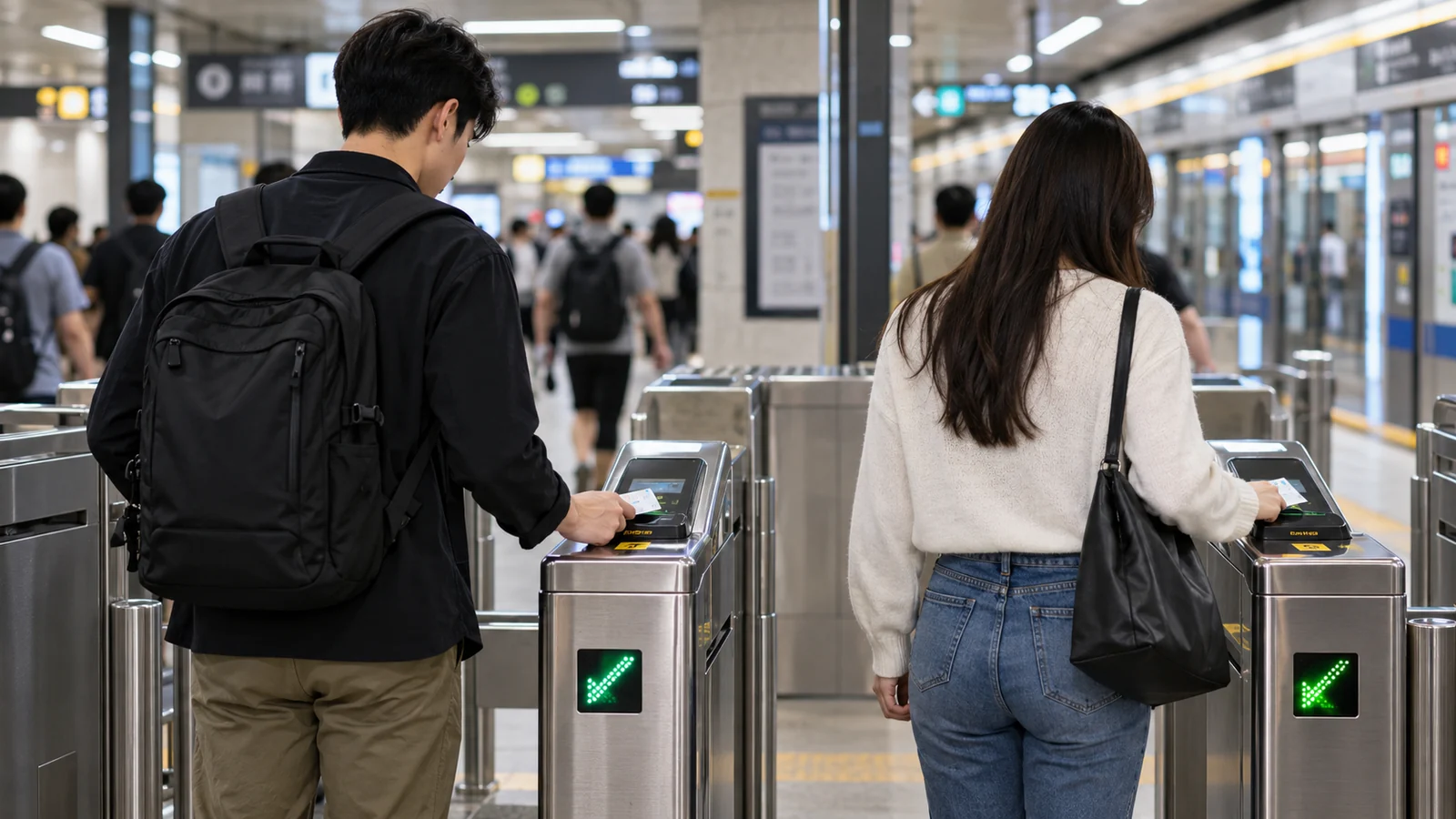
Two fare-paying travelers cannot share one T-money card to enter Seoul’s subway. A Seoul city-bus driver can set up payment for multiple passengers on one card, but that group payment does not qualify for a subway transfer discount. If your route combines bus and subway, our practical recommendation is to give each traveler their own transport card before the first ride.
These rules were checked October 23, 2026, against Incheon Transit Corporation’s metropolitan-subway FAQ and Seoul’s city-bus guidance. This guide concerns ordinary physical T-money cards, Seoul city buses and metropolitan subway journeys. Airport coaches, intercity services and unlimited passes need their own rules.
Decide from the whole route
| Your plan | What to prepare |
|---|---|
| Subway together | Each fare-paying rider needs a separate valid card or individual ticket. |
| One city bus together | Ask the driver to set up group payment before tapping. |
| City bus, then another city bus | Group transfers have conditions; keep the same passengers together. |
| City bus, then subway | Use individual cards from the first ride if relying on ordinary transfer discounts. |
| Different destinations or someone joining later | Individual cards are the simpler plan; do not assume the original group transfer still applies. |
The subway FAQ, originally published September 10, 2019, explicitly says the one-person-per-card system applies across metropolitan urban-rail operators. It distinguishes that system from a bus driver’s ability to enter multiple passengers manually. This is an existing rule, not a newly announced 2026 restriction.
On the bus, speak before you tap
Seoul’s boarding instructions say to tell or show the driver the passenger count so they can set the reader. For two adults, you can say:
성인 두 명이요.
Two adults, please.
Wait for the driver’s instruction, then tap for the group. Do not treat two quick taps as a substitute for that setup. If the party includes children or teenagers, explain the actual mix rather than calling everyone an adult. Keep enough transport balance for everyone’s fare: sharing the payment card does not make the second passenger free.
Tap the card at the exit reader when leaving. On the next eligible bus, tell the driver the original passenger count before tapping again. For other useful requests, save our Korean bus and subway phrases.
A group bus transfer only works while the group stays together
Seoul TOPIS limits multiple-passenger transfer discounts to city buses and passengers traveling to the same destination. Seoul’s detailed rules require matching boarding and alighting locations and passenger numbers. The usual transfer conditions still apply, including tapping out, the time limit and the exclusion for the same bus route.
Illustrative examples:
- Two adults, two different city buses: both board and leave each bus together. This can fit the group-transfer conditions. Tell the next driver that the original group was two; a discount does not guarantee that every later leg costs zero.
- Two adults, then a third friend joins: the passenger count changes. Do not budget on preserving the original two-person group transfer. Separate cards from the outset avoid that shared-payment complication.
- Two adults, bus then subway: the bus’s group transaction cannot serve as two subway entries. Plan individual cards for the connected journey.
Before choosing a shared card, open the complete route in your map app. Check whether a train appears after the bus and whether everyone will stay together. That check matters more than how many cards fit in one wallet.
Already at the subway with one card?
Arrange a valid fare medium for the second rider before entering. Seoul’s public-transport guide lists individual single-journey subway tickets as an option available at station machines. You do not have to buy another reusable T-money just to make one subway journey. Ask station staff if you are unsure which ticket to buy; a bus group-payment setting cannot admit both people.
For children, separately check T-money birthday registration and fare categories, including the operator’s free-accompaniment rules for young children. If your T-money is part of a WOWPASS card, our two-balance guide explains which balance funds transport. More shopping credit does not turn the physical card into two separate subway tickets.