
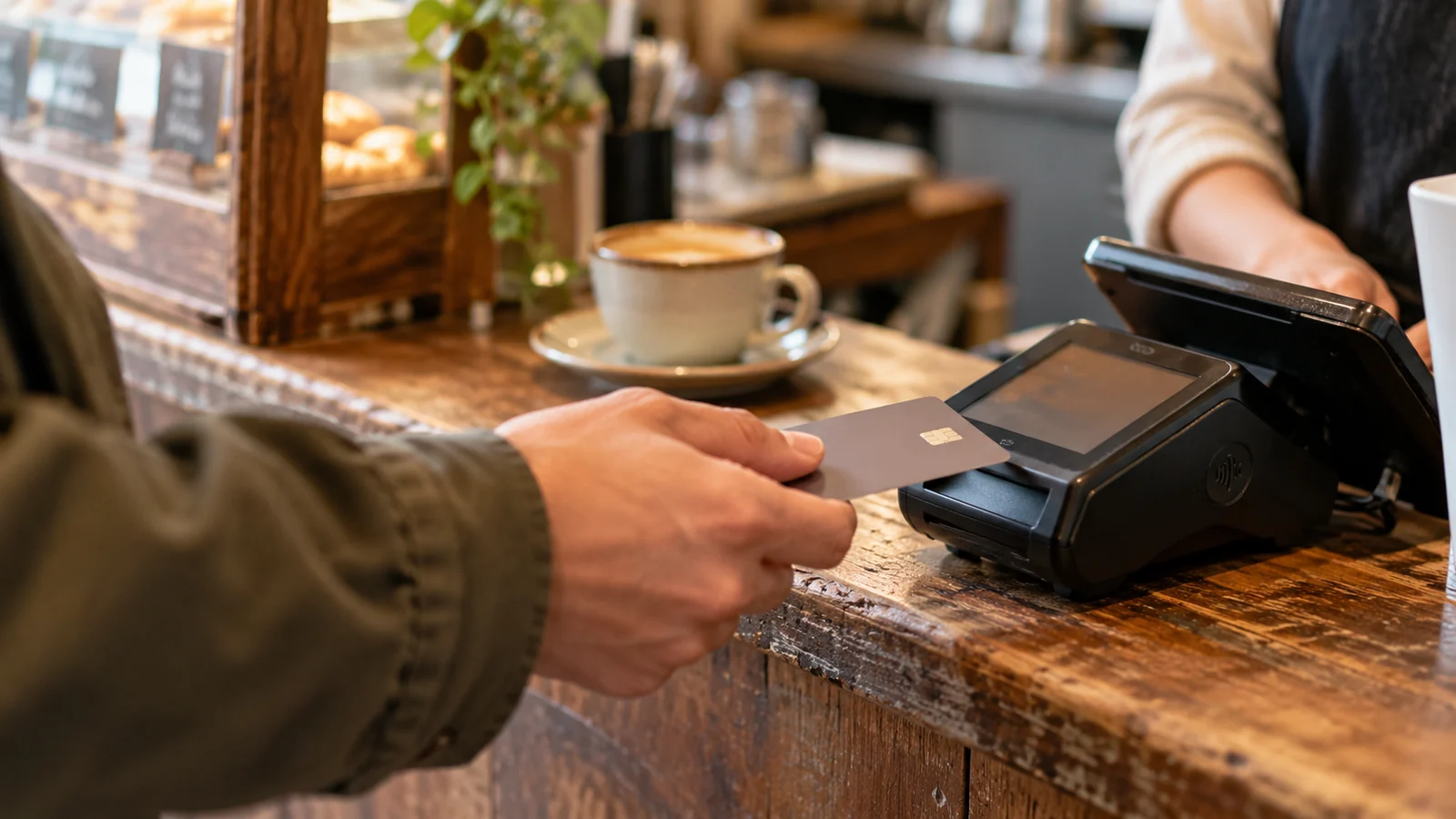
For a purchase priced in Korean won, choose KRW if you want to avoid the card terminal’s currency conversion. The familiar dollar amount can include a markup called dynamic currency conversion (DCC). Visa recommends declining that conversion and paying in local currency to avoid its markup. Your own card’s conversion terms and fees still matter, so KRW does not mean a fee-free purchase.
This guide covers a foreign-issued card offered a currency choice for a won-priced purchase or KRW cash withdrawal in South Korea. It is not a comparison of different prices on international shopping sites or duty-free price lists. Official payment guidance checked October 23, 2026; all numbers below are hypothetical, not today’s exchange rate.
What the two buttons actually change
With DCC, the merchant or ATM provider converts the amount into your card’s home currency. With a KRW transaction, conversion follows your card provider’s arrangements. Mastercard explains that its rate does not apply when the merchant or ATM performs the conversion. It also cautions that an issuer may use different rates or add fees.
| Screen choice | What you are agreeing to |
|---|---|
| KRW / Korean won / local currency | A transaction submitted in won; your card’s conversion arrangements apply |
| USD, CAD, GBP or another home currency | The terminal provider’s conversion quote, if this is a DCC offer |
| Without conversion | Declining the terminal’s conversion, where that is what the prompt describes |
Wise’s help page recommends local currency and the option without conversion for its cards. These are examples of wording, not a promise that every Korean machine has the same buttons. Read the question above the buttons: “decline conversion” and “cancel withdrawal” are different decisions.
Compare the same ₩140,000 purchase
Illustrative arithmetic only: suppose your card converts at ₩1,400 per US dollar with no additional purchase fee, while the terminal offers to charge US$106 for a ₩140,000 basket.
| Payment route | Hypothetical cost |
|---|---|
| KRW through the card | ₩140,000 ÷ 1,400 = US$100 |
| Terminal’s DCC quote | US$106, before any applicable card fees |
| Difference under these assumptions | US$6, or 6% of US$100 |
Now change the assumption: if your card adds a 3% fee to that US$100 conversion, the KRW route becomes US$103. You must compare the DCC route’s applicable card fees too. Neither 3% nor 6% is a quoted Korean fee or a promised saving.
For your own purchase, write down the won total, the DCC home-currency quote, your estimated card conversion and the fees on each route. A “no foreign transaction fee” feature does not set the merchant’s DCC rate. HSBC’s explanation separates the retailer’s conversion from the fee a bank may charge for a local-currency transaction.
Treat a network calculator as an estimate. Mastercard says its displayed amounts are indicative; authorization timing, processing timing in some cases and issuer charges can affect the result. An online rate alone cannot promise the final charge on your statement.
At a shop: ask for won before confirming
For a won-priced basket, use this short sequence:
- Check that the KRW total matches the agreed purchase price after any confirmed store discount.
- Read the currency-selection screen before accepting it.
- If you want the KRW route, say “원화로 결제해 주세요.” — “Please charge me in Korean won.”
- Keep the receipt so you can check the transaction currency later.
Visa’s DCC guidance says an offer should show both currency amounts, the exchange rate and any additional fee or markup. The merchant should give you the choice instead of making it for you. If the information is missing or you feel pressured, Visa recommends declining DCC and reporting the issue to your card issuer.
For a beauty-store purchase, decide which products and quantities are worth buying first. The Olive Young set comparison helps with that earlier decision; choosing a currency cannot make an unwanted extra product good value.
At an ATM: conversion and withdrawal fees are separate
If the machine offers to convert a KRW withdrawal into your home currency, identify the option that keeps the transaction in KRW. Declining that conversion does not answer a separate question about an ATM access fee.
Before continuing, check the machine’s disclosed charge and your card’s withdrawal terms. For a credit card, check cash-advance fees and interest as well. HSBC’s credit-card travel guidance illustrates why withdrawing cash can have different costs from making a purchase; its specific fees apply to its listed products, not every foreign card.
If you cannot tell whether a button rejects only conversion or the entire withdrawal, cancel and clarify the instructions before trying again. A bank’s logo or an English-language screen alone does not establish the cheapest total cost.
If your receipt shows dollars after you chose KRW
Check the merchant receipt’s transaction currency, not just the home-currency amount shown in your banking app. A won transaction can still be converted for your card statement.
Ask the merchant to explain a mismatch and retain the receipt. If the merchant charged another currency after you selected local currency, Visa advises contacting your issuing bank to contest it. A correction or refund is not guaranteed by this guide.
For the rest of your shopping budget, keep the tax-refund process and any WOWPASS shopping-versus-Tmoney balances separate from this card-terminal choice. Each answers a different question about where your money goes.