
Quick Info
- 📍 Area: Central Seoul and the wider subway network
- 🕒 Best time: Tour bus on a clear weekday; subway whenever speed matters
- 💰 Budget: Tour bus from ₩27,000 per adult; subway from ₩1,550 per adult card ride
- 🚇 Getting there: Tour bus starts at Gwanghwamun; subway works from nearly any connected station
- 👥 Best for: First-time visitors comparing convenience, views, cost, and flexibility
- ✅ TL;DR: Choose the tour bus for a narrated landmark loop, the subway for speed and low cost, or combine both.
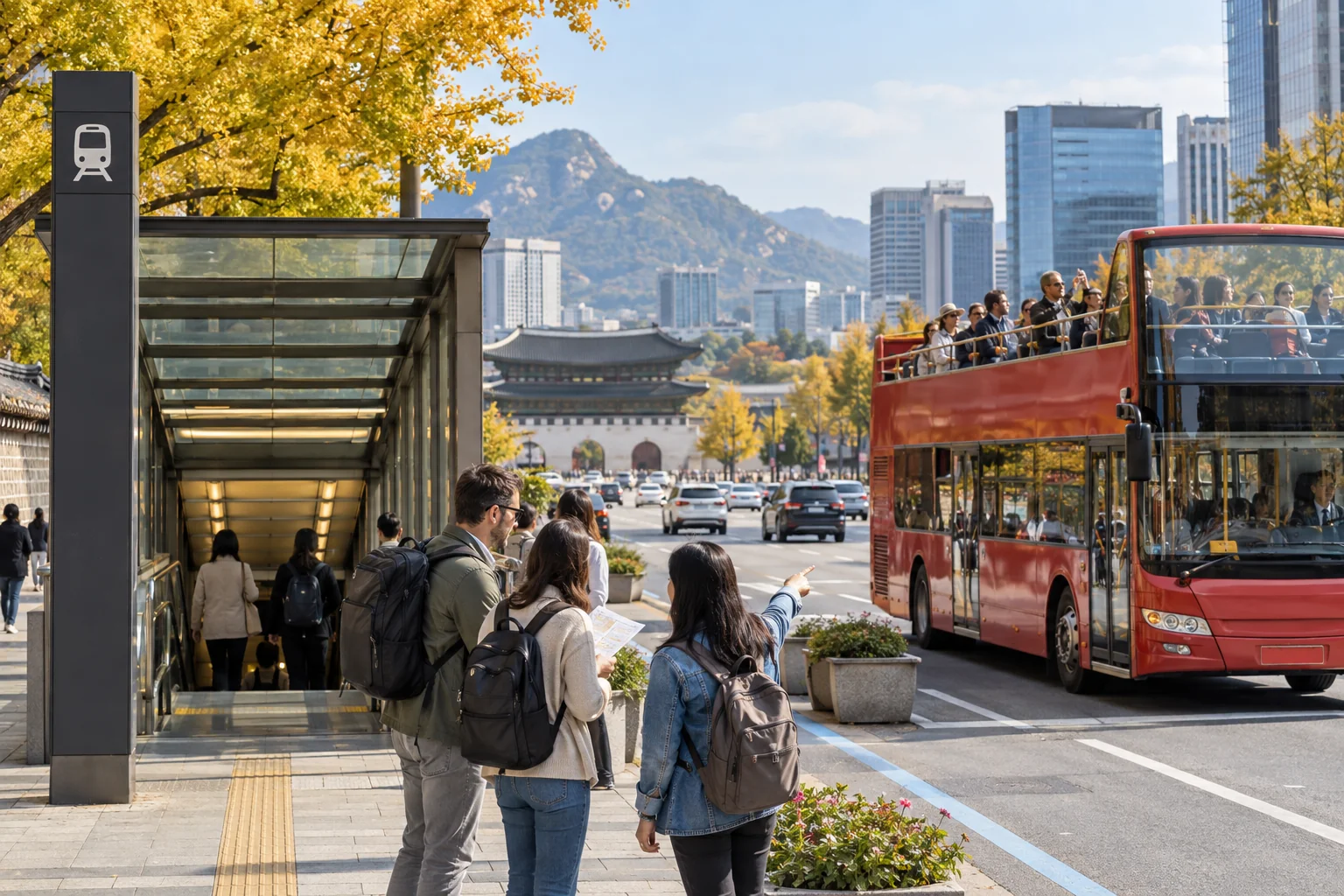
The Seoul City Tour Bus vs subway decision is not simply “tourist option versus local option.” The two systems solve different problems. A hop-on, hop-off bus turns transportation into part of the sightseeing experience. The subway is a fast, inexpensive tool for reaching the exact neighborhood you want.
For a first visit, the right choice depends on your stops, mobility, weather, and tolerance for transfers. This guide compares the official Downtown, Palaces & Namsan Course operated by Seoul City Tour Bus with ordinary pay-as-you-go subway travel and Seoul’s tourist-oriented Climate Card short-term passes. Prices and operating details were checked on September 8, 2026; always confirm the operator notice and Seoul transport pages before travel.
Seoul City Tour Bus vs Subway at a Glance
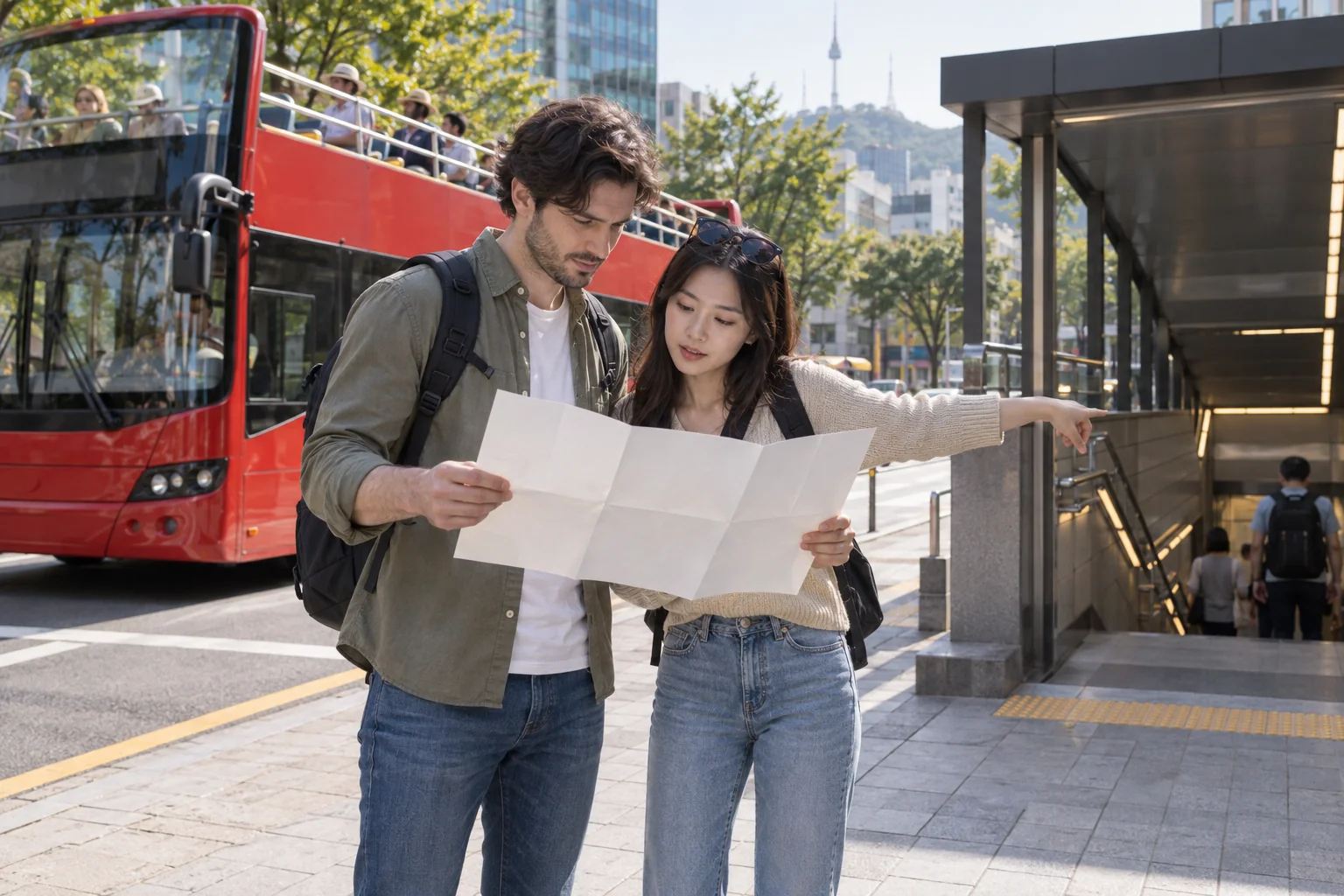
The simplest answer is this: take the city tour bus when you want an easy overview of central landmarks and the ride itself matters. Take the subway when you already know where you are going, want to cover neighborhoods beyond the tour loop, or care most about price and predictable point-to-point travel.
| Decision point | Seoul City Tour Bus | Seoul subway |
|---|---|---|
| Main advantage | Sightseeing, elevated views, audio guide, fewer navigation decisions | Speed, low fare, broad network, frequent service |
| Best itinerary | Palaces, Gwanghwamun, Myeong-dong, Namsan, DDP, Insa-dong | Any custom route, especially stops outside the central loop |
| Adult starting cost | From ₩27,000 on the official Korean booking page | ₩1,550 base fare by transit card; distance charges may apply |
| Waiting pattern | About 25 minutes between scheduled buses, plus possible road delay | Usually short headways, but transfers and station walks add time |
| Navigation effort | Low once you reach the Gwanghwamun start | Moderate; you must choose lines, exits, and transfers |
| Views during travel | A major part of the experience | Limited while underground |
| Accessibility tradeoff | Fewer transfers, but reboarding is first come, first served | Elevators exist at many stations, but long passages and stairs are common |
| Weather sensitivity | Traffic and open-top comfort can change the day | Mostly weather-protected, except walks to and from stations |
The official bus page lists 15 hop-on, hop-off stops, a 90-minute full loop without getting off, buses about every 25 minutes, and service from Gwanghwamun from 9:20 a.m. to 4:50 p.m. The course is normally closed on Mondays; when Monday is a holiday, it operates Monday and closes Tuesday instead. Seats are unreserved.
The subway has no sightseeing narration, but its network reaches far beyond the tour loop. It is better for a day that mixes places such as Yeouido, Seongsu, Jamsil, Hongdae, or Gangnam. It is also the safer choice when you have a timed reservation and cannot risk central-Seoul traffic.
Cost Comparison in September 2026

Price is the clearest difference, but the correct comparison is not one bus ticket against one subway ride. Compare the whole day: number of rides, walking saved, views, audio commentary, and time spent waiting.
City tour bus price
On September 8, 2026, the operator’s Korean page displayed the Downtown, Palaces & Namsan adult ticket from ₩27,000. Its English page displayed an adult ticket from US$22 and a child ticket from US$16. Currency, promotions, and package inclusions can change, so use the currency and final total shown at checkout rather than converting an old blog price.
That ticket is valid for the day on its designated hop-on, hop-off course. It covers the ride and onboard features; budget separately for palace admission, observatories, meals, and any attraction not explicitly included in the product you buy.
Ordinary subway fare
The Seoul Metropolitan Government subway fare page lists the adult base fare at ₩1,550 with a transit card and ₩1,650 for a single-journey ticket, effective June 28, 2025 and still displayed when this guide was checked. Longer trips can add distance charges. The same official page explains that integrated transfer discounts require tapping when boarding and exiting.
Using only base fares, four adult subway rides cost about ₩6,200 with a transit card. Six cost about ₩9,300. Those totals remain far below the tour bus price, although the comparison ignores the value of the bus’s commentary, street views, and simplified route.
Climate Card short-term pass
Seoul’s official Climate Card page lists tourist-friendly short-term prices of ₩5,000 for one day, ₩8,000 for two days, ₩10,000 for three days, ₩15,000 for five days, and ₩20,000 for seven days. A physical card costs an additional ₩3,000. Short-term validity begins on the day it is charged, so you cannot load a one-day pass in advance for a later date.
This distinction matters after Seoul’s September 2026 transit-card change. The old 30-day prepaid Climate Card was discontinued as the resident-focused Climate Pass launched, but the city says tourist short-term passes continue without change. Visitors should not confuse the resident-only monthly product with the short-term tourist passes.
International cards can be used at supported machines for Climate Card short-term purchases and single-journey tickets. Seoul says an average service fee of about 3.7% applies to international-card purchases. The short-term pass does not cover every railway or bus: the Sinbundang Line, intercity and airport buses, non-Seoul buses, and subway travel outside the permitted service area have exclusions.
Which is cheapest?
- For one to three subway rides, pay as you go is usually simplest and cheapest.
- For four or more base-fare rides in one day, a ₩5,000 one-day Climate Card can beat pay-as-you-go fares if you already own the physical card and every trip is in the coverage area.
- If you must buy the ₩3,000 physical card, compare the combined first-day cost with your expected rides.
- The tour bus costs much more than either subway method. Buy it for the experience and convenience, not because it is the cheapest transport pass.
Route and Time: Landmark Loop vs Point-to-Point Travel
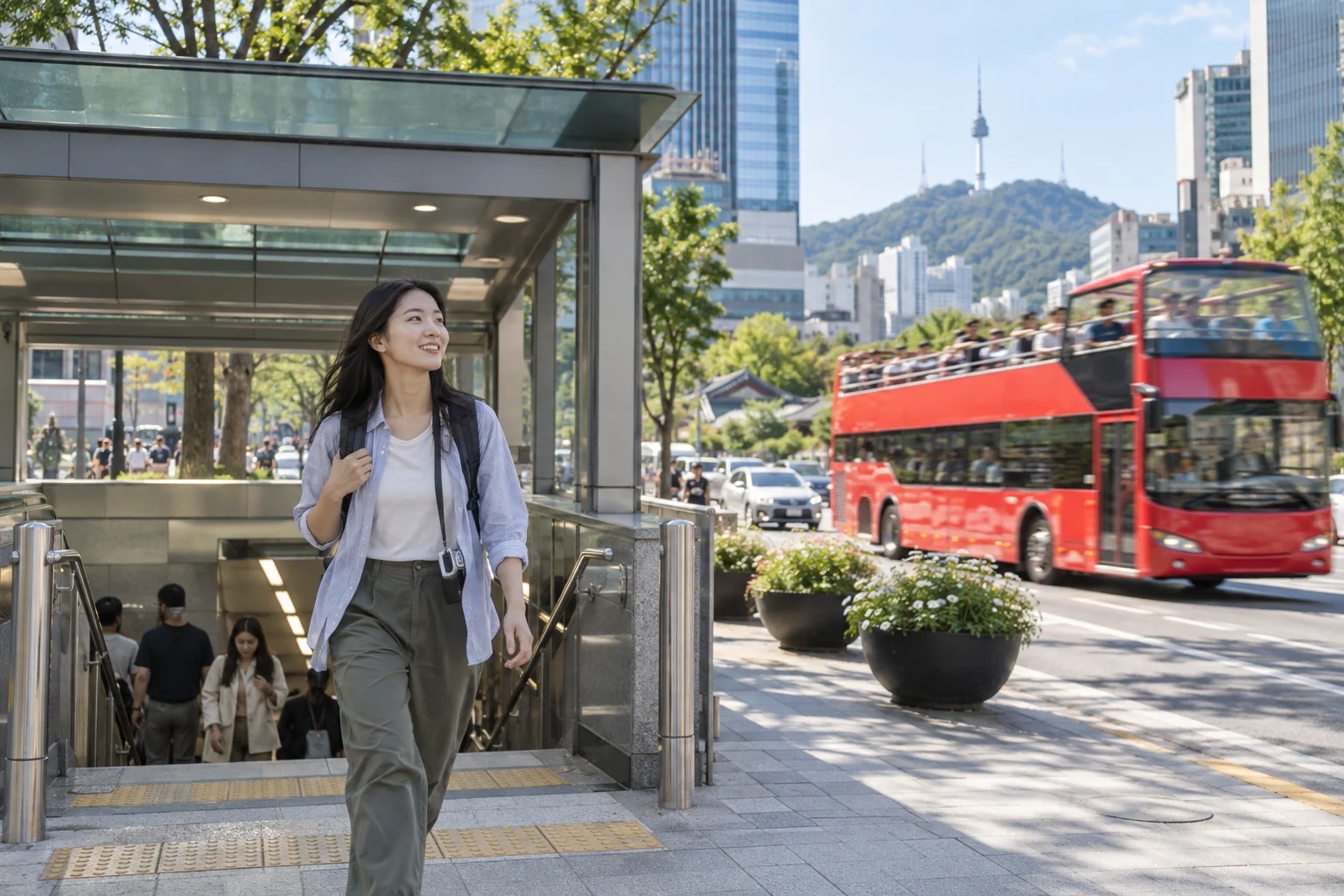
The official Seoul City Tour Bus course is a fixed clockwise sightseeing loop. It starts at Gwanghwamun and serves Myeong-dong, Namsangol Hanok Village, N Seoul Tower, DDP and Dongdaemun Market, Daehak-ro, Changgyeonggung, Changdeokgung, Insa-dong and Bukchon, Cheong Wa Dae, Gyeongbokgung, and Gwanghwamun Square among its 15 stops.
That geography is excellent for a central-Seoul highlights day. You do not need to decide which subway exit is closest to every palace or how to climb toward N Seoul Tower. The bus also lets you see the streets between landmarks, which is something underground travel cannot provide.
However, the loop makes indirect trips. If you board just after the bus has passed your desired stop, you may ride most of the circuit before reaching it. When you hop off, the next scheduled bus is about 25 minutes away, and traffic, demonstrations, festivals, or road controls can cause further delays. Reboarding is first come, first served; if the bus is full, the operator says you must wait for the next vehicle.
The subway works in the opposite way. It does not build a sightseeing narrative, but it gives you far more control over destination order. A direct ride from one connected district to another can be faster than waiting for the next tour bus. The tradeoff is hidden walking: large interchange stations, long corridors, the wrong exit, and the uphill approach to places such as Namsan can consume more energy than the train ride itself.
Use these rules when time matters:
- Put timed entries first. Take the subway to a reserved museum, performance, or tour check-in.
- Use the bus for a flexible block. It works best when two or three loop stops are desirable but none requires a precise arrival minute.
- Do not plan every bus stop. With a 25-minute interval, five short hop-offs can create more waiting than sightseeing.
- Check the day’s notices. The operator maintains a notices page for suspensions and route changes.
- Screenshot your return route. If you miss the final useful tour-bus departure, finish by subway or ordinary city bus.
For a deeper explanation of ticket pickup, seating, and the loop itself, see our Seoul City Tour Bus booking and route guide. If your arrival day is part of the plan, our Incheon Airport AREX guide explains the airport rail choice before you enter the city network.
Best Choice by Traveler Type
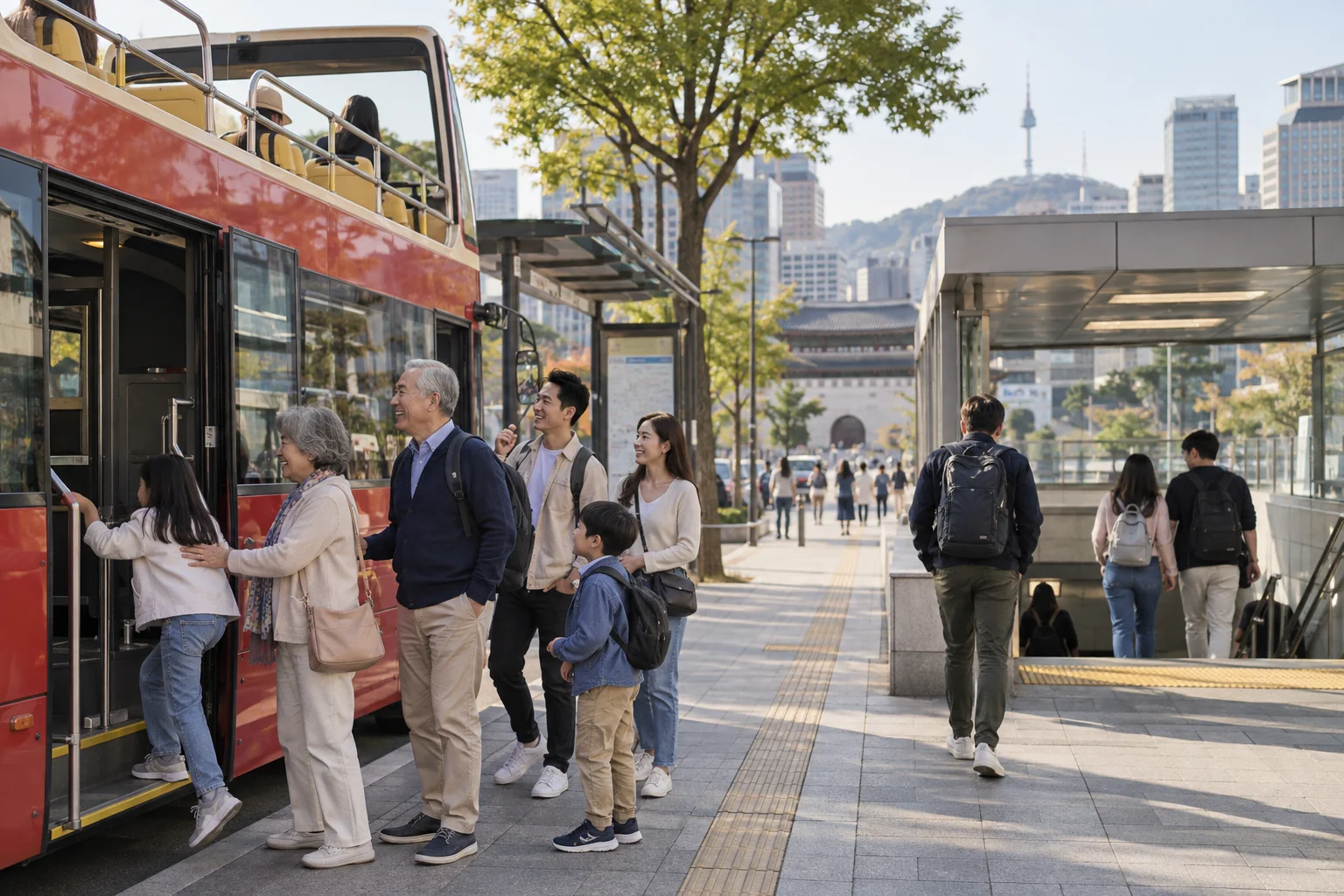
First-time visitor with one clear day
Choose the city tour bus if your list closely matches its central loop and you enjoy orientation as much as destination time. A full loop early in the trip can help you understand how Gwanghwamun, the palace district, Namsan, Myeong-dong, and Dongdaemun sit relative to one another.
Choose the subway if your one-day list includes distant districts or timed reservations. A Gyeongbokgung–Seongsu–Jamsil–Hongdae day is not a sensible tour-bus loop, but the rail network can connect it.
Family with children or older relatives
The tour bus can reduce transfers, stairs, and constant navigation. It may be worth the premium when energy is the scarce resource. But confirm that everyone can wait outdoors at stops, and remember that seats are not reserved. Under the operator’s current rule, children under 48 months may ride free with an accompanying adult, one child per adult, but no separate seat is provided.
The subway is cheaper for a family, yet station walking can be substantial. Search for elevators before leaving the platform, avoid rush hour when possible, and simplify the day to one or two geographic clusters.
Solo traveler or confident navigator
The subway usually wins. You can change the plan instantly, visit neighborhoods outside the loop, and spend the savings on attractions or food. A solo traveler also occupies little space and can move through transfers more easily than a large group.
The tour bus still makes sense for a solo visitor who wants photography from an elevated seat, multilingual commentary, or a low-effort first-day overview.
Traveler with limited mobility
Neither option is automatically perfect. The official operator lists wheelchair seating on its open-top double-decker and wheelchair storage space on the glass-top bus, but vehicle type cannot be requested. Contact the operator before purchase to confirm the day’s practical boarding arrangements.
Many subway stations have elevators, but routes through large stations may be indirect. Check elevator locations and accessible exits for every stop, not just the line map. A hybrid plan with one bus loop and one simple subway journey may minimize both road waiting and station walking.
Bad-weather traveler
In heavy rain, extreme heat, or winter cold, the subway offers more shelter and predictable comfort. The tour operator says its vehicles run in rain and snow, but the assigned vehicle may be open-top, glass-top, or semi-open and cannot be selected. Weather protection can therefore differ from the photo you saw while booking.
Photographer and scenic traveler
The tour bus wins for continuous street-level and elevated views. Pick it on a clear day, but secure cameras and hats on the upper deck and remain seated. The subway is better when the photographs you want are at the destination rather than between destinations.
How to Combine the Tour Bus and Subway in One Day
A hybrid day often gives the best result. Use the tour bus for the central landmark story, then use the subway for the evening neighborhood that is not on the loop.
Sample balanced itinerary
- 9:00 a.m.: Arrive near the Gwanghwamun ticket booth, collect or buy the ticket, and confirm service notices.
- 9:20 a.m.: Take an early departure and stay on long enough to understand the route.
- Late morning: Hop off for one major palace or Insa-dong/Bukchon cluster. Choose one anchor rather than racing through both palaces.
- Early afternoon: Reboard for Namsan or DDP, depending on weather and your interests.
- Late afternoon: Finish the tour-bus portion at a subway-connected stop before the last departures become a concern.
- Evening: Take the subway to a dining or shopping district outside the loop.
This plan prevents a common mistake: buying the tour bus and then using expensive taxis every time the loop feels slow. The subway is not a failure of the tour-bus plan; it is the flexible second half of it.
If you want more context for the historic stops, our Seoul palace guide helps you choose one palace instead of overloading the day. For practical language at stations and stops, keep the Korean subway and bus phrases guide on your phone.
Booking and Payment Checklist
For the city tour bus:
- Verify the exact course, date, and final checkout currency.
- Book online by the day before travel; the operator says same-day online booking is unavailable.
- For same-day purchase, use the Gwanghwamun ticket booth.
- Arrive early because seats are not assigned.
- Check Monday and holiday closure rules.
- Confirm the last useful departure for your planned hop-off stop, not only the first-stop timetable.
- Carry no open food or drinks; the operator prohibits them onboard.
For the subway:
- Decide between a transit card, single-journey tickets, and a Climate Card short-term pass.
- Count likely rides and include the ₩3,000 physical Climate Card cost if you do not already have one.
- Confirm every journey stays within the pass service area.
- Tap in and out correctly; transfer pricing and pass rules depend on complete taps.
- Use an official map or trusted navigation app and check the correct exit before arrival.
- Leave extra time for large stations and peak-hour crowds.
Common Mistakes to Avoid
Choosing by price alone. The subway nearly always wins on raw cost. The bus price buys views, commentary, and reduced route planning. If you do not value those, do not buy it.
Assuming the tour bus is a fast shuttle. It follows a sightseeing loop and shares roads with traffic. Use it for discovery, not a tight appointment.
Buying a Climate Card without checking coverage. A short-term pass can be excellent value, but it excludes some lines and services. Airport buses and the Sinbundang Line are important examples.
Confusing the new resident pass with the tourist pass. Seoul changed its 30-day product in September 2026. Short-term tourist passes continue, while the new Climate Pass has residency-linked eligibility.
Trying to hop off at every stop. Even a 25-minute scheduled interval can turn into a long wait. Pick two or three anchor stops.
Forgetting the final connection. End near a subway station so traffic or a missed tour bus does not strand your evening plan.
FAQ
Is the Seoul City Tour Bus cheaper than the subway?
No. The official city tour bus adult ticket started at ₩27,000 when checked on September 8, 2026, while the adult subway base fare was ₩1,550 by transit card. The bus is a sightseeing product with commentary and a curated loop, not the budget option.
Is the Seoul City Tour Bus hop-on, hop-off?
Yes. The Downtown, Palaces & Namsan daytime course allows unlimited boarding and exiting at its 15 stops during the valid day. Reboarding seats are first come, first served.
How often does the city tour bus run?
The official schedule lists departures about every 25 minutes from Gwanghwamun, with the first at 9:20 a.m. and the last at 4:50 p.m. Traffic and events can cause delays, so check the current notice and timetable.
Is a one-day Climate Card worth it for sightseeing?
It can be. The pass is ₩5,000 plus ₩3,000 if you need a new physical card. It becomes more attractive on a high-movement day, but only if your trips fall within its coverage area.
Can I use the Climate Card to reach Incheon Airport?
Coverage is directional and conditional. The official page says riders can currently exit at Incheon Airport terminals after boarding within the covered area, but cannot board at the airport terminals using the card. Verify the rule before travel because airport and rail policies can change.
Should I use both options on the same day?
Yes, especially if you want the scenic central loop and an evening in a district outside it. Use the bus for flexible sightseeing, then switch to the subway before the bus service winds down.
What to Do Next
Write down your top three Seoul stops. If at least two sit on the same official tour-bus loop and you value the ride itself, check the current ticket and notice page. If your stops are spread across the city, build a subway route and compare pay-as-you-go fares with a short-term Climate Card. The best choice is the one that protects your energy and gives your must-see places enough time.