
Quick Info
- 📍 Area: Seoul subway stations, major travel hubs, hotels, and Incheon International Airport
- 🕒 Best time: Reserve or locate storage before checkout day; allow a delivery buffer before any flight or train
- 💰 Budget: Official September 2026 subway examples start at KRW 2,200 for a small weekday T-Locker or KRW 3,000 for four hours of small-bag T-Luggage storage
- 🚇 Getting there: Choose a facility on your actual route, preferably near the station exit or hotel you will use again
- 👥 Best for: Travelers between checkout and departure, early arrivals, shoppers, and anyone changing hotels
- ✅ TL;DR: Use a locker for short self-service storage, a staffed counter for a large case, hotel storage when permitted, or delivery when avoiding a return trip is worth the higher price.
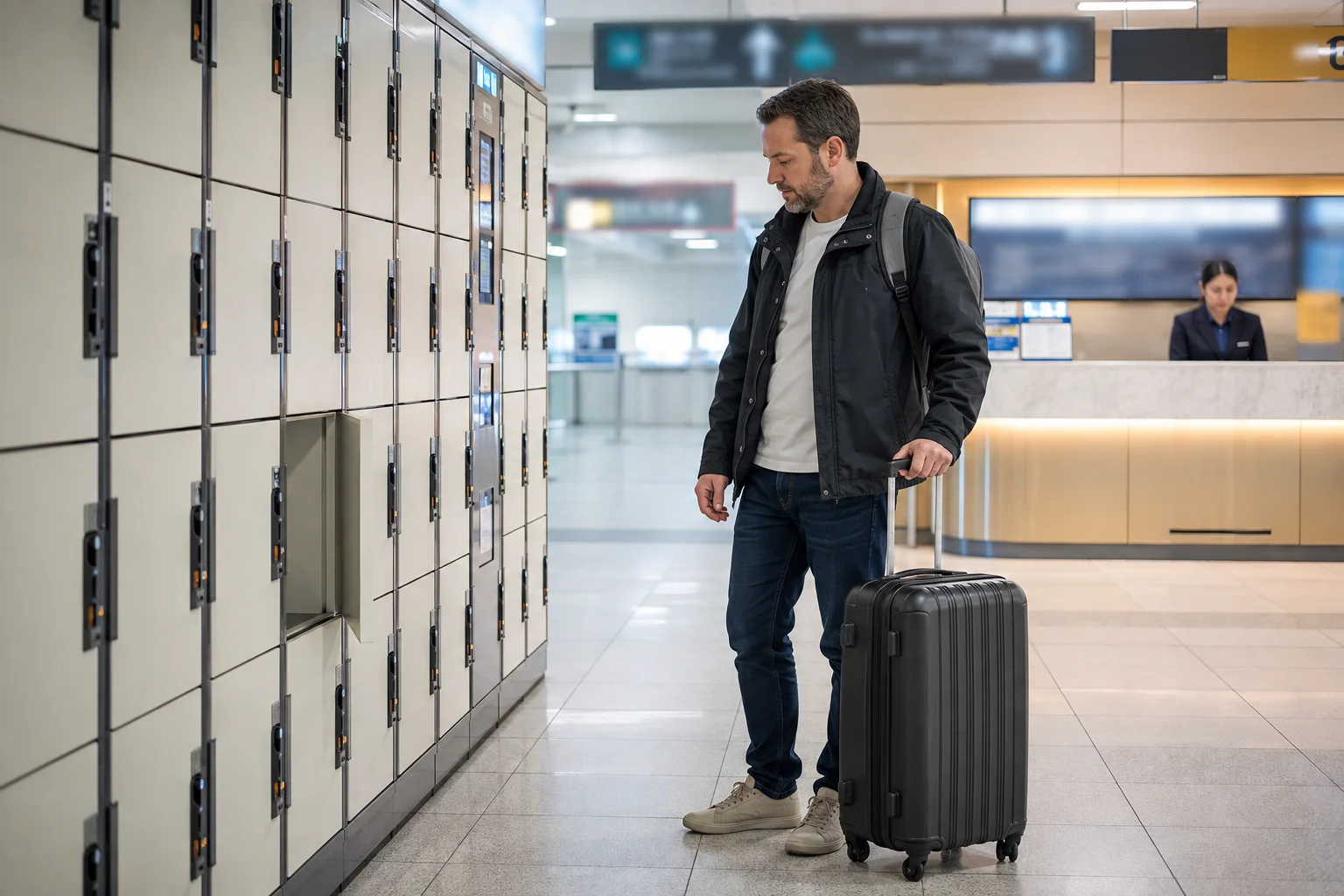
Dragging a suitcase through Seoul after hotel checkout is rarely a good use of your last day. The better choice depends on four things: bag size, storage time, where you will finish sightseeing, and whether you are willing to return to the same place.
Prices, locations, dimensions, and operating details in this guide were checked on September 5, 2026. The main source is the Seoul Metropolitan Government’s current English subway storage facilities guide. Availability, acceptance rules, and same-day delivery cutoffs can change, so confirm the live service before building a flight connection around it.
Seoul Luggage Storage Options at a Glance
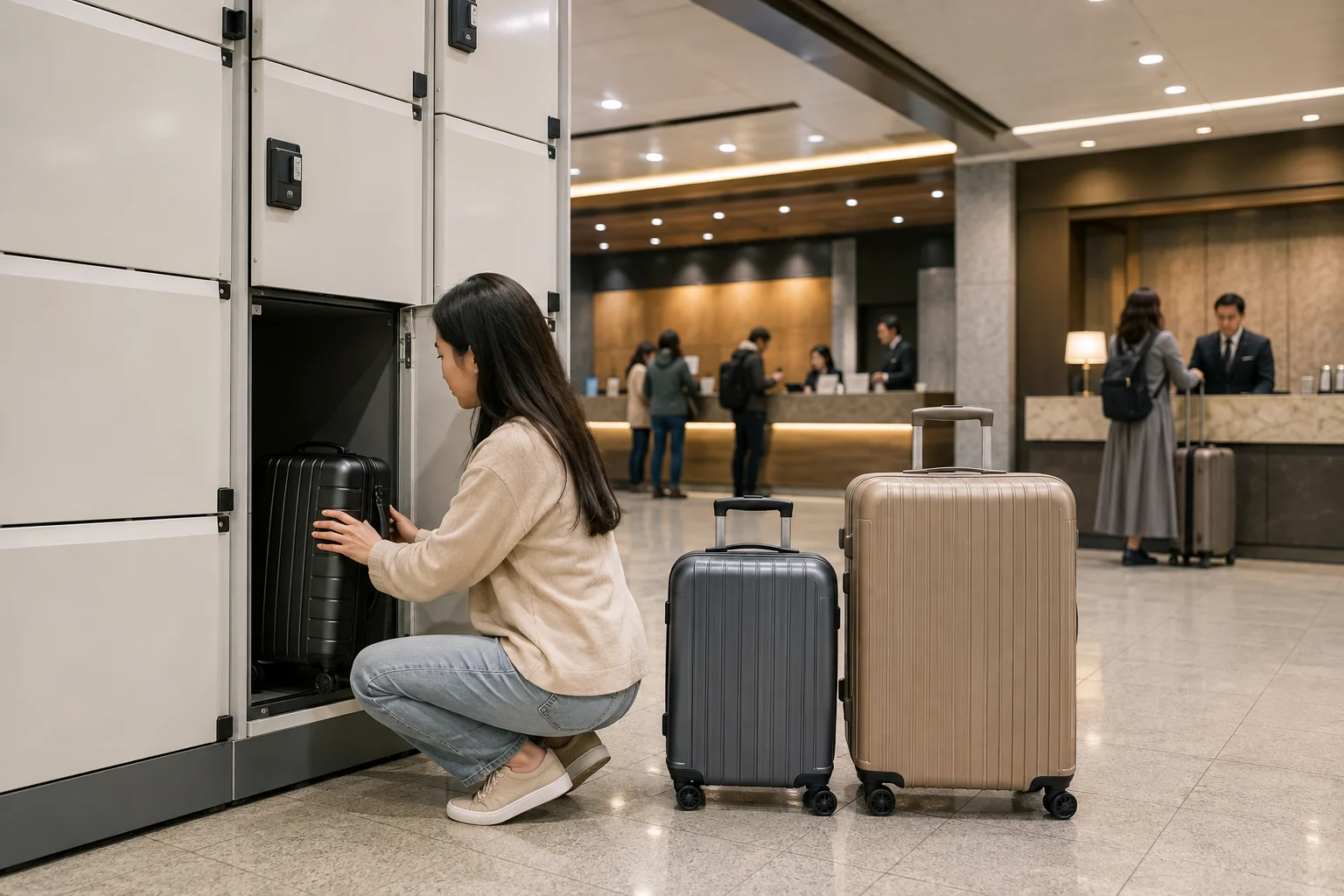
There is no single “Seoul luggage storage” system that fits every trip. Subway lockers are self-service compartments. T-Luggage is a staffed storage and delivery service at selected stations. A hotel may hold bags for guests, while airport operators provide their own counter services. These options have different hours and require different return plans.
| Option | Best use | Main advantage | Main limitation | Published price example |
|---|---|---|---|---|
| T-Locker subway locker | A few hours with a bag that fits | Many station locations and self-service access | App and locker instructions may be Korean; compartments can sell out | Weekday four-hour base: KRW 2,200 small, KRW 3,300 medium, KRW 4,400 large |
| T-Luggage staffed counter | Full-size luggage or help from staff | Size categories extend to XL and a person can check the bag | Only selected stations; counter hours are narrower than the subway day | Weekday four-hour base: KRW 3,000 small to KRW 9,000 XL |
| Hotel or guesthouse storage | Before check-in or after checkout | Often the least complicated route when returning to the property | Not guaranteed; policies may exclude non-guests, long holds, or late pickup | Ask the property directly; this guide does not assume a fee or free service |
| Same-day delivery | Airport day or a one-way sightseeing route | Removes the need to return to the original station | Costs more and requires cutoff, destination, and collection planning | Official station-to-airport weekday examples start at KRW 20,000 |
| Airport storage counter | A layover or time spent around the terminals | Keeps the bag at the airport | Poor fit if you need the bag delivered to a Seoul hotel | Confirm current operator, terminal, hours, and quote at the airport |
Start with geography. If you will return to the same station before taking a train, a locker is efficient. If you begin in Hongdae but end at Seoul Station, a same-day transfer may save an unnecessary cross-city journey. If your hotel is close to your evening departure route, asking its front desk first can be simpler than either.
Do not compare only the listed fee. Add the subway fare, walking time, stairs, and the risk of a last-minute detour. Saving a few thousand won is not good value if collecting the bag forces you to cross Seoul during rush hour.
T-Locker Prices, Sizes, and Hours
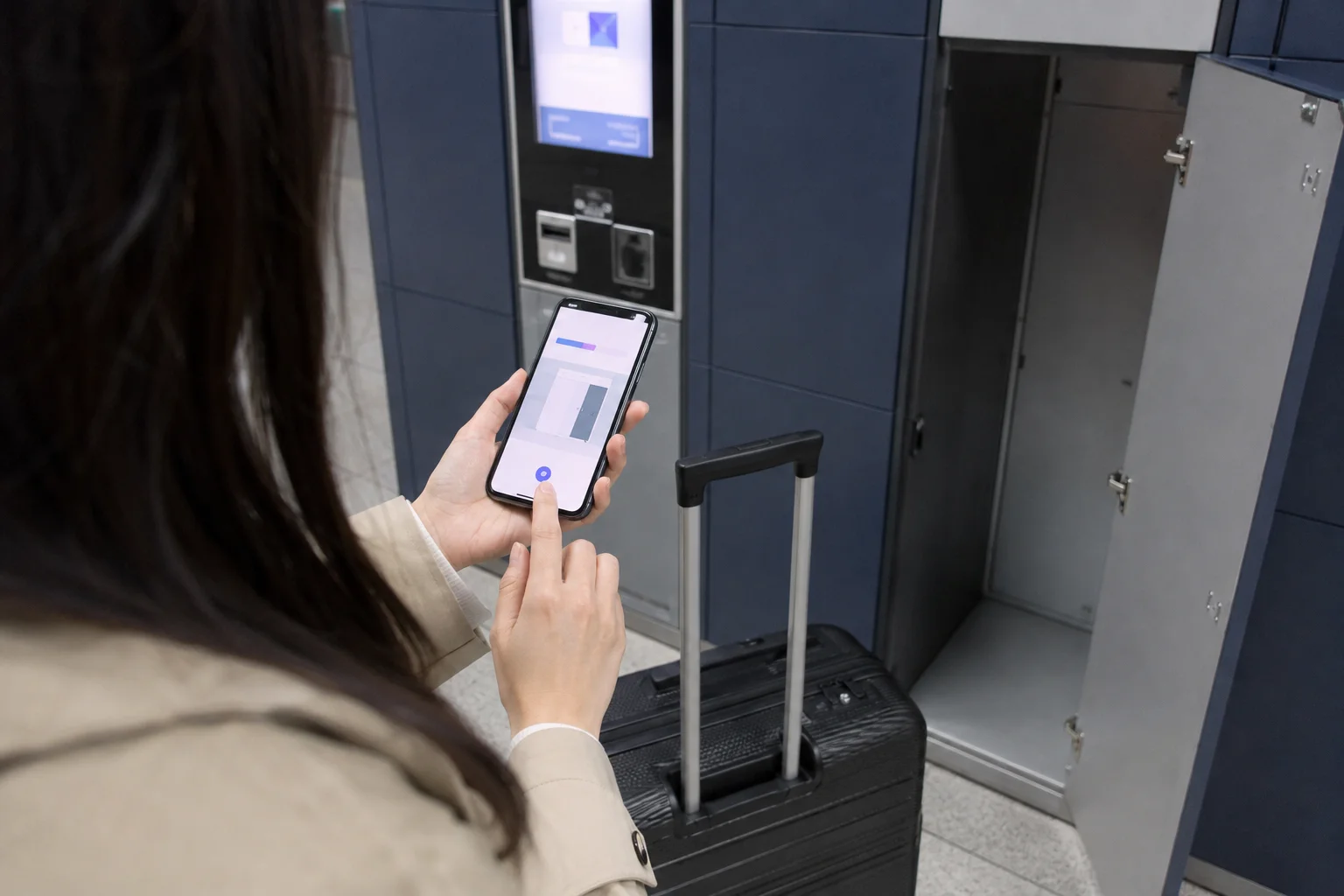
The official Seoul guide lists 5,557 T-Locker compartments across 336 locations in 273 stations. That broad network is the main reason to consider a subway locker: you can choose a station that matches the day’s route instead of defaulting to Seoul Station or Myeongdong.
The city page lists the following dimensions. Confirm the orientation and door opening on the exact locker before paying; do not infer fit from a suitcase’s marketed inch size or from the order of these numbers alone:
| T-Locker size | Published interior dimensions | Weekday base for 4 hours | Weekend base for 4 hours | Extra per hour |
|---|---|---|---|---|
| Small | 50 × 30 × 60 cm | KRW 2,200 | KRW 3,100 | KRW 500 |
| Medium | 50 × 45 × 60 cm | KRW 3,300 | KRW 4,600 | KRW 800 |
| Large | 50 × 90 × 60 cm | KRW 4,400 | KRW 6,100 | KRW 1,000 |
Worked example using the dated table: six weekday hours in a large locker cost ₩4,400 + (2 × ₩1,000) = ₩6,400, assuming two extra hourly units and no other charge. Check the screen for rounding and current charges.
Measure the bag’s widest points, including wheels, handles, side pockets, and any items tied to the outside. A suitcase described by a shop as “24 inch” does not automatically fit a particular locker: product sizing conventions and actual exterior dimensions are not the same thing. Keep a photograph of your measurements, and choose a staffed alternative if the fit is close.
The official page gives T-Locker access hours as 5:00 a.m. to midnight every day and warns that storage and retrieval are unavailable outside operating hours. Treat midnight as a hard planning boundary, not a target pickup time. Station entrances, final trains, maintenance, and unfamiliar passages can all slow you down.
The city guide describes an app-based T-Locker workflow and labels that app Korean-only. That does not establish the language options of every locker or the separate T-Luggage booking website. Check the specific machine or reservation flow before committing your bag. Older units may have different on-locker instructions. Before placing a bag inside:
- Confirm that you are using the correct station and locker bank.
- Photograph the nearby landmark, exit number, and locker position without capturing another customer’s personal details.
- Finish the reservation and test that the door has locked.
- Save the retrieval method and transaction confirmation offline.
- Set a collection alarm well before the last practical train.
Do not put your passport, wallet, medication, only phone, or flight documents in the locker. If the phone is required for retrieval, its battery and data connection are part of the plan. Carry a power bank and save any help number or confirmation you may need.
T-Luggage Staffed Counters and Storage Fees
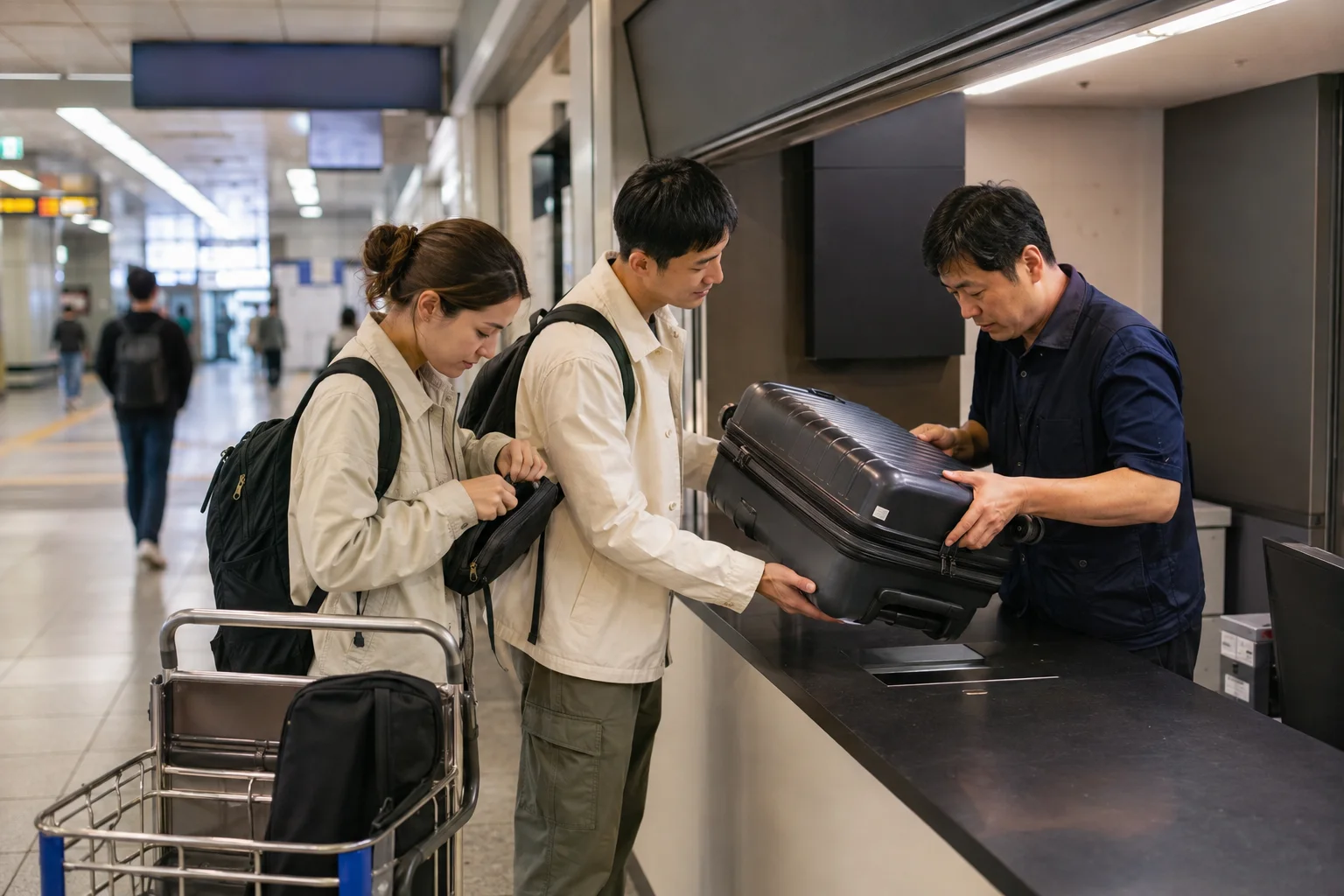
T-Luggage is useful when a suitcase is too large for a convenient locker or when you want a staffed handoff. The current English city page lists six counter locations:
- Seoul Station, Line 1: B1 near Exit 1
- Hongik University Station, Line 2: B1 near Exits 3 and 4
- Jamsil Station, Line 2: B1 near Exits 3 and 4
- Myeongdong Station, Line 4: B1 near Exits 9 and 10
- Gimpo International Airport Station, Line 5: B1 near the information center
- Jongno 3-ga Station, Line 5: B1 near Exit 6
The operator’s delivery guide, checked October 4, 2026, marks Suseo staffed operations/delivery as suspended. Do not route a same-day handoff through Suseo based on an older seven-location announcement. Confirm the actual station and service in the reservation.
The official T-Luggage storage table groups bags by exterior length in inches and charges a four-hour base:
| Bag category | Published size | Weekday 4-hour base | Weekend 4-hour base | Extra time |
|---|---|---|---|---|
| Small | Up to about 20 inches | KRW 3,000 | KRW 4,000 | KRW 1,000 per hour |
| Medium | About 20–23 inches | KRW 4,000 | KRW 6,000 | KRW 1,000 per hour |
| Large | About 23–27 inches | KRW 6,000 | KRW 9,000 | KRW 1,000 per hour |
| Extra large | About 27 inches and above | KRW 9,000 | KRW 13,000 | KRW 1,000 per hour |
The same page gives offline counter hours as 9:00 a.m. to 10:00 p.m. year-round and links to online storage and delivery reservations. Confirm the specific point’s availability and last acceptance time rather than assuming every service can begin at 9:59 p.m.
At handoff, look over the suitcase with staff and retain the receipt or digital confirmation. Remove loose straps and old airline tags that could catch during handling. Keep cash, valuables, electronics, travel documents, medicine, and fragile essentials in your day bag. If an item is unusually valuable or delicate, ask about exclusions and liability before payment.
Same-Day Delivery to a Station or Incheon Airport
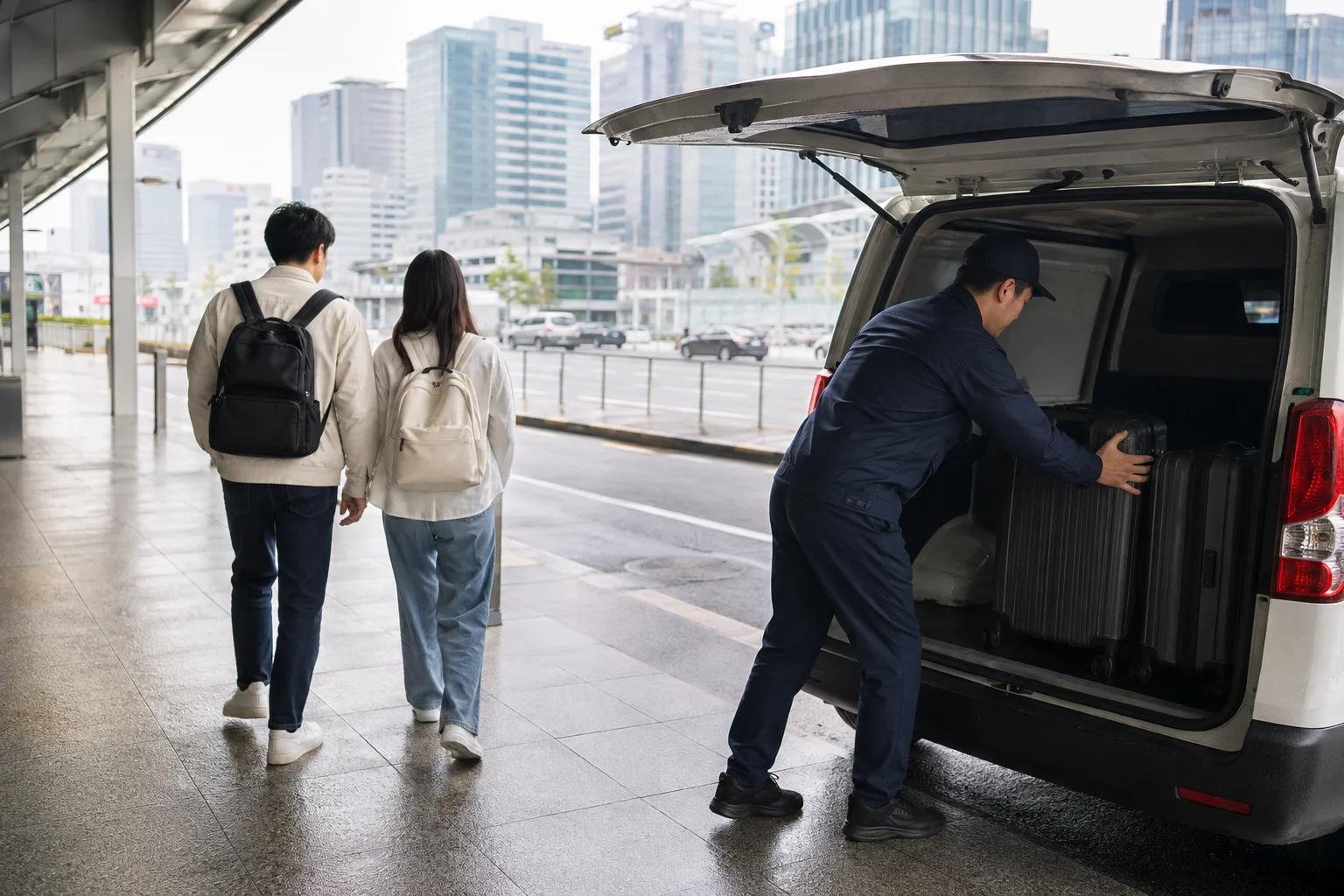
Delivery becomes attractive when storage would force a return trip. T-Luggage advertises same-day movement between participating Seoul stations and between a station and Incheon Airport. The current official fee examples are:
| Bag category | Within Seoul weekday / weekend | Station–Incheon weekday / weekend |
|---|---|---|
| Small or medium, up to about 23 inches | KRW 17,000 / 25,000 | KRW 20,000 / 29,000 |
| Large, about 23–27 inches | KRW 26,000 / 38,000 | KRW 26,000 / 38,000 |
| Extra large, about 27–36 inches | KRW 31,000 / 45,000 | KRW 31,000 / 45,000 |
These figures are a September 5, 2026 snapshot, not a permanent quote. The airport column describes a delivery service; it is not the same as checking a suitcase onto your flight. You still need to collect the bag at the designated point, comply with your airline’s check-in deadline, and carry it through the normal baggage process unless you separately qualify for an official off-airport check-in service.
Build a generous buffer. A delivery arrival that is “on time” for the service may still be too close for your airline, terminal transfer, security, or bag-drop deadline. Confirm all of the following before handing over anything:
- Exact destination counter and terminal
- Same-day acceptance cutoff
- Earliest or promised collection window
- Maximum dimensions and weight
- Items the operator will not accept
- Identification and receipt required for collection
- Delay, cancellation, and compensation terms
- Contact method that will work without a Korean phone number
Incheon Airport separately lists Hanjin Express luggage storage and delivery counters. Its official airport service notice says hours vary by terminal and location; the published examples range from 7:00 a.m.–9:00 p.m. to a 24-hour Terminal 2 counter. Search the airport’s current facilities directory for the operator before travel because counters and hours can change.
The airport’s Easy Drop guide describes a different product: eligible passengers on participating airlines can check in and hand over checked baggage at designated off-airport locations. Airline, route, day, check-in, and cutoff restrictions apply. Do not assume that booking ordinary luggage delivery makes you eligible for Easy Drop.
If you are traveling between the airport and Seoul Station, coordinate storage with your rail choice. Our Incheon Airport AREX guide compares the Express and All-Stop trains, while the airport limousine bus guide explains when under-bus storage and a hotel-near stop can reduce handling.
When Hotel Luggage Storage Is the Better Choice
Ask your accommodation before paying for a separate facility. Many staffed hotels can explain whether they hold bags for registered guests before check-in or after checkout, but LoveKorea does not assume that the service is free, overnight, insured, or available to every room type.
Send a precise message:
I have a reservation for September 12. Can you store one 26-inch suitcase from about 10:00 a.m. before check-in? Is there a fee, closing time, or item restriction?
For departure day, replace the date and ask how late collection is possible. A 24-hour front desk does not necessarily mean the luggage room accepts pickups at any hour. Guesthouses and unmanned properties may have no secure staffed area at all.
Hotel storage works best when you will naturally return to the property. It is less appealing when the hotel is in Hongdae and your final activity and airport train are near Seoul Station. Map the complete last-day route before deciding. Our Seoul hotel neighborhood guide can help compare the transport tradeoffs of Myeongdong, Hongdae, and Gangnam.
Never leave a bag unattended in a lobby because a message was unanswered. Get a claim tag or clear staff confirmation, and verify that the person receiving it understands when you will return. If you plan to send a courier, confirm that the property accepts third-party luggage deliveries and will match the bag to your reservation.
Best Storage Plan by Seoul Itinerary
Early arrival before hotel check-in
Ask the hotel first if it is on the day’s route. If it is far from your first activity, choose a locker near the activity and collect the bag before heading to the hotel. Avoid storing at an interchange merely because it is famous; a smaller station beside your destination can mean less walking.
Checkout day with an evening flight
Compare three routes: return to the hotel, store near the airport railway or bus, or arrange same-day delivery. Keep your passport and flight essentials with you. If you use AREX, identify the exact airport terminal and leave more time than the transport operator’s minimum.
If you hope to check the suitcase with your airline before leaving central Seoul, use our Seoul Station City Airport Terminal checklist before buying the train ticket. It explains the flight eligibility, earlier check-in deadlines and Express-ticket requirement for this separate airline service.
Shopping in Myeongdong
A staffed T-Luggage point is listed near Myeongdong Station Exits 9 and 10, while lockers may be available elsewhere in the station network. Storage keeps shopping aisles easier to navigate, but leave space and weight allowance for purchases. Review the Korea tourist tax-refund guide before packing receipts and goods into a checked suitcase.
Day trip from Seoul Station
Use a locker or staffed counter only if the opening and collection times match both trains. Seoul Station is large, so record which concourse and level you used. A 15-minute pickup plan can fail if you return to the wrong operator’s locker bank.
Changing hotels across Seoul
Delivery may be worth the premium when it replaces two subway journeys with a full-size case. Confirm that the receiving hotel will accept the bag before you send it. Put identifying information inside the suitcase as well as on a protected external tag, but do not display unnecessary passport or home-address details.
Plan Your Luggage-Free Day
Measure your largest bag, mark the place where you will finish sightseeing, and work backward from the time you must collect or receive it. Then verify the live locker, counter, hotel, or delivery details. Ten minutes of route planning can turn a stressful checkout day into one final meal, museum, or neighborhood walk without a suitcase behind you.
Images are original AI-generated editorial illustrations of typical luggage-storage situations, not photographs of a named facility, operator, or documented transaction.