
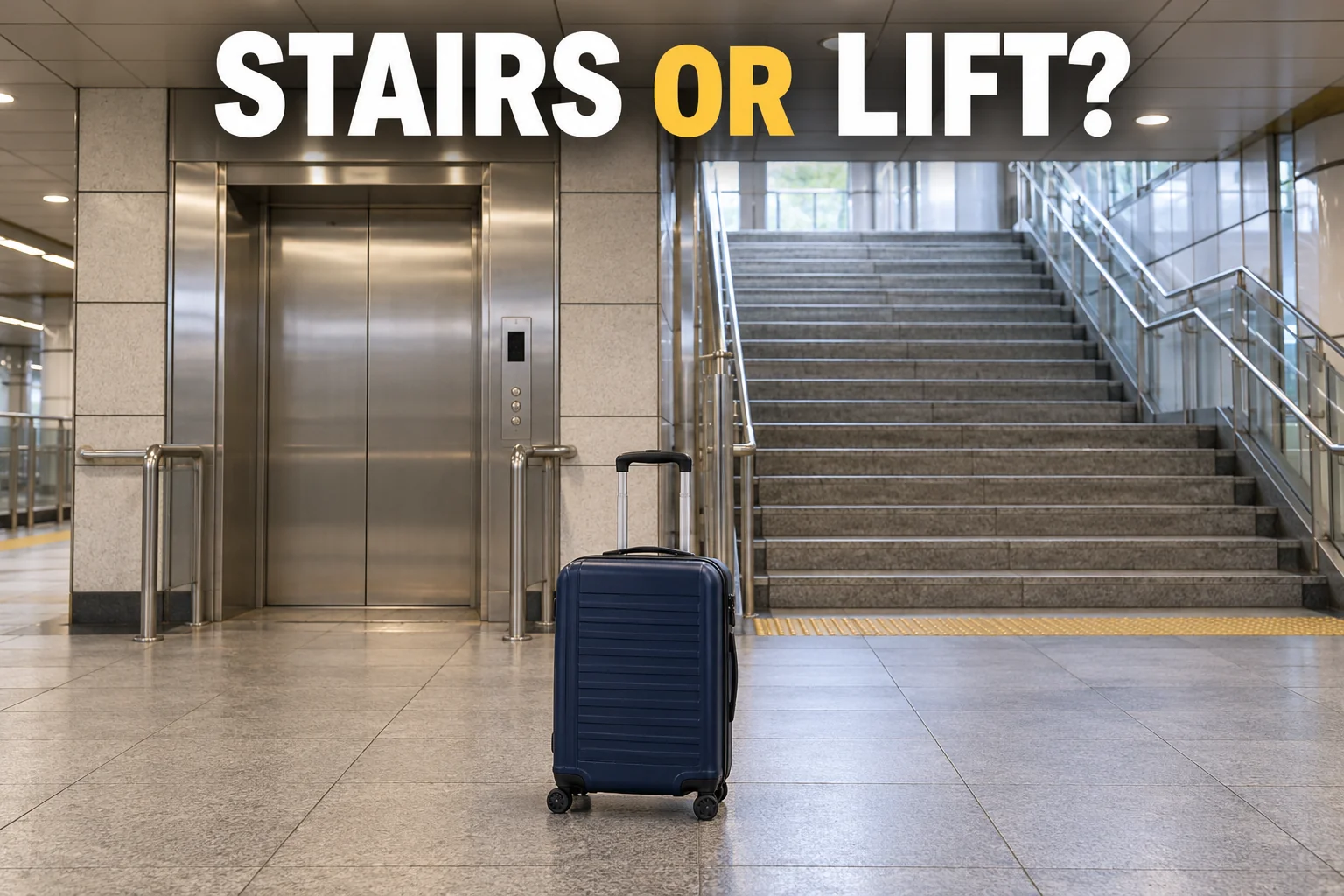
Find the elevator route before heading for your hotel’s nearest numbered subway exit. A station can have elevators without having one at that exit. With a suitcase, check the route from your platform to the ticket gates, then from the concourse to the street, and finally from the elevator landing to your hotel. The shortest-looking exit on a booking page may still involve stairs.
Official sources checked October 29, 2026. This is a planning guide, not an inspection of every station or a guarantee that a particular elevator is working when you arrive.
Why “the station has elevators” is not enough
In its December 29, 2025 announcement, Seoul reported completing at least one independent street-to-platform elevator route at all 338 stations in its 11-line project. That is a useful improvement, but the claim concerns a route through each station. It does not mean every numbered entrance has an elevator, every transfer is short, or every station on the wider metropolitan rail network falls within that project.
The same announcement treats long transfers as a separate problem. For a traveler, the distinction is practical: check your line, your direction and your street access, rather than treating the station name as a complete route.
Start with the operator’s accessibility information
Seoul Subway – Official on Google Play, also called Ttota Subway, is published by Seoul Metro. The operator’s Korean feature description lists mobility routes, elevator breakdown information and alternative routes when a lift is out of service. An official iPhone listing is also available; check compatibility and availability in your own store.
Use the station’s accessibility information alongside your ordinary journey planner. Look for the elevator route and current equipment status; a fastest-route result alone does not answer those questions. Save the relevant station map before traveling, then check for changed notices on the day.
Seoul’s illustrated introduction to the app shows separate platform guidance and mobility-route information. It uses the Korean labels 승강장 안내 (platform guide) and 교통약자 경로 (route for passengers with mobility needs). That walkthrough dates from July 2024, so treat the labels as translation help if you encounter them, not a promise that your current screen has an identical layout.
If you cannot establish a continuous route from the map, ask station staff before entering a stairway or leaving the paid area.
Check three connections, not one elevator icon
| Connection to verify | What to identify | What a single icon can miss |
|---|---|---|
| Train platform → concourse | Your line, travel direction and lift serving that platform | A lift elsewhere in the interchange may serve another line or level |
| Concourse → street | The street elevator and where it emerges | The closest numbered exit may use stairs |
| Street elevator → hotel entrance | The actual hotel door, road crossings and final walking route | A nearby map pin may be on the other side of a road or building |
For a transfer, insert another check between the first two rows: can you reach the next line’s correct platform by the route you have identified? Do not assume the most direct transfer signs describe the elevator route.
Seoul’s accessibility-facility tables distinguish elevators, escalators and other equipment by station and line. A facility count is useful background; it is not a live operating-status check or a turn-by-turn map.
Keep your bags with you and allow people who need the lift for mobility access to board first. If the route is unclear, stop somewhere out of the passenger flow to check it.
A hotel exit number is a starting point
Ask the hotel a more useful question than “Which exit is closest?”:
Which street-level subway elevator should I use with a suitcase, and how do I reach your entrance from there?
Send or show the station name and line you will arrive on. At a large interchange, those details change the question. Ask about the hotel entrance itself as well; a lift out of the station does not establish step-free access into the building.
Illustrative example: a hotel describes itself as a short walk from one exit, but that exit uses stairs. An elevator emerges farther along the same street. Compare the walk from that actual landing, including crossings, with your luggage and mobility needs. This is a planning example, not a claim about a particular hotel or exit.
Our Naver Map hotel-address guide explains how to confirm the Korean address and the correct building entrance.
When to reconsider a rail transfer
| Your situation | A useful next decision |
|---|---|
| A small bag, a clear elevator route and a manageable final walk | Rail may fit the journey; save the route |
| Large bags and several unfamiliar transfers | Compare a simpler rail route or an airport bus that serves the hotel area |
| A lift on your intended route is reported out of service | Check the operator’s alternative and ask staff whether it meets your needs |
| You require an uninterrupted step-free journey | Confirm the whole route with the operator and hotel, including transfers and the final entrance |
| You cannot comfortably manage the final walk | Compare a suitable taxi or transfer, including baggage capacity |
These are decision prompts, not claims that a bus or taxi is automatically accessible or cheaper. Check the vehicle, stop and boarding arrangements for your own requirements.
For an airport arrival, start with the AREX Express versus All-Stop comparison. If your hotel is in Myeongdong, the airport bus versus AREX guide helps compare the full journey. Do not choose a rail ticket solely on the advertised airport-to-station time.
Save this before you board
Write one note with arrival station + line + direction + platform lift + street elevator + hotel entrance. Add each transfer if there is one.
For help at the station, show 엘리베이터가 어디예요? — “Where is the elevator?” — with your destination. Our Korean subway and bus phrases also cover direction, transfers and asking someone to speak slowly.
The useful goal is a route you can follow with your bags all the way to the door. Finding an elevator somewhere in the station is only one part of that plan.